
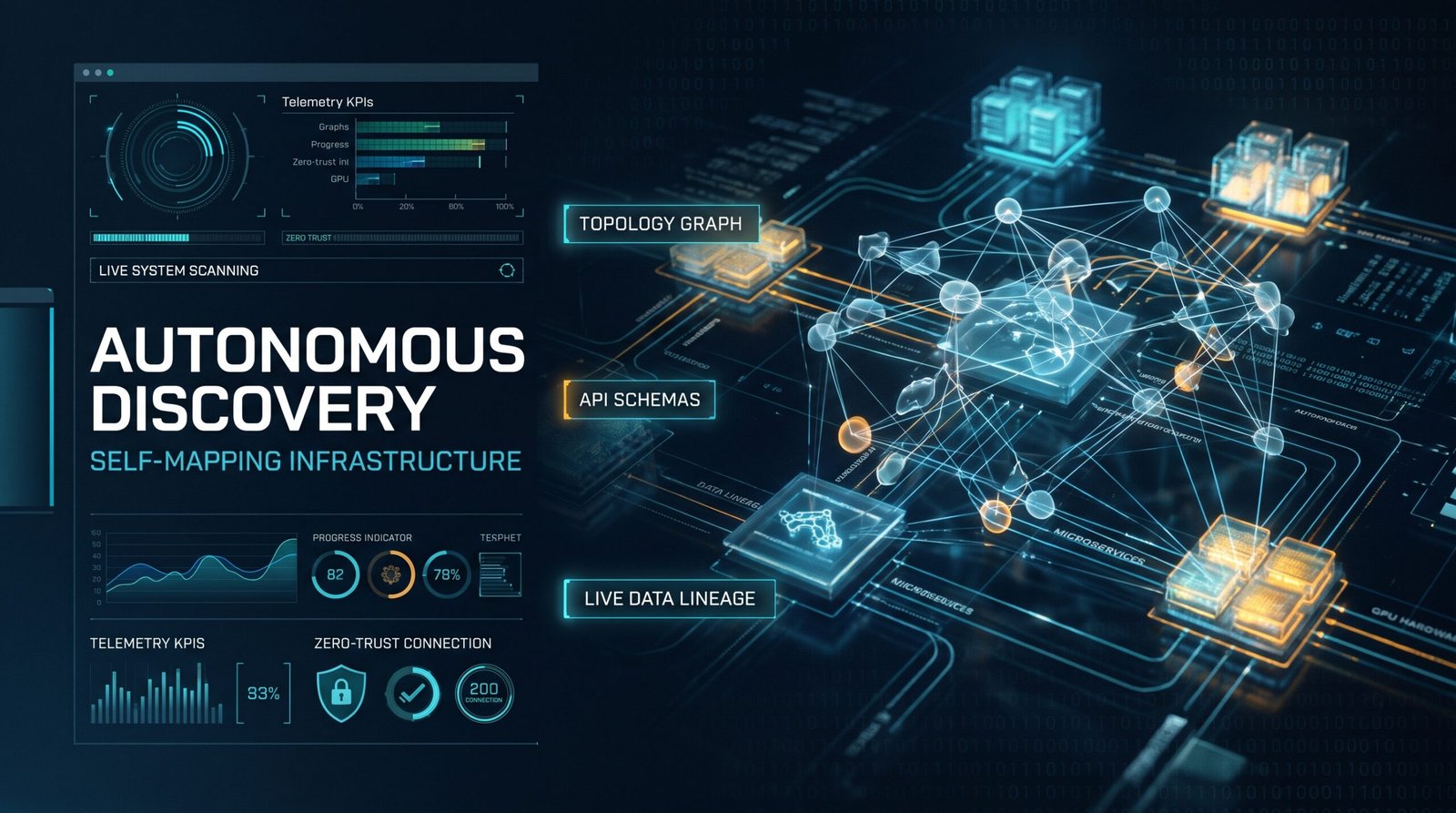
Autonomous Discovery in the Enterprise: Architecting Self-Mapping AI Infrastructure, Telemetry, and Multi-Agent Topologies
The operationalization of artificial intelligence at enterprise scale is no longer constrained by foundational model capability; it is bottlenecked by environmental blind spots. As organizations transition from isolated generative AI pilots to distributed, multi-agent production systems, static configuration management and manual dependency mapping have become catastrophic points of failure. When infrastructure state shifts every millisecond across ephemeral Kubernetes clusters, serverless inference endpoints, and federated data lakes, human-led cataloging is obsolete before the documentation is committed to version control.
Enter autonomous discovery—the foundational architectural paradigm where enterprise systems continuously, proactively, and deterministically identify, map, and index topology assets, data lineages, API schemas, and latent operational patterns without human intervention. For Directors of Engineering, Principal Enterprise Architects, and MLOps Leaders, autonomous discovery is not a vendor buzzword. It is the prerequisite control plane for high-availability AI infrastructure, automated incident response, and ruthless compute cost optimization.
This technical briefing dissects the reference architecture, discovery protocols, telemetry pipelines, and governance guardrails required to deploy autonomous discovery at scale—eliminating shadow AI, preventing cascading deployment failures, and establishing a self-aware enterprise topology.
The Death of Static CMDBs and the Mandate for Autonomous Discovery
For two decades, enterprise architecture relied on Configuration Management Databases (CMDBs), static service registries, and scheduled network sweeps to maintain an inventory of infrastructure assets. In a cloud-native, AI-driven enterprise, this model is structurally broken. Traditional discovery tools operate on polling intervals measured in hours or days. Modern MLOps pipelines and elastic inference workloads operate on lifecycles measured in seconds.
When an enterprise deploys autonomous agentic workflows or dynamic Retrieval-Augmented Generation (RAG) pipelines, the underlying topology mutates continuously. Vector database shards autoscale under query load, quantized model weights are hot-swapped across GPU node pools, and microservices spin up transient gRPC connections to external data providers. Relying on static registries in this environment introduces three critical operational vulnerabilities:
- Topological Drift and Configuration Rot: Manual YAML manifests, Terraform state files, and service catalogs diverge from runtime reality the moment an auto-scaler or spot-instance eviction triggers. Architects are left designing against a hallucinated view of their own infrastructure.
- Unmonitored Shadow AI and Rogue Endpoints: Engineering teams routinely spin up unindexed inference endpoints, local embedding servers, and third-party LLM API integrations. Without continuous autonomous discovery implementing autonomous shadow AI detection and egress quarantine, these assets bypass enterprise API gateways, creating massive data exfiltration vectors and untracked cloud spend.
- Cascading Blast Radius During Incident Response: When a latency spike or memory leak hits a downstream data pipeline, Site Reliability Engineering (SRE) teams cannot isolate the root cause if the dependency graph fails to reflect real-time runtime couplings between model routers, feature stores, and caching layers.
True autonomous discovery replaces periodic, rule-based scanning with continuous, event-driven introspection. By combining kernel-level observability, semantic schema inference, and graph-based topology reconstruction, the architecture maps itself in real time.
The Three Pillars of Enterprise Autonomous Discovery
To architect a resilient autonomous discovery engine, technical leaders must decouple the discovery domain into three distinct, yet interconnected, operational planes. Attempting to solve discovery solely at the network layer ignores the semantic realities of enterprise AI; solving it solely at the data layer leaves the underlying compute infrastructure exposed.
1. Infrastructure, Compute, and Service Topology Discovery
At the physical and virtualized substrate, autonomous discovery must maintain a live, zero-latency graph of all compute nodes, container orchestrators, service meshes, and hardware accelerators. In AI-heavy workloads, this goes far beyond tracking IP addresses and open ports. The discovery plane must interrogate the hardware and orchestration layers to extract granular operational metadata:
- Ephemeral Workload Tracking: Automatic detection of Kubernetes pods, Ray cluster workers, and serverless functions the millisecond they are scheduled, capturing their exact container image hashes, resource limits, and namespace isolation policies.
- GPU and Accelerator Telemetry Mapping: Continuous discovery of physical and partitioned GPU assets (such as NVIDIA MIG instances), mapping VRAM allocation, NVLink interconnect topologies, and thermal throttling states directly to the specific inference or training jobs consuming them.
- Service Mesh and API Dependency Reconstruction: Passive interception of east-west and north-south traffic across Envoy proxies, Istio service meshes, and enterprise API gateways to construct a live directed acyclic graph (DAG) of inter-service communication, protocol versions (HTTP/2, gRPC, WebSockets), and mutual TLS (mTLS) certificate states.
2. Autonomous Data Lineage, Dark Data, and Schema Discovery
Enterprise AI models are only as reliable as the data pipelines feeding them. Yet, up to 70% of enterprise data remains “dark”—unstructured, unindexed, and trapped in legacy object stores, transactional databases, and SaaS silos. Designing automated data lineage for RAG pipelines eliminates manual data cataloging by deploying intelligent crawler agents and stream inspectors that continuously profile the enterprise data estate:
- Semantic Schema Inference: As new parquet files, JSON streams, or Kafka topics appear in the enterprise architecture, autonomous discovery engines parse payload structures, infer data types, detect schema drift, and map relational foreign keys without requiring predefined DDL statements.
- Automated PII and Compliance Classification: Discovery workers utilize lightweight, local classification models (such as fine-tuned BERT or DeBERTa architectures) to scan discovered data streams in transit and at rest, automatically tagging Personally Identifiable Information (PII), Protected Health Information (PHI), and proprietary financial records before they can be ingested into enterprise vector databases.
- Dynamic Vector and Feature Store Indexing: In complex RAG architectures, autonomous discovery continuously monitors enterprise knowledge bases, identifying stale embeddings, orphaned vector namespaces, and unindexed document repositories, automatically triggering re-chunking and re-embedding pipelines when source-of-truth documents mutate.
3. Agentic Capability and Model Registry Discovery
As enterprises move toward multi-agent systems, static API integrations are being replaced by dynamic agent-to-agent negotiation. For an orchestrator agent to delegate a sub-task effectively, it cannot rely on hardcoded tool definitions. The architecture requires an autonomous discovery protocol for AI capabilities:
- Dynamic Tool and MCP Server Discovery: Leveraging standardized interfaces, deploying dynamic tool discovery via the Model Context Protocol (MCP) and OpenAPI 3.1 specifications allows autonomous discovery mechanisms to continuously crawl internal registries to index available tools, function signatures, input/output JSON schemas, and authentication scopes.
- Model Endpoint Profiling: Automated detection of active LLM, SLMs (Small Language Models), and custom ML endpoints across multi-cloud environments (AWS Bedrock, Azure OpenAI, self-hosted vLLM or TensorRT-LLM instances), profiling their context window limits, token throughput capacities, quantization levels, and cost-per-million-token metrics.
- Semantic Routing Table Generation: By continuously discovering the real-time latency, availability, and domain specialization of internal models and agents, the discovery plane dynamically updates semantic routers—ensuring high-complexity reasoning tasks are routed to frontier models while high-volume classification tasks are offloaded to quantized local endpoints.
Reference Architecture: Building a Self-Mapping Enterprise Control Plane
Designing an enterprise-grade autonomous discovery architecture requires zero-overhead data collection coupled with a high-throughput analytical graph backend. If your discovery agents consume 15% of cluster CPU or introduce network latency into production inference paths, the architecture has failed. Below is the battle-tested reference architecture for a four-layer autonomous discovery pipeline.
Layer 1: Zero-Instrumentation Telemetry and eBPF Collectors
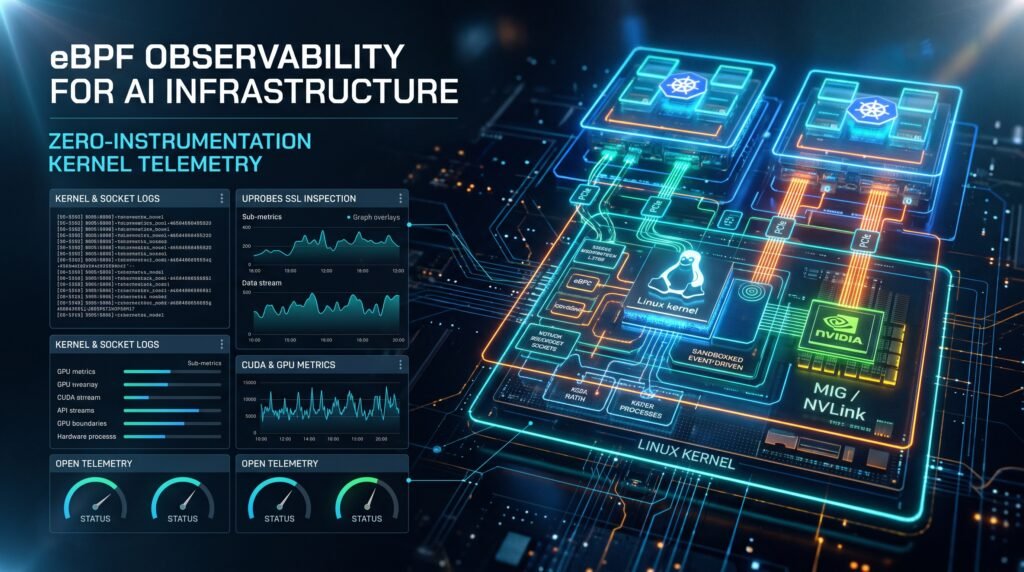
The era of injecting heavy, language-specific APM (Application Performance Monitoring) agents into every container image is over. Modern autonomous discovery relies on zero-instrumentation eBPF observability for AI infrastructure running directly inside the Linux kernel alongside OpenTelemetry (OTel) collectors. Because eBPF operates at the kernel level, it observes every socket connection, system call, file descriptor access, and process execution across the node with near-zero CPU overhead and zero modifications to application code.
- Kernel-Level Visibility: eBPF probes automatically detect when a new Python process spins up a FastAPI inference server or opens a TCP socket to an external vector database, even if the developer neglected to include OpenTelemetry SDKs in the container build.
- Cryptographic Traffic Inspection: By attaching uprobes to SSL/TLS libraries (such as OpenSSL or BoringSSL) prior to encryption, eBPF collectors can inspect unencrypted HTTP/gRPC headers and JSON payloads in memory, enabling autonomous discovery of API routes, model parameters, and token consumption rates without breaking zero-trust network encryption.
- Passive Network ARP and DNS Snooping: At the VPC and subnet layers, passive DNS inspection captures outbound queries to third-party AI providers (e.g.,
api.openai.com,api.anthropic.com), instantly flagging unauthorized shadow AI integrations across corporate networks.
Layer 2: High-Throughput Event Streaming and Normalization
Raw kernel events, cloud provider audit logs (AWS CloudTrail, GCP Audit Logs), Kubernetes API server watch streams, and database change-data-capture (CDC) logs generate petabytes of noisy telemetry. Layer 2 ingests this firehose into a distributed streaming backbone—typically Apache Kafka or Redpanda—paired with stream processing engines like Apache Flink or Vector.
- Deduplication and Windowed Aggregation: Stream processors aggregate millions of ephemeral TCP handshake events into consolidated topological edges (e.g., Service A called Service B 45,000 times over a 60-second window with a p99 latency of 42ms), reducing downstream storage and compute overhead by over 90%.
- Schema Normalization via OTel Semantic Conventions: All discovered infrastructure, data, and model entities are normalized into a unified OpenTelemetry schema, enriching raw IP addresses with Kubernetes pod labels, cloud IAM roles, cost allocation tags, and Git commit SHAs.
- Dead-Letter Isolation for Unknown Entities: When the ingestion pipeline encounters an unrecognized protocol, unindexed data store, or anomalous payload structure, it routes the metadata sample to an isolated inspection topic for deep semantic analysis rather than dropping the event.
Layer 3: The Dynamic Knowledge Graph and Vector Topology Store
Relational databases cannot efficiently query deep, multi-hop infrastructure and data lineage dependencies at runtime. Layer 3 persists the normalized discovery stream into a hybrid storage engine utilizing temporal knowledge graphs for infrastructure topology. This combines a Real-Time Property Graph Database (such as Neo4j, Memgraph, or Amazon Neptune) with a High-Performance Vector Database (such as Qdrant or Milvus).
- Temporal Graph Modeling: Every discovered asset is represented as a node (
ComputeNode,K8sPod,DataStream,ModelEndpoint,AgentTool), and every interaction is represented as a timestamped, directed edge (DEPENDS_ON,READS_FROM,ROUTES_TO,PROVISIONED_BY). Temporal indexing allows architects to query the exact state of the enterprise topology at any historical millisecond to correlate deployment changes with incident spikes. - Semantic Embedding of System Capabilities: Whenever the discovery engine identifies a new API schema, database table, or agentic tool, it generates a dense vector embedding of the asset’s structural metadata and documentation. This allows orchestrator agents and platform engineers to execute semantic natural language queries against the infrastructure itself (e.g., “Find all internal gRPC endpoints that process customer billing data and have a p95 latency under 100ms”).
- Automated TTL and Ephemeral Pruning: To prevent graph bloat from terminated containers and scaled-down worker nodes, edges and nodes maintain strict Time-To-Live (TTL) heartbeats. If an entity ceases emitting telemetry, its active status transitions to
HISTORICAL, preserving audit lineage while keeping active routing tables lean.
Layer 4: The Autonomous Action and Policy Enforcement Engine
Discovery without automated remediation is merely expensive observability. Layer 4 sits atop the dynamic knowledge graph, continuously evaluating discovered topological states against codified enterprise policies (via Open Policy Agent / Rego) and triggering closed-loop engineering workflows:
- Automated Drift Reconciliation: When the discovery graph detects a discrepancy between runtime infrastructure and the declarative GitOps state (ArgoCD or Flux), it automatically generates a pull request to codify the unmanaged resource or triggers an automated rollback to terminate the unauthorized drift.
- Dynamic Cache and Routing Optimization: By discovering repetitive semantic query patterns across distributed AI workloads, the control plane automatically provisions and warms distributed semantic caching layers (such as Redis Enterprise or custom vector caches) directly upstream of bottlenecked LLM endpoints.
- Zero-Trust Quarantine Execution: If the autonomous discovery engine identifies an unapproved container image making outbound connections to an external IP while reading from a PII-tagged database node, it immediately invokes Kubernetes NetworkPolicies or cloud security group APIs to sever the pod’s network egress and alerts SecOps.
Autonomous Discovery in Scientific and Algorithmic R&D vs. Enterprise IT
For Enterprise Architects evaluating vendor solutions and internal R&D roadmaps, it is vital to distinguish between the two dominant paradigms of autonomous discovery operating in the market today: Operational Topology Discovery (covered above) and Autonomous Hypothesis and Algorithmic Discovery.
While operational discovery maps existing digital estates, algorithmic autonomous discovery utilizes multi-agent reinforcement learning, evolutionary algorithms, and Bayesian optimization to explore massive combinatorial search spaces without human guidance. In advanced B2B environments, these two paradigms are rapidly converging:
- Automated Architecture Search and Hyperparameter Optimization: Rather than ML engineers manually tuning model architectures, quantization bit-widths, or chunking strategies for RAG pipelines, autonomous discovery frameworks systematically generate hypotheses, provision ephemeral evaluation sandboxes, run benchmark suites against production traffic shadows, and promote the optimal configuration to production.
- Autonomous Heuristic and Feature Discovery: In quantitative finance, supply chain logistics, and predictive maintenance, autonomous discovery agents continuously mine raw time-series telemetry to synthesize novel predictive features and trading heuristics, backtesting them against historical structural breaks and automatically pruning decaying signals.
- Self-Healing Chaos Engineering: Advanced SRE organizations deploy autonomous discovery agents that proactively probe the enterprise topology graph for single points of failure, formulate failure hypotheses, inject controlled fault latencies during low-traffic windows, and autonomously discover latent circuit-breaker misconfigurations before they trigger a P1 outage.
Overcoming the Engineering Bottlenecks of Autonomous Discovery
Deploying an autonomous discovery architecture across a multi-cloud, multi-tenant enterprise introduces severe engineering challenges. Technical leaders must design around four common failure modes that routinely collapse naive implementations:
1. The Telemetry Feedback Loop and “Discovery Storms”
When an aggressive discovery engine actively scans APIs, queries database metadata tables, and triggers health checks across thousands of microservices, the discovery traffic itself can induce a distributed denial-of-service (DDoS) against internal infrastructure. If an auto-scaler interprets discovery probes as legitimate production load, it will spin up new nodes—which in turn trigger more discovery scans, creating a runaway compute cost spiral.
Architectural Mitigation: Enforce strict passive-first discovery via eBPF and log stream introspection. Where active probing is unavoidable (such as schema interrogation on legacy databases), implement token-bucket rate limiting, exponential backoff, and out-of-band read-replica targeting. Ensure all discovery synthetic traffic carries cryptographic header tags that auto-scalers and billing meters explicitly ignore.
2. Context Window Saturation and Graph Explosion in Multi-Agent Systems
In dynamic agentic architectures, if an orchestrator agent uses autonomous discovery to query a registry containing 10,000 internal APIs and tools, injecting all discovered tool definitions into the LLM’s prompt context will immediately blow out token limits, spike inference latency, and degrade tool-calling accuracy due to the “lost-in-the-middle” phenomenon.
Architectural Mitigation: Implement Hierarchical Semantic Discovery. Agents should never ingest the raw topology catalog. Instead, the agent queries a lightweight discovery router using natural language intent; the router executes a hybrid vector-plus-graph traversal over the Layer 3 topology store and returns only the top k (typically 3 to 5) verified, permission-scoped tool schemas required for that specific execution step.
3. Credential Sprawl and the “God-Mode” Security Vulnerability
Traditional discovery tools require high-privilege service accounts—SSH root keys, cluster-admin Kubernetes roles, and global database read credentials—to crawl the enterprise estate. If the central discovery control plane is compromised, the attacker immediately inherits a comprehensive map of the enterprise along with the master keys to every critical asset.
Architectural Mitigation: Decouple discovery execution from centralized credential storage using a Zero-Trust Pull Architecture. Deploy lightweight, immutable discovery micro-agents inside isolated security zones (VPCs, namespaces). These local agents operate with strictly scoped, short-lived IAM roles (via SPIFFE/SPIRE workload identities), strip sensitive payload data locally, and push only sanitized structural metadata outbound to the central graph via unidirectional mTLS streams.
4. Hallucinated Lineages in LLM-Assisted Discovery
Many modern data and code discovery platforms use LLMs to infer undocumented relationships between legacy COBOL/Java monoliths, stored procedures, and downstream analytics tables. When relying purely on probabilistic LLM inference, the system will inevitably hallucinate data lineages or misclassify schema dependencies, leading to catastrophic errors during database migrations or deprecation cycles.
Architectural Mitigation: Never allow probabilistic AI models to write directly to the production topology graph as ground truth. Combine LLM semantic inference with deterministic verification (Static Application Security Testing [SAST] abstract syntax tree parsing, runtime eBPF socket confirmation, and query plan execution logs). Edges inferred purely by an LLM must be tagged with a CONFIDENCE_SCORE attribute and isolated in a candidate state until validated by deterministic runtime telemetry.
Measuring ROI: Executive KPIs for Autonomous Discovery
For VP-level and C-suite stakeholders, architectural elegance must translate directly into P&L impact and risk reduction. When presenting an autonomous discovery initiative to executive leadership or the architecture review board, anchor the business case on four quantifiable operational metrics:
- Mean Time to Innocence (MTTI) and Mean Time to Resolution (MTTR): By replacing manual war-room dependency hunting with real-time topological blast-radius queries, enterprises routinely compress MTTR during complex multi-service AI outages by 60% to 75%.
- Orphaned Compute and FinOps Reclamation: Autonomous discovery continuously identifies unattached EBS volumes, idle GPU allocations running zombie training jobs, and redundant vector index replicas. Organizations implementing continuous infrastructure discovery typically reclaim 18% to 30% of wasted cloud compute spend within the first 90 days.
- Shadow AI Eradication Velocity: Measure the time elapsed between an engineering team spinning up an unapproved LLM integration or unindexed data store and the central governance plane automatically detecting, cataloging, and applying policy guardrails to the asset—reducing exposure windows from months to sub-minute intervals.
- Engineering Onboarding and Integration Throughput: When autonomous discovery maintains self-updating OpenAPI catalogs, data lineage graphs, and MCP tool registries, principal and staff engineers eliminate the 6-to-8 hours per week previously wasted reverse-engineering undocumented internal services.
The 90-Day Architectural Implementation Blueprint
Transitioning from static configuration management to a self-mapping enterprise architecture does not require a multi-year rip-and-replace transformation. Execute the deployment in three deterministic 30-day phases:
- Days 1–30: Passive Kernel & Network Visibility (The Sensor Layer). Deploy DaemonSet eBPF collectors (such as Cilium Tetragon, Pixie, or Coroot) alongside OpenTelemetry collectors across your primary production Kubernetes clusters and AI inference node pools. Configure passive DNS and API gateway log forwarding into a centralized Kafka/Redpanda topic. Do not enforce blocking policies yet; focus exclusively on zero-overhead telemetry stability.
- Days 31–60: Graph Construction & Shadow AI Triage (The Intelligence Layer). Stand up your property graph backend and stream processors to consume the normalized OTel telemetry. Construct the live dependency DAG connecting compute nodes, microservices, data stores, and external LLM APIs. Run your first automated audit to expose orphaned GPU resources, undocumented API dependencies, and unauthorized third-party AI data egress.
- Days 61–90: Closed-Loop Automation & Agentic Indexing (The Action Layer). Integrate Open Policy Agent (OPA) with your discovery graph to automate drift alerts and security quarantines. Expose a read-only, vector-indexed view of your verified service and tool catalog via an internal MCP server or semantic routing API, empowering your internal AI agents and engineering teams to dynamically discover and consume enterprise capabilities with zero manual configuration.
The Architectural Verdict
In the next 24 months, the divide between enterprises that successfully scale autonomous AI and those that collapse under operational complexity will not be determined by which foundational model they license. It will be determined by whether their infrastructure possesses real-time situational awareness.
You cannot govern what you cannot see, you cannot optimize what you have not measured, and you cannot orchestrate autonomous agents across a blind topology. By architecting continuous autonomous discovery across your compute, data, and agentic planes today, you transform your enterprise infrastructure from a fragile collection of static configurations into a resilient, self-mapping, and self-optimizing operational fortress.


Leave a Reply