
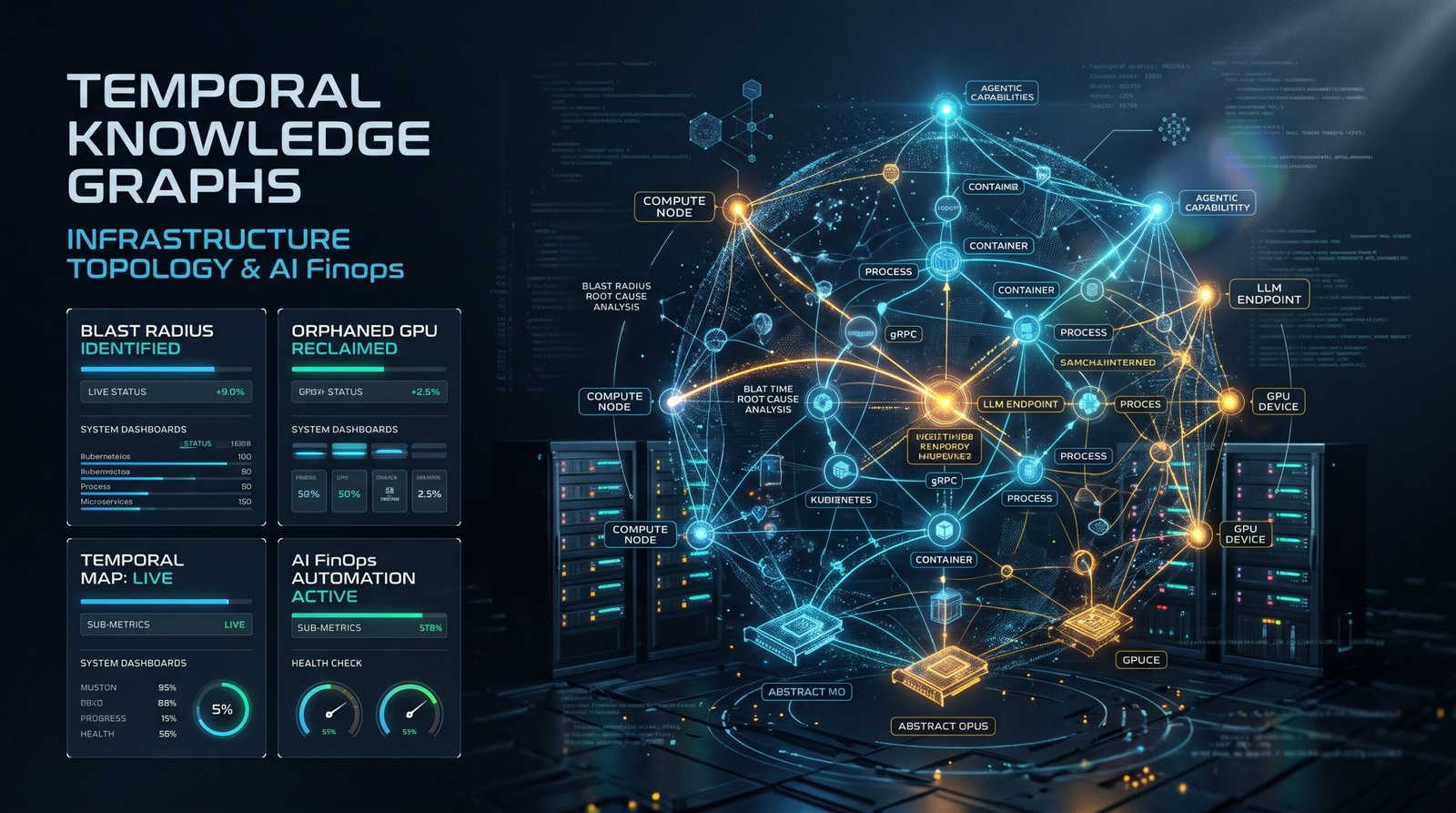
Temporal Knowledge Graphs for Infrastructure Topology: Compressing MTTR and Reclaiming Orphaned GPU Spend
The modern enterprise AI ecosystem is a chaotic, hyper-dimensional web of ephemeral dependencies. As organizations scale from monolithic machine learning pipelines to distributed, multi-agent microservice architectures, the sheer volume of transient connections—Kubernetes pods spinning up for sub-second inference, dynamic vector database shards, and federated external LLM API calls—renders traditional infrastructure monitoring fundamentally obsolete. For VP of Infrastructure and FinOps Leads, this lack of visibility carries a devastating twofold penalty: catastrophic Mean Time to Resolution (MTTR) during system outages and bleeding cloud compute budgets tied to orphaned GPU allocations.
To survive this architectural complexity, technical leaders are abandoning flat, relational asset registries in favor of a dynamic autonomous discovery reference architecture. At the core of this system sits the temporal knowledge graph. By modeling compute nodes, software services, data pipelines, and hardware accelerators as interconnected nodes with time-bound edges, platform engineers can execute sub-second blast radius queries and automate AI FinOps at scale.
This technical briefing breaks down the deployment of knowledge graph infrastructure topology. We will dissect why relational Configuration Management Databases (CMDBs) fail, outline the exact schema design for temporal property graphs combined with vector search, and demonstrate how to automate TTL (Time-To-Live) pruning to reclaim zombie GPU training allocations and compress Mean Time to Innocence (MTTI).
Why Relational CMDBs Collapse Under Multi-Hop Microservice Dependency Queries
For decades, IT organizations have relied on relational CMDBs (Configuration Management Databases) to track hardware assets, IP addresses, and software deployments. Under the hood, these systems rely on SQL databases characterized by rigid schemas and computationally expensive `JOIN` operations. While adequate for tracking static bare-metal servers or monolithic virtual machines, the relational model structurally collapses when forced to query the deep, multi-hop dependencies inherent in cloud-native AI workloads.
Consider a standard generative AI inference request: A user prompt hits an API gateway, which routes to a semantic router, which calls an embedding model, which queries a distributed vector database, which returns context to an orchestrator agent, which finally invokes a TensorRT-LLM inference pod running on a partitioned NVIDIA H100 GPU.
If the inference request times out, an SRE must map the dependency chain to isolate the bottleneck. In a relational database, finding a 5-hop dependency requires joining a massive “Assets” table against itself five consecutive times. Because relational databases use index lookups for every join step, the computational complexity scales exponentially. A 5-hop dependency query that spans 100,000 microservice endpoints can take minutes to execute—or simply crash the database due to memory exhaustion.
A temporal property graph MLOps architecture solves this via index-free adjacency. In a graph database (such as Neo4j, Memgraph, or Amazon Neptune), the relationships (edges) between entities (nodes) are stored as direct physical memory pointers. Traversing from the API gateway down to the specific physical GPU takes microseconds, regardless of the total size of the network. This architectural shift from “search and join” to “pointer traversal” is the foundational prerequisite for real-time root cause analysis.
Schema Design for Temporal Topology Graphs (Neo4j / Memgraph + Vector Hybrid)
Deploying a knowledge graph for infrastructure topology requires a meticulous schema design that captures not just the structural relationships, but the semantic meaning and temporal state of the AI ecosystem. Elite platform teams utilize a hybrid data layer: a Real-Time Property Graph to map the deterministic topology, paired with a Vector Database to enable semantic, natural language queries against the infrastructure.
Node Taxonomy and Metagraph Definition
The metagraph must capture the full stack, from the physical silicon up to the logical agent capability. Standard node labels include:
- Compute & Hardware Nodes:
CloudRegion,KubernetesNode,GPU_Device,MIG_Slice. These nodes store attributes such as architecture type, VRAM capacity, and provider costs. - Workload Nodes:
Deployment,Pod,Container,Process(captured via eBPF). - Network & Routing Nodes:
Service,Endpoint,Ingress,LoadBalancer. - AI & Data Nodes:
ModelEndpoint,VectorIndex,DataPipeline,AgentTool.
Temporal Edge Strategies
The power of the graph lies in its edges. Unlike a static map, an infrastructure graph must represent state changes over time. Every edge (e.g., DEPENDS_ON, CALLS, ALLOCATES) is injected with timestamp metadata (first_seen, last_seen). By implementing a temporal model, SREs can execute “time-travel” queries to reconstruct the exact topology of the cluster as it existed during a 2:00 AM outage, even if the offending Kubernetes pods have long since been terminated and garbage-collected.
The Graph-Vector Hybrid Injection
To empower orchestrator agents and platform developers, the structured graph data is continuously embedded into a vector space. When a new internal API (mapped as an AgentTool node) is discovered, its OpenAPI schema is passed through a lightweight embedding model (like `text-embedding-3-small`). The resulting dense vector is stored directly as an array property on the graph node, or synced to a sidecar vector database. This allows engineers to query the graph using semantic intent: “Show me the blast radius of all high-throughput text summarization models running in the EU-West region.”
Automated TTL Pruning and Identifying Zombie GPU Training Allocations
The most immediate and quantifiable ROI of deploying a knowledge graph infrastructure topology is the eradication of cloud waste. In AI environments, compute resources—specifically NVIDIA GPUs and specialized AI accelerators—are astronomically expensive. Unfortunately, MLOps workflows are notoriously leaky.
A data scientist might provision a 4-node A100 cluster for a PyTorch fine-tuning job on a Friday. The script crashes silently over the weekend due to a CUDA out-of-memory error. Because the pod didn’t exit cleanly, the Kubernetes scheduler never reclaims the resources. The cloud provider continues to bill $130 per hour for idle silicon. This is known as a “zombie allocation.”
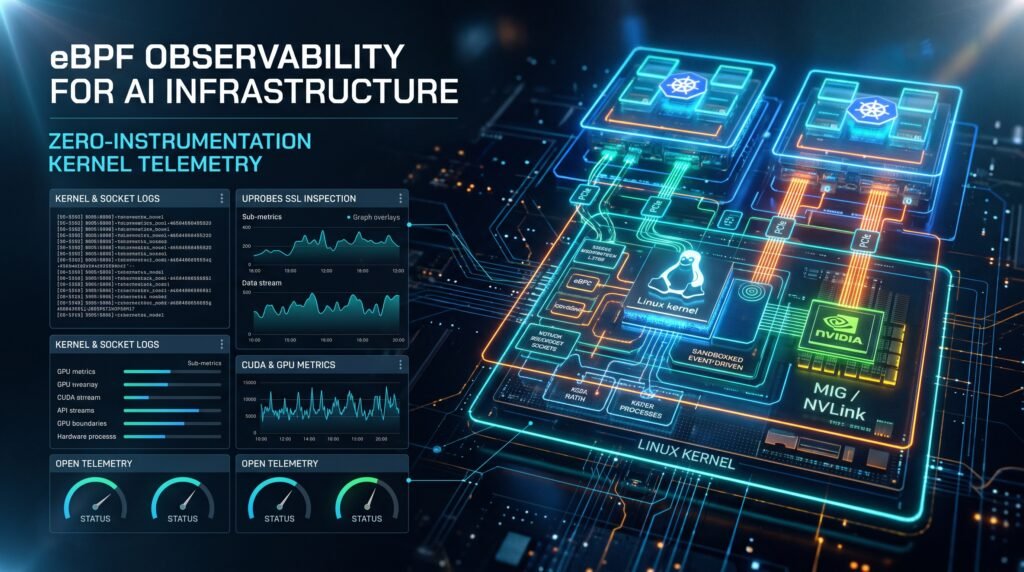
By connecting eBPF kernel telemetry and NVIDIA DCGM hardware metrics to the knowledge graph, enterprises can implement orphaned GPU reclamation and AI FinOps automation autonomously.
Implementing Automated TTL Pruning
The knowledge graph continuously ingests connection streams. When a container process allocates GPU memory, the graph creates an ALLOCATES edge between the Process node and the GPU_Device node. However, this edge is bound by a strict Time-To-Live (TTL) heartbeat.
- The Heartbeat Monitor: The graph expects a continuous stream of hardware telemetry (e.g.,
cudaLaunchKernelexecutions or non-zero Tensor Core utilization) confirming the GPU is actively processing workloads. - State Degradation: If the eBPF layer detects that the process is still holding the VRAM allocation, but the physical SM (Streaming Multiprocessor) utilization has remained at 0% for 45 minutes, the graph automatically degrades the edge state from
ACTIVEtoSTALE. - Autonomous Reclamation Playbooks: Once the graph tags a cluster of expensive nodes as zombies, it triggers an event-driven FinOps webhook. A serverless function cross-references the environment tags. If it’s a development namespace, it forcefully terminates the pod and releases the GPU back to the cluster pool. If it’s a production namespace, it pages the owning engineer with a localized graph visualization of the idle resources, demanding immediate justification.
Enterprises implementing this temporal graph automated FinOps loop routinely reclaim 15% to 30% of their total AI compute spend within the first operating quarter, simply by algorithmically pruning forgotten experiments and orphaned cache layers.
Executing Sub-Second Blast Radius Queries to Compress Mean Time to Innocence (MTTI)
When a tier-one generative AI application fails in production, the war room descends into chaos. The frontend team blames the backend service; the backend service blames the vector database; the database team blames the underlying storage layer. In a highly decoupled architecture, everyone’s individual dashboard looks green while the overall system is critically degraded. This frantic finger-pointing phase is the costliest segment of an outage.
A temporal property graph drastically compresses Mean Time to Innocence (MTTI) and subsequently MTTR by enabling instantaneous blast radius root cause analysis.
The Upstream Blast Radius (Root Cause Isolation)
If the frontend gateway begins throwing HTTP 504 Gateway Timeouts, the SRE team executes a simple Cypher or Gremlin query against the graph:
MATCH (g:Gateway {name: 'gen-ai-ingress'})-[*1..5]->(dependency)
WHERE dependency.error_rate > 5 OR dependency.latency_p99 > 2000
RETURN path
This query traverses up to 5 hops deep across the entire infrastructure topology in milliseconds. It instantly reveals that the gateway depends on a semantic router, which depends on a specific LangChain agent, which is currently blocked because an unauthorized network policy update severed its connection to a Redis cache. The root cause is isolated without a single human having to consult outdated network diagrams.
The Downstream Blast Radius (Impact Assessment)
Conversely, when a platform engineer needs to patch a critical vulnerability in a foundational embedding model, they must know exactly who will break if the model is taken offline. A downstream query traverses the graph in reverse:
MATCH (m:ModelEndpoint {version: 'v1.4'})<-[*1..4]-(consumer)
RETURN consumer.owner_email, consumer.service_tier
The graph instantly generates a definitive list of every internal service, RAG pipeline, and autonomous agent that relies on that specific endpoint. The architect can preemptively notify the exact stakeholders and route their traffic to a fallback cluster before executing the patch.
The Architectural Verdict on Infrastructure Graphs
You cannot optimize an AI topology that you cannot map, and you cannot secure a multi-agent ecosystem using relational spreadsheets. The speed of modern enterprise infrastructure demands an observability layer that operates natively in multiple dimensions: structure, semantics, and time.
By migrating your control plane to a temporal property graph, you transcend reactive dashboarding. You arm your SREs with sub-second blast radius analysis to eliminate downtime, and you empower your FinOps teams to autonomously hunt and terminate bleeding GPU costs. The temporal knowledge graph is the indispensable central nervous system of the autonomous enterprise.

Leave a Reply