
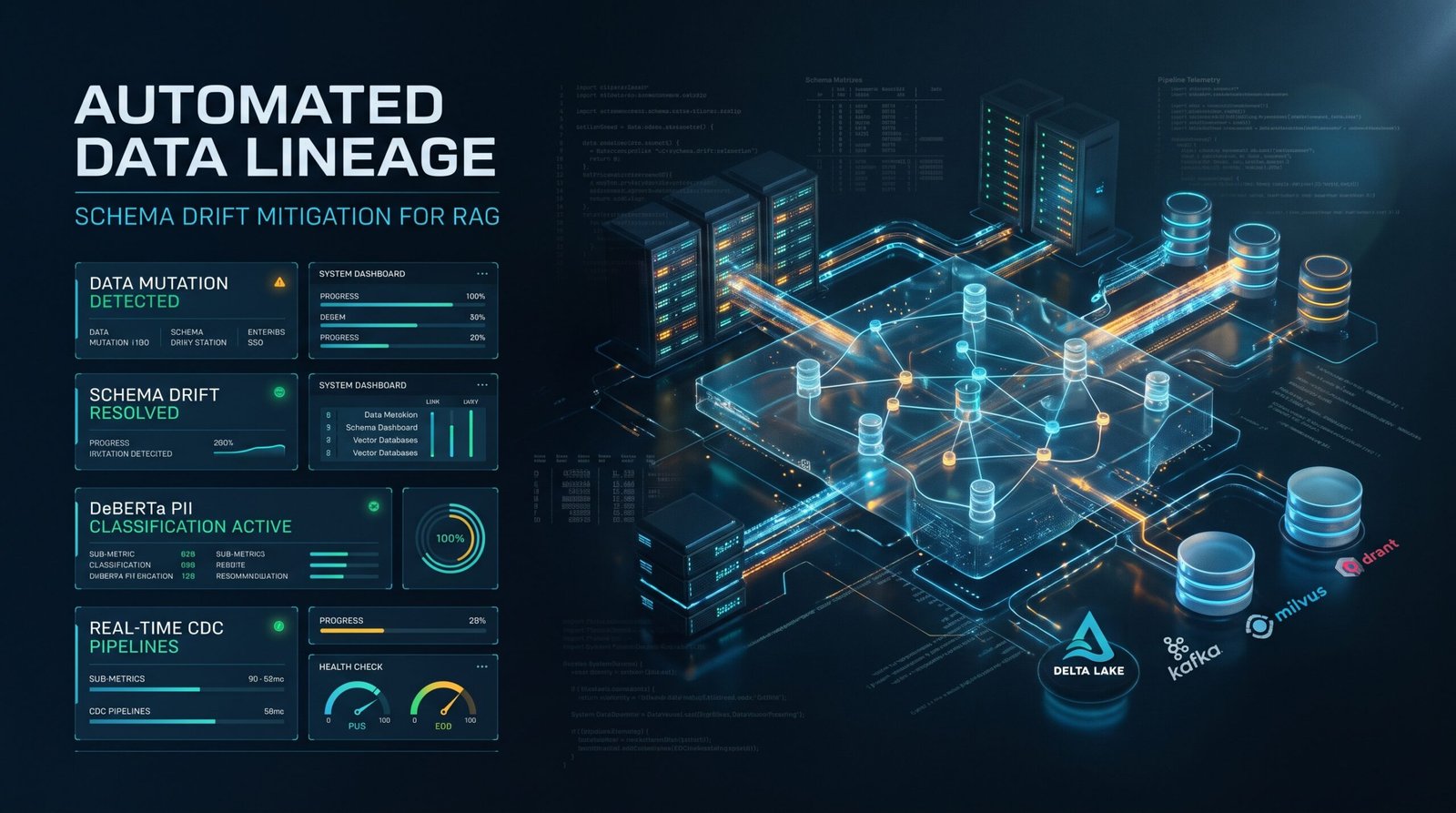
Self-Healing RAG Pipelines: Automated Data Lineage, Dark Data Indexing, and Schema Drift Mitigation
The operationalization of Retrieval-Augmented Generation (RAG) at an enterprise scale is fundamentally a data engineering challenge masquerading as an artificial intelligence initiative. Data Architects and MLOps Engineers rapidly discover that while prototyping a RAG application against a static repository of PDF documents takes hours, maintaining a production pipeline connected to hundreds of mutating transactional databases, data lakes, and SaaS APIs is an operational nightmare. When the upstream data substrate mutates, the downstream AI system does not gracefully degrade—it confidently hallucinates.
To prevent catastrophic contextual drift, the enterprise must transition from static ETL (Extract, Transform, Load) paradigms to autonomous data governance. Maintaining manual documentation of data pipelines, static schema registries, and scheduled batch embeddings is no longer viable in a high-velocity environment. The architectural mandate requires deploying automated data lineage for RAG—a self-healing data supply chain where data mutation, schema drift, and sensitive payload identification trigger deterministic, automated remediation without human intervention.
This technical briefing dissects the reference architecture for building resilient, self-healing RAG pipelines. We will explore the mechanics of vector database corruption, the deployment of local classification models for in-transit compliance, event-driven embedding updates, and the deterministic methodologies required to map complex enterprise data lineage accurately.
How Silent Schema Drift Corrupts Enterprise Vector Stores
In a traditional relational database, a schema change (such as dropping a column or modifying a data type) immediately triggers a cascading failure in downstream applications, generating a clear alert for engineering teams to investigate. In a vector database driving a RAG architecture, however, schema drift is often entirely silent. The vector store continues to accept and index multi-dimensional floats, oblivious to the fact that the underlying semantic meaning of the source data has fundamentally structurally degraded.
Consider a dynamic enterprise data lake where product inventory and technical specifications are continuously ingested from external vendor APIs into Delta Lake or Apache Hudi tables. The data engineering team dynamically updates the upstream schema to merge two technical specification columns into a single nested JSON blob. The scheduled Python chunking script, operating on the obsolete schema definition, blindly extracts the now-empty legacy columns, passes empty strings or malformed null values into the embedding model, and persists useless vectors into the vector database.
This silent corruption introduces three critical failure modes into the enterprise architecture:
- Semantic Degradation and Hallucination: When the orchestrator LLM executes a semantic search against the polluted vector space, the retrieval engine returns low-relevance or malformed chunks. Deprived of high-fidelity context, the LLM hallucinates technical specifications, leading to disastrous business outcomes if the output is surfaced to enterprise clients or automated decision engines.
- Orphaned Vectors and Vector Database Drift: Without bidirectional automated data lineage RAG pipelines, deleted source documents or purged database rows leave behind “ghost” vectors in the semantic index. The RAG system will continue to confidently cite obsolete pricing sheets, revoked compliance policies, or deleted customer records long after the source of truth has been eradicated. This condition, known as vector database drift, completely undermines the integrity of the generative application.
- Dark Data Proliferation: In large enterprises, up to 70% of generated telemetry and unstructured text remains unindexed and invisible to RAG pipelines. When new S3 buckets or Kafka topics are provisioned, they become “dark data”—rich with potential context but isolated from the semantic index. Dark data discovery requires an autonomous agentic crawler to identify newly provisioned data assets, infer their structure, and integrate them into the retrieval graph automatically.
Combating these failure modes requires semantic schema inference. Rather than hardcoding chunking logic to specific column indices, self-healing RAG pipelines utilize autonomous agents to continuously profile incoming data streams. When the schema mutates, the pipeline pauses ingestion, infers the new structural layout, dynamically rewrites the chunking mapping rules, and triggers an alert to the MLOps team for final validation—ensuring that malformed payloads never reach the embedding model.
Deploying Local DeBERTa Classifiers for In-Transit PII/PHI Discovery
A primary architectural roadblock to scaling enterprise RAG is the inherent risk of data exfiltration and compliance violations. When ingesting raw Slack archives, customer support transcripts, or unredacted Jira tickets into a centralized vector store, the pipeline inevitably sweeps up Personally Identifiable Information (PII), Protected Health Information (PHI), and proprietary financial data. If this sensitive data is embedded and indexed, any user with access to the RAG application can potentially execute a semantic query that extracts confidential salaries, social security numbers, or unannounced M&A strategies.
Legacy data loss prevention (DLP) tools rely on brittle regular expressions (Regex) that fail to capture contextual PII. For instance, a Regex can easily identify a standard social security number format, but it will fail to flag the phrase, “The patient’s diagnosis of early-onset Alzheimer’s was confirmed by Dr. Smith on Tuesday.”
To solve this, elite platform engineering teams are deploying automated PII classification pipelines utilizing Small Language Models (SLMs) acting as intelligent, in-transit sidecars. Specifically, models derived from the DeBERTa (Decoding-enhanced BERT with disentangled attention) architecture provide unparalleled accuracy in Named Entity Recognition (NER) and contextual classification while requiring a fraction of the compute resources of frontier LLMs.
The In-Transit Quarantine Architecture
Rather than sending unstructured data directly to the embedding model (e.g., OpenAI’s text-embedding-3-large), the self-healing RAG pipeline routes the parsed text chunks through a localized, air-gapped classification cluster:
- Local Execution via ONNX/TensorRT: Highly quantized DeBERTa models (often fine-tuned on specific enterprise compliance datasets) are compiled to ONNX or TensorRT formats and deployed on low-cost edge GPUs (like NVIDIA L4s) or heavily threaded CPU nodes directly alongside the data ingestion workers. Because these models execute entirely within the enterprise VPC, the raw text never traverses the public internet prior to sanitization.
- Contextual Entity Masking: When the SLM identifies sensitive context, it does not simply drop the chunk. Dropping data creates severe gaps in the semantic knowledge base. Instead, the model dynamically masks the entities (e.g., rewriting the sentence to “The patient’s diagnosis of [REDACTED_CONDITION] was confirmed by [REDACTED_PERSON] on [REDACTED_DATE].”). This preserves the syntactic structure and general semantic meaning of the document, allowing the embedding model to generate a useful, albeit sanitized, vector.
- Automated Dead-Letter Routing: If a document chunk is flagged with a high confidence score for extreme sensitivity (such as unencrypted API keys or highly classified internal project code names), the pipeline autonomously routes the payload to a dead-letter queue (DLQ) in an encrypted object store. It simultaneously writes a structural edge into the data lineage graph, notifying the SecOps team of the quarantine event and identifying the exact source system and data owner responsible for the leak.
Event-Driven Change Data Capture (CDC) for Automatic Re-Chunking and Re-Embedding
The traditional approach to synchronizing enterprise data with a vector database is the nightly batch job. Every 24 hours, a massive Apache Spark or Databricks job scans the data lake, identifies modified files via timestamp watermarks, and re-processes the embeddings. In an era of real-time autonomous agents, a 24-hour latency window is unacceptable. An autonomous enterprise requires a continuous, event-driven synchronization architecture.
To eliminate vector database drift and ensure semantic parity with the source of truth, architects must implement Change Data Capture (CDC) streaming directly from the transactional layer into the MLOps pipeline.
The Real-Time CDC Embedding Pipeline
By leveraging robust CDC frameworks like Debezium paired with a distributed event streaming platform like Apache Kafka or Redpanda, the RAG architecture becomes inherently self-updating:
- Transaction Log Interception: Debezium connectors attach directly to the Write-Ahead Logs (WAL) of enterprise databases (such as PostgreSQL, MySQL, or Oracle) or the oplog of MongoDB clusters. When an application updates a customer record or modifies a wiki article, Debezium instantly captures the row-level
UPDATE,INSERT, orDELETEevent without executing expensive polling queries against the primary database. - Stream-Processing for Dynamic Re-Chunking: The CDC event is pushed to a specific Kafka topic consumed by a stream-processing engine (e.g., Apache Flink, Faust, or Bytewax). If the event is a
DELETE, the stream processor immediately issues a gRPC call to the vector database (like Pinecone, Milvus, or Qdrant) to purge the corresponding vector ID, instantly eradicating the orphaned knowledge from the LLM’s retrieval scope. - Differential Re-Embedding: If the event is an
UPDATE, the stream processor retrieves the new text payload, executes the chunking algorithm, and passes the chunks to the embedding model. Crucially, the system computes a cryptographic hash (SHA-256) of the new chunks and compares them against a lightweight Redis cache of existing chunk hashes. Only the specific chunks that have fundamentally changed are sent to the expensive LLM embedding API, drastically reducing cloud compute costs and API rate-limit throttling. - Lineage State Persistence: Every CDC event, chunking operation, and embedding update is recorded as an immutable edge in the autonomous discovery topology graph. This guarantees that platform engineers can trace any specific vector in the database all the way back to the exact PostgreSQL WAL transaction ID that generated it.
Preventing Hallucinated Lineages: Combining AST Parsing with Runtime Telemetry
As the complexity of the enterprise data estate grows, many vendors are pitching “AI-driven” data lineage tools that use Large Language Models to read source code and guess the relationships between upstream databases, ETL scripts, and downstream analytics tables. This approach is highly dangerous. Probabilistic models are prone to hallucinating connections based on naming conventions (assuming that a table named user_data_v2 is fed by user_pipeline_v2) rather than executing rigorous structural analysis.
Enterprise data architecture cannot rely on probabilistic guesses for compliance and operational routing. Establishing a mathematically sound, deterministic map of the data supply chain requires combining static code analysis with real-time infrastructure observability.
Deterministic Lineage via Abstract Syntax Trees (AST)
The foundation of accurate data lineage is parsing the actual execution code that transforms the data. Whether the enterprise relies on dbt (data build tool), complex SQL stored procedures, or PySpark dataframes, the lineage engine must parse this logic deterministically.
- SQL and Python AST Extraction: Using specialized parsers (like SQLGlot or Python’s native
astmodule), the autonomous discovery engine deconstructs complex transformation scripts into Abstract Syntax Trees. This allows the system to programmatically map exact column-level lineages. It identifies exactly which upstream columns were concatenated, aggregated, or cast into new data types to populate the final vector store payload. - dbt Manifest Integration: For teams utilizing dbt for data transformations, the discovery engine continuously ingests the
manifest.jsonandrun_results.jsonartifacts generated during CI/CD pipeline executions. This provides a highly accurate, declarative map of the Directed Acyclic Graph (DAG) that drives the enterprise data warehouse (e.g., Snowflake or BigQuery).
Fusing Static Analysis with eBPF Runtime Telemetry
Static code analysis alone is insufficient. Code residing in a Git repository may represent the intended architecture, but it does not represent the runtime reality. An ETL job might be defined perfectly in code, but if the orchestrator (like Apache Airflow) is failing to trigger the job, or if a network firewall is blocking the connection to the source database, the data lineage is effectively broken.
To build a truly self-healing architecture, the statically parsed AST lineage is overlaid with live runtime telemetry captured via eBPF (Extended Berkeley Packet Filter) probes operating in the Linux kernel.
- Runtime Validation of Static Edges: The autonomous discovery graph expects to see an active TCP connection between the Airflow worker pod and the Snowflake endpoint, as defined by the AST analysis. If the eBPF network telemetry indicates that this connection has not occurred in the last 12 hours, the graph automatically flags the lineage edge as “Degraded,” alerting the MLOps team that the vector embeddings are becoming stale.
- Discovering Shadow Data Pipelines: Conversely, if the eBPF sensors detect a rogue Python script running on an unmanaged EC2 instance executing massive
SELECTqueries against the production Postgres database and writing to an unknown S3 bucket, the discovery engine immediately draws a new, unauthorized edge on the lineage map. This fusion of static and runtime analysis is the only reliable method for achieving absolute transparency across the data plane.
The Architectural Verdict for Data-Driven AI
The success of generative AI within the enterprise will not be dictated by the parameter count of the chosen LLM; it will be dictated by the reliability, security, and freshness of the underlying data infrastructure. When vector databases are treated as static dumping grounds, schema drift, compliance violations, and context hallucinations are inevitable mathematical certainties.
By implementing local DeBERTa classification sidecars, event-driven CDC re-chunking pipelines, and deterministic AST-based lineage graphs, enterprises can transition from fragile, reactive MLOps to a robust, self-healing architecture. This automated data capability is a foundational pillar of the comprehensive self-mapping autonomous discovery blueprint, ensuring that as your enterprise data mutates, your artificial intelligence adapts with speed, precision, and absolute compliance.

Leave a Reply