
Eradicating Shadow AI: Autonomous API Discovery and Zero-Trust Egress Quarantine
The decentralization of artificial intelligence development has introduced a severe architectural vulnerability into the modern enterprise: shadow AI. While executive boards mandate accelerated generative AI integration, engineering teams, data scientists, and individual business units bypass centralized API gateways to spin up unmonitored LLM endpoints, unauthorized third-party SaaS wrappers, and local embedding models. When developer velocity outpaces enterprise governance, thousands of uncatalogued inference keys and untracked API routes emerge across multi-cloud environments, creating massive data exfiltration vectors and unpredictable cloud spend.
Traditional perimeter defenses—such as static URL filtering, legacy web proxies, and manual security reviews—are fundamentally incapable of securing dynamic, containerized AI architectures. Securing the modern enterprise requires shifting from static policy enforcement to autonomous API discovery and real-time egress quarantine. By combining passive network inspection, service mesh telemetry, and automated policy engines, technical leaders can neutralize shadow AI without disrupting engineering velocity.
This technical briefing details the enterprise architecture required to discover, classify, and autonomously quarantine unauthorized AI endpoints across hybrid cloud substrates—establishing a zero-trust perimeter for autonomous enterprise operations.
The Anatomy of Enterprise Shadow AI: From Rogue vLLM Containers to Unmonitored SaaS Keys
Shadow AI in the enterprise rarely manifests as malicious actor intent; rather, it is driven by friction. When central IT or platform engineering teams take weeks to provision API keys or approve custom model endpoints, developers spin up their own solutions to meet product deadlines. In a cloud-native architecture, shadow AI typically emerges across three distinct attack vectors:
- Rogue Local Inference Containers: Development teams frequently spin up local instances of open-weight models (such as Llama, Mistral, or Qwen) using vLLM or Ollama inside internal Kubernetes namespaces, exposing unauthenticated gRPC or HTTP endpoints that bypass corporate API management and authentication proxies.
- Unmonitored Third-Party SaaS Integrations: Developers hardcode corporate API keys or personal subscription tokens for external LLM providers (OpenAI, Anthropic, Cohere) directly into application codebases, sending proprietary source code and customer data outside the corporate network perimeter without data-loss prevention (DLP) oversight.
- Ephemeral Serverless Functions and Scripts: Autonomous agent scripts and automated data pipelines deployed via AWS Lambda, Google Cloud Functions, or internal cron jobs communicate directly with external model endpoints, leaving no persistent footprint in static service catalogs or configuration management databases (CMDBs).
Without continuous autonomous discovery, these rogue endpoints remain invisible until a data exfiltration event or compliance audit exposes the breach. Manual code reviews and static security audits cannot scale to meet the velocity of modern software delivery cycles.
Passive DNS Snooping and East-West Envoy Mesh Interception
To eliminate shadow AI, security and platform teams must implement non-invasive, continuous network introspection. Relying on active port scanning or scheduled vulnerability sweeps creates unnecessary network noise and misses ephemeral containers that spin down before a scan completes. Modern autonomous discovery relies on passive inspection architectures operating at the network and service mesh layers.
1. VPC-Level Passive DNS and SNI Inspection
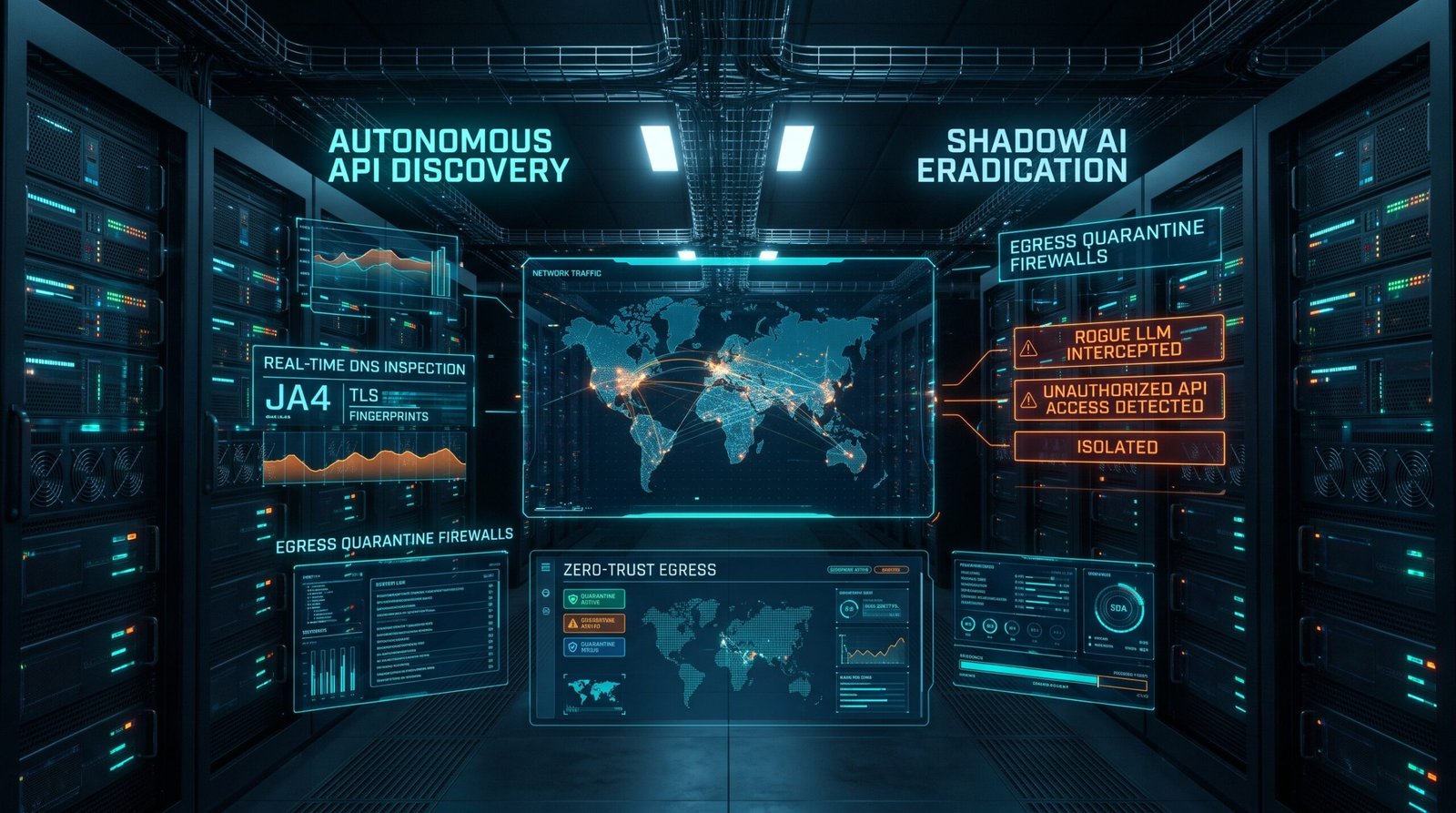
At the cloud provider and virtual private cloud (VPC) layers, autonomous discovery agents intercept outbound traffic metadata without altering application packets. By monitoring DNS query logs and inspecting the Server Name Indication (SNI) fields during TLS handshakes at corporate egress gateways, the discovery engine instantly captures every connection targeting known artificial intelligence APIs:
- Domain Signature Matching: Passive scanners cross-reference destination domains against an updating threat intelligence and vendor registry containing known AI endpoints (e.g.,
*.openai.com,*.anthropic.com,*.cohere.ai,*.groq.com), instantly flagging any pod or IP address initiating outbound traffic to unapproved providers. - TLS Fingerprinting (JA3/JA4): When encrypted traffic bypasses standard DNS resolution or utilizes hardcoded IP addresses, JA4 TLS fingerprinting analyzes the cryptographic hello packet structure to identify specific client libraries and runtime frameworks attempting to communicate with external AI inference APIs.
2. East-West Service Mesh Telemetry Interception
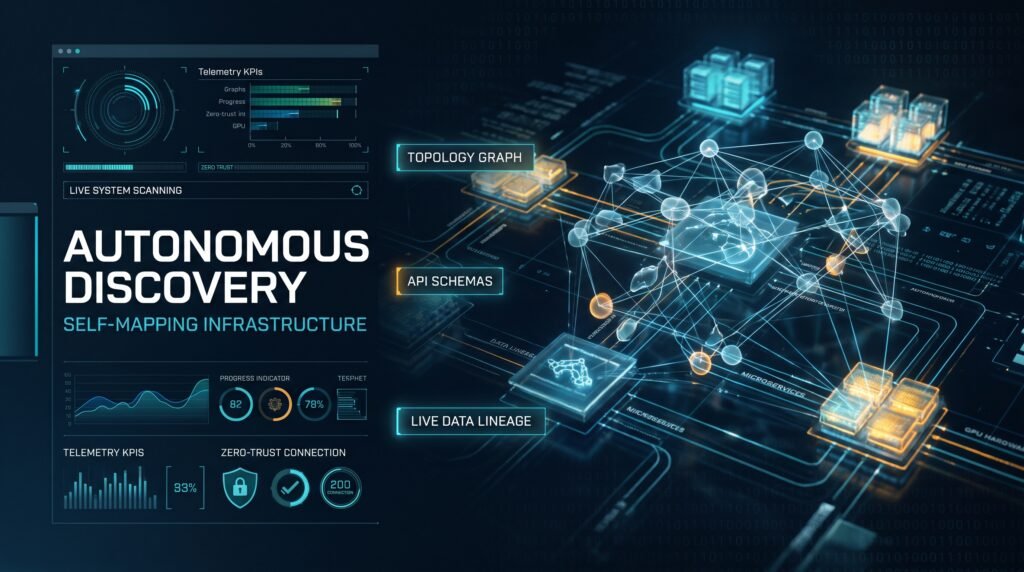
Within the Kubernetes cluster, internal east-west traffic between microservices and rogue inference containers is captured via Envoy proxies operating within an Istio or Cilium service mesh. Because every service-to-service call routes through the mesh proxy layer, the autonomous discovery control plane intercepts metadata streams to construct a live dependency map:
- Header and Payload Signature Extraction: Envoy access logs and telemetry extensions parse HTTP/2 and gRPC headers for characteristic AI payload structures (such as JSON keys containing
messages,prompt,max_tokens, ortemperature), identifying internal shadow LLM routers even when they are disguised behind generic internal DNS names. - Identity Attribution: Every discovered traffic flow is instantly correlated with its Kubernetes namespace, service account, and container image digest, ensuring platform teams know precisely which deployment team initiated the unauthorized connection.
Decoupling Discovery Credentials with Zero-Trust Pull Micro-Agents
A critical architectural pitfall in legacy vulnerability scanning and asset discovery tools is the requirement for “God-mode” credentials. Traditional security tools demand cluster-admin Kubernetes privileges, root SSH keys, and global cloud IAM permissions to crawl enterprise infrastructure. If a centralized discovery scanner is compromised, the attacker inherits master access to the entire enterprise estate.
Autonomous Enterprise architectures replace centralized credential-heavy scanning with a Zero-Trust Pull Architecture powered by lightweight micro-agents.
1. Ephemeral Workload Identity via SPIFFE/SPIRE
Discovery agents deployed across isolated VPCs and Kubernetes namespaces do not store static cloud credentials or master API keys. Instead, they authenticate using cryptographic workload identities issued by a secure SPIFFE/SPIRE (Secure Production Identity Framework for Everyone) control plane:
- Short-Lived X.509 Certificates: Micro-agents receive cryptographically signed X.509 certificates with lifetimes measured in minutes, ensuring that even if a local discovery agent container is compromised, the blast radius is strictly contained to that single isolation zone.
- Unidirectional mTLS Data Egress: Local discovery agents strip sensitive application payloads locally, retaining only normalized structural metadata (such as discovered endpoint URIs, protocol versions, and traffic frequencies) which they push outbound to the central graph via authenticated, unidirectional mutual TLS streams.
Automated OPA (Open Policy Agent) Quarantine Playbooks for Unauthorized Data Egress
Discovery without automated remediation is merely passive observation. When an autonomous discovery engine identifies a shadow AI endpoint or unauthorized data egress path, the control plane must execute immediate, deterministic policy enforcement. This is achieved by integrating the discovery topology store with Open Policy Agent (OPA) and Kubernetes NetworkPolicies.
1. Codifying Enterprise AI Governance via Rego Policies
Platform architects define enterprise AI compliance rules as code using OPA’s Rego language. When a new container endpoint or outbound connection is discovered and indexed into the temporal knowledge graph, OPA evaluates the asset against corporate governance rules:
- Approved Provider Whitelisting: Policies verify whether the destination API endpoint maps to an enterprise-approved, procurement-vetted gateway (e.g., internal enterprise Azure OpenAI or AWS Bedrock endpoints). Any connection to unvetted external providers (such as consumer-tier SaaS wrappers) triggers an immediate policy violation.
- Data Classification Guardrails: If the discovery engine detects that an internal microservice communicating with an external endpoint is simultaneously mounting a database volume tagged with PII or financial classification metadata, OPA flags a critical compliance breach.
2. Closed-Loop Automated Quarantine Execution
Upon detecting a critical policy violation, the autonomous control plane bypasses human ticketing queues to execute closed-loop remediation workflows within milliseconds:
- Kubernetes NetworkPolicy Enforcement: The automation engine immediately updates the Kubernetes cluster’s NetworkPolicies for the offending namespace, applying strict egress drop rules that sever the container’s ability to communicate with external IP addresses while preserving local debugging capabilities.
- SecOps Webhook Dispatch: A structured security incident payload is dispatched directly to the Security Operations Center (SecOps) SIEM platform, including the exact pod metadata, container image hash, destination IP, and a historical graph trace of the shadow AI activity.
Scaling Security Without Crushing Engineering Velocity
A common executive concern is that aggressive shadow AI eradication will alienate engineering teams and stall product deployment. However, automated governance paired with autonomous discovery actually accelerates velocity when implemented as a self-service guardrail rather than a bureaucratic roadblock.
By integrating discovery outputs with internal developer portals, the enterprise can automatically route developers attempting to use shadow AI toward approved, secure enterprise endpoints. For a deeper exploration of how these automated control loops integrate into the broader enterprise architecture, review our foundational hub briefing on enterprise autonomous discovery architecture.


Leave a Reply