
DreamX Breakthrough: Universal Latent Actions Drive 300x Efficiency and Zero-Shot Transfer for Autonomous Systems
Key Enterprise Leader Takeaways
- Universal Action Learning: DreamX repurposes video diffusion models to learn a universal action representation, disentangled from visual appearance and embodiment, enabling unprecedented generalization.
- Extreme Compression: Achieves a remarkable 300x compression of latent video frames (1,200 to 4 tokens), drastically reducing computational overhead for AI policy learning and deployment.
- Zero-Shot Transfer: Demonstrates state-of-the-art zero-shot action transfer across diverse embodiments (human and robot) and environments, establishing a shared action interface for any-to-any video transfer.
- Operational Efficiency: This innovation significantly lowers the computational cost of video-diffusion-based policies, directly impacting AI FinOps and compute optimization strategies.
The AI Strategic Shift
The DreamX model represents a fundamental strategic shift in how enterprises should conceptualize and deploy autonomous AI. By creating a truly universal latent action learner that disentangles actions from specific embodiments and visual noise, it unlocks unprecedented levels of transferability and efficiency for intelligent agents. This innovation promises to dramatically reduce the development cycles and operational costs associated with training and deploying AI in complex, multi-modal environments, offering a clear path to accelerated ROI in robotics, automation, and agentic systems.
Strategic Analysis
The introduction of DreamX marks a pivotal moment for enterprise AI architecture, moving beyond specialized models to a paradigm of universal action representation. The core breakthrough lies in repurposing a pretrained video diffusion model to extract compact latent actions, achieving an astonishing 300x compression of video frames (from 1,200 to just 4 tokens). This isn’t merely an incremental improvement; it’s a foundational change that addresses one of the most significant bottlenecks in autonomous systems: the inability to generalize actions across diverse physical forms and operational contexts.
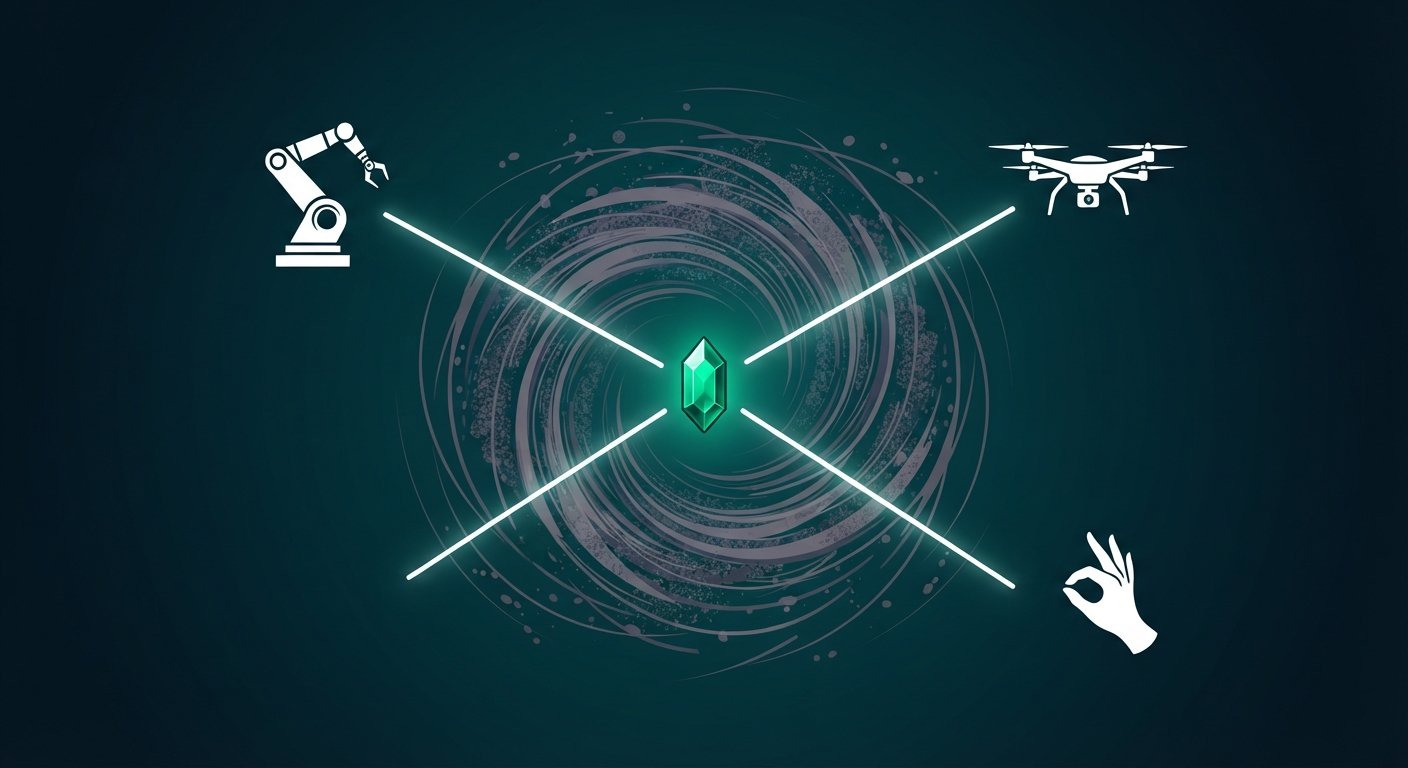
For enterprise leaders, the implications are profound. Imagine a single AI policy learned from human demonstrations that can be immediately applied to a robotic arm on a factory floor, a drone inspecting infrastructure, or even a virtual agent in a simulation, all without retraining. This “zero-shot action transfer” capability, explicitly demonstrated across human and robot embodiments and various environments, shatters previous limitations on AI deployment scalability. It means that the investment in training an action for one scenario can yield immediate dividends across an entire ecosystem of agentic AI and autonomous systems.
Furthermore, the disentanglement of action-relevant dynamics from visual appearance is a hidden advantage. It means AI systems become more robust to changes in lighting, background clutter, or even the specific model of a robot. This enhances reliability and reduces the need for extensive data augmentation or re-calibration, streamlining MLOps observability and telemetry by simplifying the underlying action space. The reduced computational cost, a direct result of the 300x compression, directly translates into significant savings in cloud compute and hardware resources, aligning perfectly with AI FinOps and compute optimization strategies. This efficiency also enables more complex policies to be learned and deployed faster, accelerating time-to-market for new autonomous capabilities. This breakthrough fundamentally redefines the competitive landscape for enterprises investing in robotics, industrial automation, and advanced AI agents, offering a pathway to truly adaptable and cost-effective intelligent operations.
The Bottom Line and ROI Potential
The DreamX model signals a new era for enterprise AI, where universal action learning drives unprecedented efficiency and adaptability. Industry leaders must recognize this as a critical inflection point for their autonomous system strategies.
Here are concrete, actionable steps:
- Evaluate Existing AI Roadmaps: Reassess current investments in robotics and autonomous agents. Prioritize R&D into integrating universal latent action learners to reduce redundant training efforts and accelerate multi-embodiment deployment.
- Optimize Compute Infrastructure: Leverage the 300x compression potential to re-evaluate cloud spending and on-premise hardware. Explore opportunities for AI FinOps and compute optimization, potentially shifting resources to more strategic AI initiatives.
- Pilot Cross-Embodiment Projects: Initiate pilot programs that explicitly test zero-shot action transfer between different robot types or between human demonstrations and robot execution within your operational environments.
- Invest in MLOps for Universal Agents: Adapt your MLOps observability stack to monitor and manage these new universal action representations, ensuring robust performance and rapid iteration across diverse deployments.
The ROI potential is substantial: enterprises can expect dramatically reduced development costs, faster deployment cycles for new autonomous capabilities, enhanced operational flexibility through adaptable agents, and significant savings in compute resources. This translates into a stronger competitive advantage, enabling rapid innovation and more resilient, intelligent operations.


Leave a Reply