Robot Autonomy Breakthrough: ThinkWorld’s Dynamics-Based Learning Eliminates Data Bottlenecks
Key Enterprise Leader Takeaways
- Data Scarcity Solved: ThinkWorld’s Chain-of-Dynamics (CoD) framework enables robots to learn complex manipulation tasks directly from unannotated human videos, bypassing the need for expensive, action-labeled robot demonstrations
- Universal Action Representation: CoD provides a common, embodiment-agnostic action representation, facilitating seamless knowledge transfer across diverse robotic platforms and accelerating deployment
- Human-to-Robot Transfer: By grounding action reasoning in world dynamics and reinforcing predictions against observed outcomes, the system achieves effective human-to-robot transfer and strong generalization to unseen tasks and environments
- Operational Agility: This paradigm shift fundamentally redefines robot training and deployment workflows, making enterprise robotics significantly more agile, scalable, and cost-effective.
The AI Strategic Shift
This development signals a profound strategic shift in enterprise robotics, moving away from costly, data-intensive, and embodiment-specific training paradigms. ThinkWorld’s ability to extract actionable intelligence from ubiquitous human video data, via its Chain-of-Dynamics representation, dramatically lowers the barrier to entry for advanced automation. For C-Suite leaders, this translates directly into accelerated robot deployment, reduced operational expenditure on training, and unprecedented agility in adapting robotic systems to new tasks and environments, fundamentally altering the ROI calculus for automation initiatives.
Strategic Analysis
The ThinkWorld framework, centered on its Chain-of-Dynamics (CoD) representation, represents a critical inflection point for enterprise AI architecture, particularly in the domain of physical robotics. Historically, the Achilles’ heel of Vision-Language-Action (VLA) models in robotics has been the prohibitive cost and scarcity of diverse, action-labeled robot demonstrations. This bottleneck has severely limited generalization capabilities and slowed the adoption of advanced robotic systems across varied operational contexts.
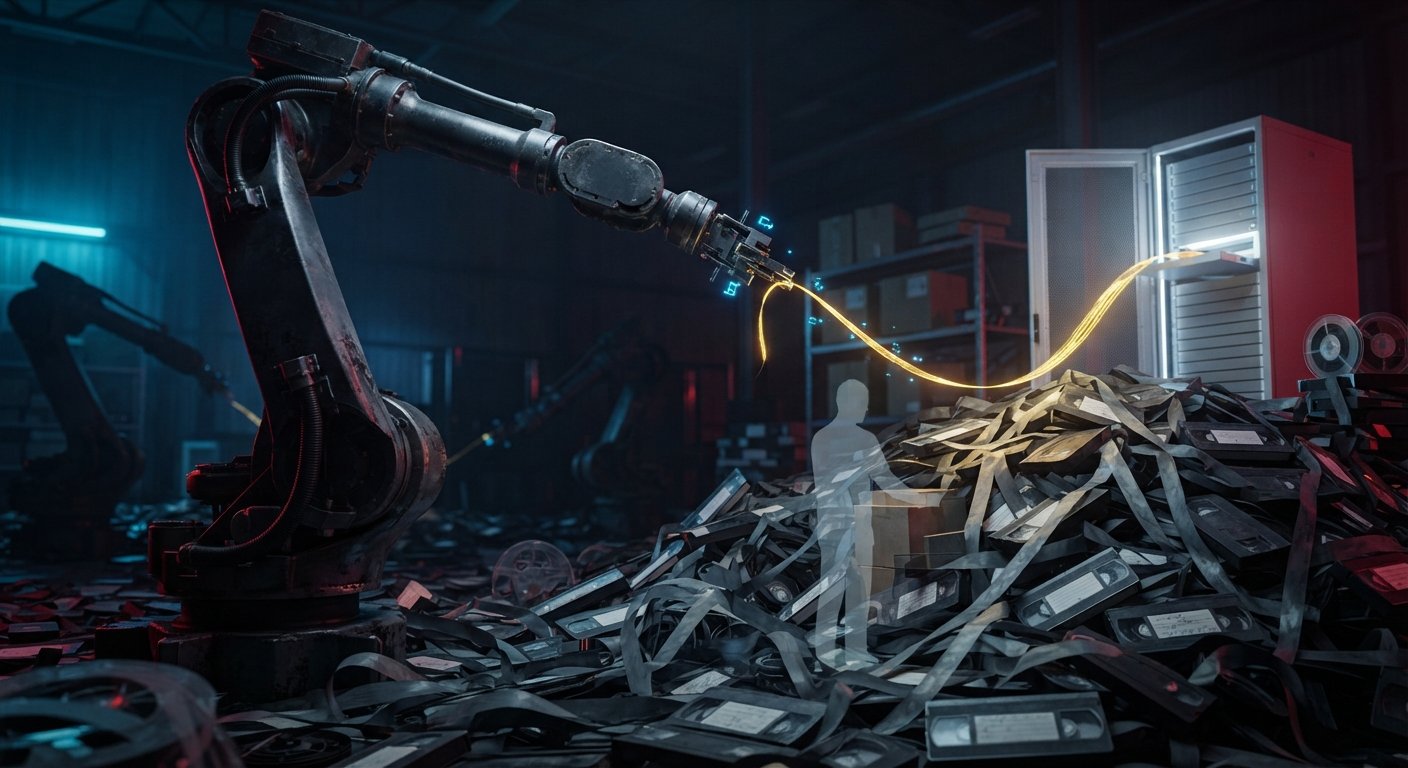
ThinkWorld directly confronts this by introducing a novel mechanism for “world imagination” and reinforcement learning. By representing actions as CoDs – sequences of discrete motion tokens that capture intermediate dynamics – the system can predict future states induced by an action. The genius lies in reinforcing those CoDs whose predictions align with observed outcomes in human videos, effectively turning vast amounts of unannotated human behavioral data into direct supervision for robot learning. This means enterprises can leverage existing video assets (e.g., surveillance footage, training videos, human operational recordings) as a rich, scalable data source, rather than investing in bespoke robot data collection.
The implications for enterprise architecture are substantial. It necessitates a shift towards data pipelines capable of processing and analyzing unstructured video data at scale, moving beyond traditional sensor data. MLOps strategies will need to incorporate dynamics prediction and reinforcement learning loops, potentially requiring more sophisticated simulation environments for “world imagination.” The hidden advantage is the creation of a truly “embodiment-agnostic” action representation. A CoD learned from a human demonstrating a task can be directly transferred to a robot, regardless of its specific kinematics or form factor, as long as it can execute the underlying dynamics. This drastically simplifies fleet management, enables rapid prototyping, and accelerates the deployment of new robotic applications across diverse hardware.
For operational scalability, this is a breakthrough. Enterprises can now envision a future where a new robotic task can be taught by simply showing a human performing it, rather than requiring complex programming or extensive robot-specific demonstrations. This dramatically reduces the time-to-value for automation projects, enhances the flexibility of robotic workforces, and provides a significant competitive advantage by enabling faster adaptation to market demands and operational changes. The risk, while low, lies in the initial integration complexity of such a sophisticated learning framework into existing enterprise IT and OT (Operational Technology) stacks, and ensuring the robustness of dynamics prediction in highly variable real-world environments. However, the potential for unlocking unprecedented levels of autonomous capability far outweighs these integration challenges.
The Bottom Line and ROI Potential
Industry leaders must recognize that ThinkWorld represents a fundamental shift in how robotic intelligence is acquired and deployed. The era of expensive, bespoke robot training data is drawing to a close, replaced by a scalable, dynamics-driven approach that leverages human experience.
Actionable Steps:
- Evaluate Existing Data Assets: Conduct an audit of your enterprise’s existing video data (e.g., operational footage, safety training videos, human workflow recordings). These unannotated assets are now potential goldmines for robot training.
- Investigate VLA Integration: Begin exploring partnerships or internal R&D initiatives focused on integrating advanced Vision-Language-Action (VLA) frameworks like ThinkWorld into your robotics strategy. Prioritize solutions that offer embodiment-agnostic learning.
- Pilot Human-to-Robot Transfer Programs: Initiate small-scale pilot projects to test the efficacy of learning complex tasks from human demonstrations on your existing robotic fleet. Focus on tasks currently requiring extensive manual programming or data collection.
- Reskill & Upskill Teams: Prepare your engineering and operations teams for a future where robot “programming” involves more observation and less explicit coding, emphasizing skills in data pipeline management for video, and understanding of dynamics-based AI.
ROI Potential: By embracing this paradigm, enterprises can expect a significant reduction (potentially 50% or more) in the cost and time associated with robot training and deployment. This translates to faster time-to-market for automated solutions, enhanced operational flexibility allowing rapid adaptation to new production demands, and a substantial increase in the ROI of robotic investments by unlocking broader application domains and reducing reliance on specialized, scarce robotics expertise.
Leave a Reply