
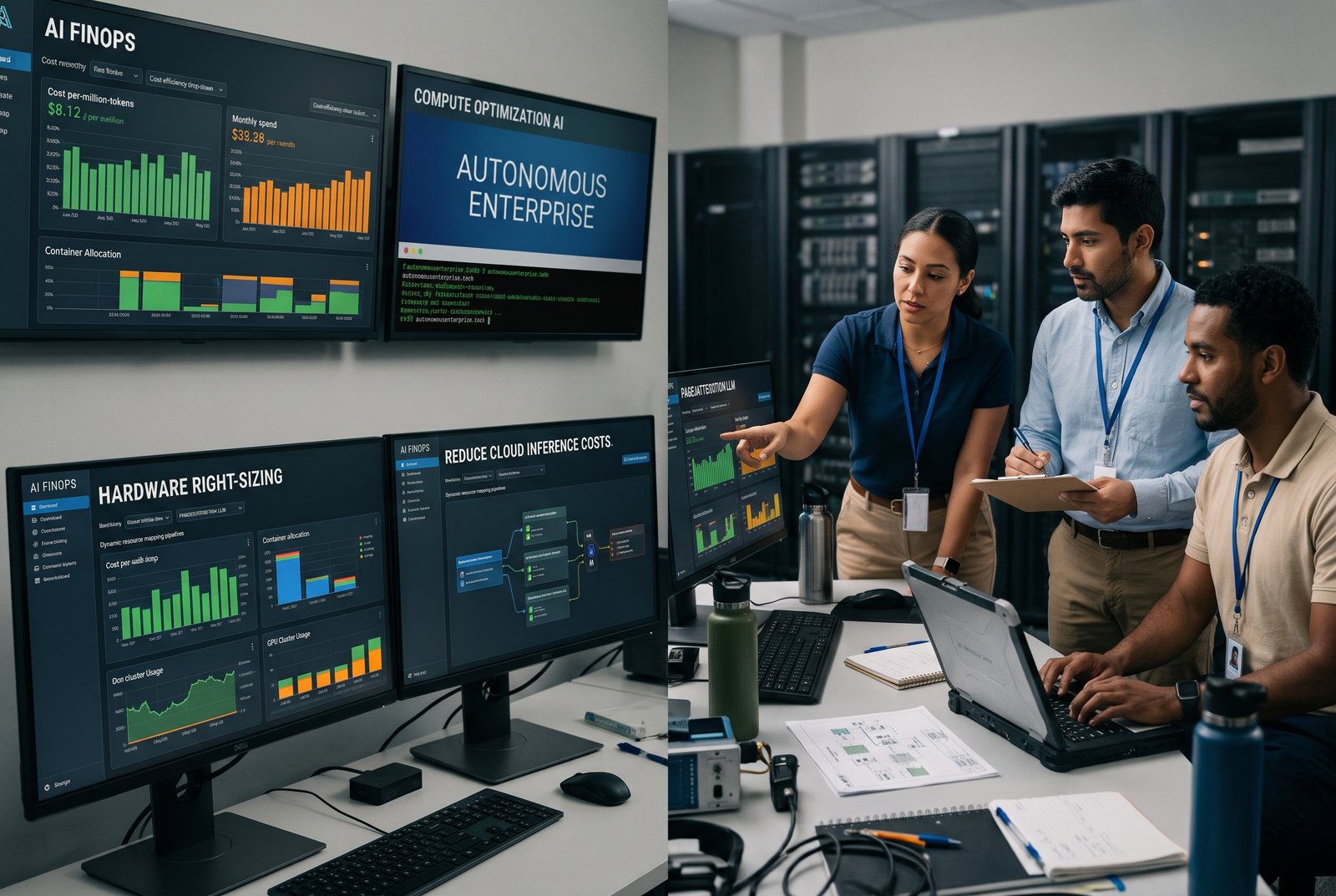
AI FinOps: Compute Optimization and Hardware Right-Sizing for Generative Workloads
The operationalization of generative artificial intelligence has introduced a stark financial reality to the modern boardroom: AI infrastructure is brutally expensive. While the initial capital expenditure (CapEx) of training a foundational model captures headlines, the true financial threat to an organization lies in the perpetual operational expenditure (OpEx) of AI inference. When deployed globally without strict architectural governance, Large Language Models (LLMs) consume cloud budgets at an unprecedented velocity. For technical leadership, optimizing these workloads is no longer just an engineering objective; it is a fiduciary responsibility.
This mandate gives rise to AI FinOps—a rigorous, cross-functional discipline that bridges the gap between machine learning engineering, cloud architecture, and financial governance. Unlike traditional IT cost-cutting, which often relies on simple rate negotiation or turning off idle servers, AI FinOps requires a deep, forensic understanding of GPU memory allocation, matrix multiplication efficiency, and advanced routing algorithms.
In this technical brief, we will dissect the methodologies required to achieve uncompromising cost and risk efficiency at enterprise scale. We will explore the mechanics of hardware right-sizing, the deployment of GPU quantization techniques, and the implementation of PagedAttention frameworks necessary to maximize inference throughput per dollar spent.
The Financial Anatomy of LLM Inference
To implement effective compute optimization AI strategies, architects must first understand why serving generative models is inherently costly. The bottleneck in modern LLM inference is rarely the raw computational speed (TFLOPS) of the GPU; rather, it is the memory bandwidth and the sheer volume of Video RAM (VRAM) required.
An inference request consists of two distinct phases:
- The Prefill Phase: The GPU processes the user’s prompt (which can be thousands of tokens in a RAG system) in parallel. This phase is compute-bound.
- The Decode Phase: The LLM generates the response one token at a time, auto-regressively. To do this, it must hold the entire context of the conversation in the GPU’s memory, known as the Key-Value (KV) cache. This phase is heavily memory-bound.
In unoptimized deployments, the KV cache grows dynamically and unpredictably for every concurrent user. Traditional serving frameworks allocate memory for the KV cache in large, contiguous blocks based on the maximum possible sequence length. If a user only generates 50 tokens, the rest of that allocated block sits empty, resulting in severe memory fragmentation. The GPU runs out of memory long before its compute cores are fully utilized, forcing the enterprise to spin up additional, highly expensive GPU nodes just to handle a moderate number of concurrent users.
Eradicating Memory Fragmentation: PagedAttention LLM
The single most impactful optimization an enterprise can make to reduce cloud inference costs is abandoning legacy inference servers in favor of modern frameworks that implement PagedAttention. Inspired by how traditional operating systems manage virtual memory, PagedAttention fundamentally rewrites how the KV cache is handled on the GPU.
Utilized by advanced serving engines like vLLM, PagedAttention breaks the KV cache down into fixed-size “pages” (e.g., blocks of 16 tokens). Instead of allocating massive, contiguous chunks of VRAM up front, the framework allocates these pages dynamically, non-contiguously, and precisely as needed during the token generation phase.
The financial implications of a PagedAttention LLM deployment are staggering:
- Near-Zero Waste: Memory fragmentation drops from upwards of 60% in traditional systems to less than 4%.
- Massive Batch Size Increases: Because memory is utilized so efficiently, the inference server can safely stack significantly more concurrent user requests (a larger batch size) onto the exact same hardware.
- Cost-Per-Token Reduction: By increasing the throughput of a single NVIDIA A100 or H100 by 2x to 4x, the cost to generate a single token plummets, dramatically improving the ROI of the AI deployment.
Model Compression: GPU Quantization and Precision Scaling
Hardware optimization is only half of the FinOps equation; the other half is optimizing the model itself. Foundational models are typically trained in 16-bit floating-point precision (FP16 or BF16). A 70-billion parameter model in FP16 requires approximately 140GB of VRAM just to load the weights into memory. This forces enterprises to deploy multi-GPU setups (like an 8x A100 node costing tens of thousands of dollars per month) simply to get the model to boot.
GPU quantization is a mathematical compression technique that reduces the precision of the model’s weights and activations without severely degrading the statistical quality of the output. By mapping FP16 values down to 8-bit integers (INT8) or even 4-bit integers (INT4), architects can drastically shrink the hardware footprint of the deployment.
Advanced quantization formats deployed in the autonomous enterprise include:
- AWQ (Activation-Aware Weight Quantization): This technique observes the activation patterns of the LLM during a brief calibration phase and protects the most “salient” (important) weights from being compressed, applying 4-bit quantization to the rest. AWQ provides near-FP16 accuracy while reducing VRAM requirements by over 60%.
- GPTQ: A widely used post-training quantization method that compresses models to 4-bit or 3-bit precision, making it possible to run massive enterprise models on cheaper, commodity hardware.
- FP8 (8-bit Floating Point): Natively supported by NVIDIA’s Hopper architecture (H100s), FP8 offers a mathematical sweet spot, halving the memory footprint while requiring virtually zero calibration or quality trade-offs.
Quantization directly enables hardware right-sizing. By quantizing a 70B model via AWQ, an enterprise can theoretically fit the entire model onto a single 80GB GPU or a pair of cheaper 40GB GPUs, slicing the cloud hosting costs by up to 75%.
Hardware Right-Sizing: Escaping the H100 Trap
The hype cycle surrounding AI has led many IT departments to assume that NVIDIA H100s are required for all workloads. This is a catastrophic FinOps failure. True hardware right-sizing involves matching the specific silicon architecture to the exact phase and requirement of the machine learning pipeline.
An optimized AI FinOps strategy categorizes hardware utilization as follows:
- Deep Inference and Training (H100 / A100): Reserved strictly for training foundational models, executing massive batch jobs, or serving unquantized 70B+ parameter models where maximum Tensor Core performance is non-negotiable.
- Lightweight Inference (L4 / T4): For quantized models (e.g., Llama-3 8B in INT4) or specialized LoRA adapters, commodity GPUs like the NVIDIA L4 provide exceptional performance at a fraction of the hourly cloud cost.
- Asynchronous AI Pipelines (Spot Instances): Not all AI workloads are user-facing. For background tasks—such as generating vector embeddings for a RAG database, summarizing overnight logs, or offline batch translation—architects must leverage cloud Spot (preemptible) instances. Because these workloads are asynchronous, if the cloud provider reclaims the spot instance, the pipeline simply pauses and resumes later, yielding up to 70% savings on compute.
- Alternative Silicon (Inferentia / TPUs): AI FinOps teams should actively benchmark workloads against non-GPU accelerators. AWS Inferentia chips or Google Cloud TPUs often provide a significantly lower cost-per-inference for specific, optimized transformer architectures.
Implementing Chargebacks and FinOps Telemetry
Architectural optimizations must be paired with financial accountability. In a multi-tenant AI environment, a centralized IT budget will quickly evaporate if business units are not held accountable for their specific AI consumption.
The API gateway must be instrumented to track token usage (both input and output) at the namespace or API-key level. By marrying the OpenTelemetry spans of an inference request with the hourly cost of the underlying Kubernetes node, the AI FinOps team can calculate a precise “Cost Per Transaction.”
This telemetry is then exported to financial dashboards, enabling the enterprise to implement strict chargeback models. If the marketing department’s new generative AI campaign consumes $50,000 in GPU compute, that cost is routed directly to their P&L. This visibility fundamentally shifts organizational behavior, encouraging developers to write more concise prompts, utilize semantic caching, and request smaller, cheaper models whenever possible.
Conclusion: The Architecture of Profitability
Deploying generative AI is an engineering feat; scaling it profitably is a FinOps mastery. Unmanaged compute overhead will suffocate innovation, forcing technical leaders to scale back initiatives just as they begin to deliver value.
By enforcing a rigorous AI FinOps culture—deploying PagedAttention frameworks to eradicate memory waste, utilizing GPU quantization to compress models, right-sizing silicon to the specific workload, and leveraging spot instances for background processing—the autonomous enterprise can break the linear relationship between AI adoption and cloud spend. Compute optimization is not merely about saving money; it is about maximizing the strategic reach and operational endurance of your artificial intelligence.



Leave a Reply