
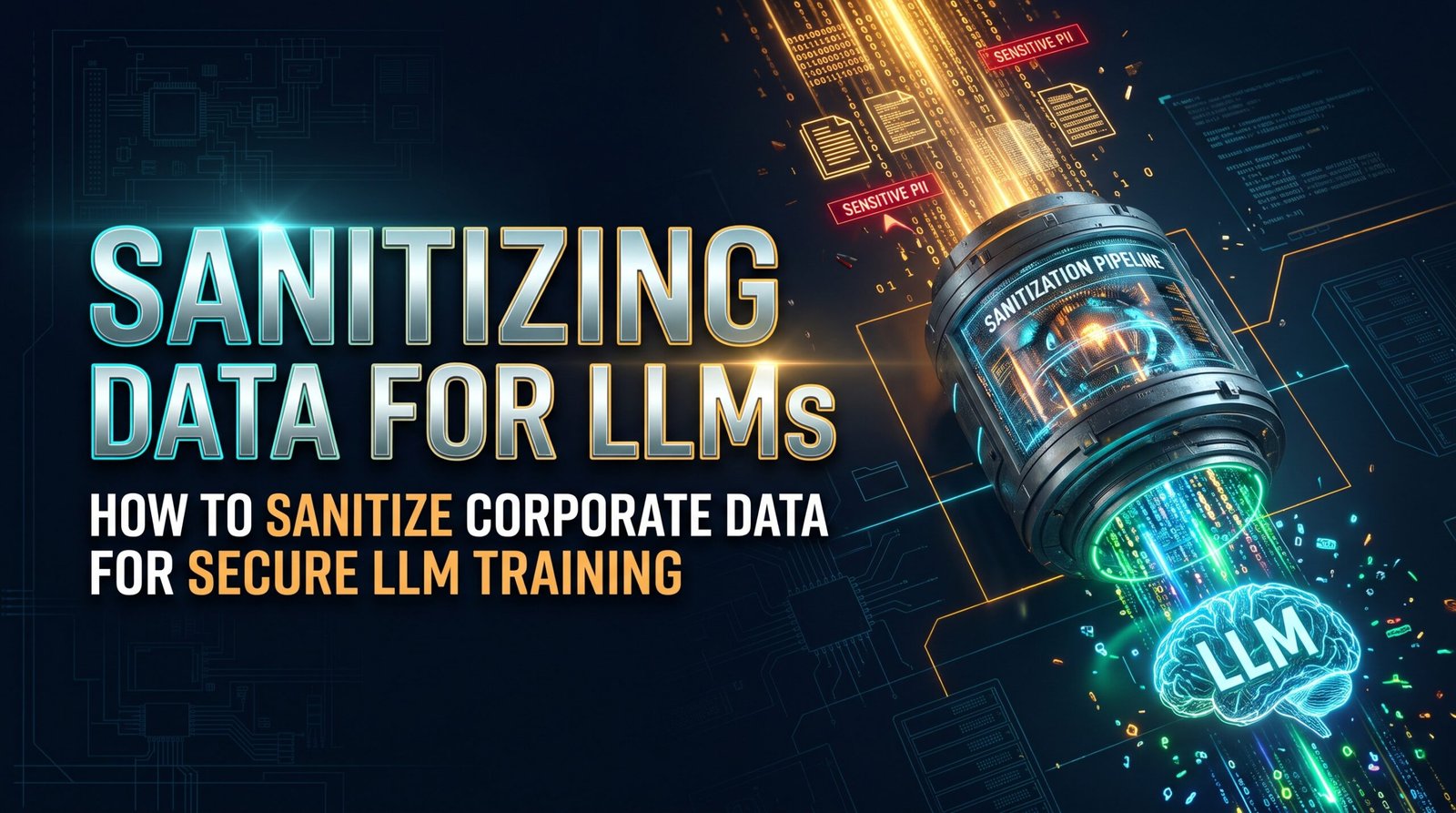
Sanitizing Data for LLMs: How to Sanitize Corporate Data for Secure LLM Training
The operationalization of artificial intelligence at an enterprise scale is no longer just a model development challenge; it is a critical architectural, engineering, and security mandate. As organizations rush to deploy Large Language Models (LLMs) to unlock internal knowledge bases, automate complex reasoning workflows, and drive autonomous decision-making, they face a severe intelligence bottleneck: the secure handling of proprietary data. Training or fine-tuning models on raw corporate data without a rigorous, infrastructure-level sanitization protocol is a catastrophic security incident waiting to happen. The inadvertent memorization and subsequent exposure of Personally Identifiable Information (PII), protected health information (PHI), financial records, or closely guarded trade secrets by an LLM can result in massive regulatory fines, loss of market capitalization, and irreparable brand damage.
Technical leaders, enterprise architects, and MLOps directors are frequently inundated with marketing hype regarding “safe AI.” However, theoretical frameworks offer zero operational value when deploying models to production. What is required is a highly robust, fault-tolerant engineering blueprint for sanitizing data for LLMs. This blueprint must focus on architectural scalability, ensuring that global caching and multi-tenancy are preserved without compromising data privacy. It must deliver operational intelligence through advanced telemetry to catch deployment failures. Finally, it must optimize cost and risk efficiency by preventing infrastructure collapse under the massive compute overhead required for enterprise-scale data processing.
This technical briefing provides a comprehensive blueprint for engineering automated, secure AI training data pipelines. We will dismantle the noise and focus exclusively on high-signal, battle-tested methodologies for data redaction, tokenization, synthetic generation, and continuous validation.
Identifying PII and Sensitive Corporate Secrets
The foundation of secure AI training data lies in the accurate, deterministic, and probabilistic identification of sensitive information across vast, unstructured data lakes. Corporate environments are notorious for data sprawl; sensitive information is rarely confined to neatly structured SQL databases. It exists in highly unstructured formats: massive text corpuses, Slack chat logs, customer support transcripts, internal wikis, Jira tickets, and legacy PDF documents. Relying on basic regular expressions (Regex) to find this data is an antiquated approach that will fail at enterprise scale.
To architect a resilient identification layer, engineering teams must deploy advanced Named Entity Recognition (NER) models and context-aware classifiers directly into the data ingestion stream. This requires a multi-layered detection strategy:
- Deterministic Pattern Matching: Utilizing optimized, highly parallelized Regex engines (such as Hyperscan) to identify standardized formats like Social Security Numbers, credit card numbers, and standardized internal employee IDs. While insufficient on its own, this provides a low-latency baseline for obvious infractions.
- Contextual Machine Learning Models: Deploying transformer-based NER models (e.g., fine-tuned RoBERTa or specialized models like Microsoft Presidio) to identify contextual PII. For example, the word “Apple” could refer to the fruit or the corporation, and a string of digits could be a routing number or a benign server metric. Context-aware models evaluate the surrounding tokens to calculate a confidence score for data classification.
- Proprietary Trade Secret Fingerprinting: Standard PII detectors will not catch internal corporate secrets, such as unreleased source code, upcoming M&A targets, or proprietary API keys. Enterprise architects must implement custom entity recognition trained on the company’s specific lexicon. This involves creating custom dictionaries and using document fingerprinting techniques to flag content that matches highly sensitive internal repositories.
- Cross-Lingual and Multi-Modal Detection: Global enterprises cannot rely on English-only detection. The identification architecture must support multi-lingual NLP processing and Optical Character Recognition (OCR) to extract and evaluate text embedded within images and scanned documents prior to vectorization.
The operational challenge here is throughput. Running heavy NLP models over petabytes of data can introduce severe latency and compute overhead. The solution requires a distributed computing framework, leveraging GPU clusters or specialized hardware accelerators within an Apache Spark or Ray ecosystem, to process data streams in parallel. This identification phase is merely the diagnostic step; it dictates the routing of data into the subsequent sanitization pipelines.
Automated Data Scrubbing Pipelines
Once sensitive data is identified, it must be neutralized before it ever reaches the embedding model or the LLM training loop. Manual data cleaning is impossible at scale. Organizations must architect automated data scrubbing pipelines that operate with high availability and strict idempotency. These pipelines must be integrated natively into the enterprise data fabric, functioning as an immutable checkpoint between raw data lakes (e.g., Amazon S3, Azure Data Lake) and the curated feature stores or vector databases used for AI training.
A mature, enterprise-grade scrubbing architecture utilizes stream-processing frameworks like Apache Kafka or Apache Flink. As data is ingested, it is published to a Kafka topic. Consumer groups, running containerized sanitization microservices, subscribe to these topics, process the payloads in real-time, and output the sanitized data to a secure destination. This decoupling ensures architectural scalability and fault tolerance.
The sanitization microservices must execute a combination of the following operational techniques:
- Redaction and Masking: The simplest approach involves replacing identified sensitive entities with generic placeholders (e.g., replacing “John Doe” with
[PERSON_1]or a specific masking character like***). While computationally inexpensive, naive masking can destroy the syntactic structure and semantic context of the text, degrading the performance of the resulting LLM. The model needs to understand the relationship between entities, even if the entities themselves are obscured. - Format-Preserving Encryption (FPE) and Tokenization: A more sophisticated approach is tokenization, where sensitive data is replaced with a non-sensitive surrogate value (a token) that preserves the length and format of the original data. This is critical when integrating AI systems with legacy databases that enforce strict schema validations. A highly secure vault must manage the token mapping, ensuring that the AI model only trains on the tokens. Implementing this requires a rigorous AI Governance framework to manage cryptographic key lifecycles, access control lists (ACLs), and audit logging for the tokenization infrastructure.
- Anonymization and K-Anonymity: For tabular data or structured metadata accompanying text, techniques like k-anonymity, l-diversity, and t-closeness must be applied to prevent re-identification attacks. This involves generalizing data attributes (e.g., replacing a specific age with an age range) so that individuals cannot be isolated within the dataset.
Crucially, the automated pipeline must generate comprehensive operational telemetry. Enterprise architects need real-time dashboards displaying the volume of data processed, the types of entities redacted, latency metrics, and error rates. If a sanitization node fails, the pipeline must automatically halt the flow of data to the training environment—a concept known as “fail-closed” architecture—to prevent unscrubbed data from leaking into the model.
Synthetic Data Generation for Safe Testing
While automated scrubbing pipelines are essential for sanitizing existing historical data, they inherently introduce a destructive element. Redaction removes signal, and aggressive masking can warp the statistical distribution of the dataset, leading to sub-optimal model convergence and degraded reasoning capabilities. To counter this, elite technical teams are increasingly relying on synthetic data generation as a primary component of their secure AI training data strategy.
Synthetic data is artificially generated information that mimics the statistical properties, schemas, and complex relationships of the original production data without containing any actual PII or sensitive corporate secrets. By training LLMs on high-fidelity synthetic datasets, organizations can bypass the privacy bottlenecks entirely while maintaining model performance.
The architecture for synthetic generation involves deploying advanced generative models—such as Generative Adversarial Networks (GANs), Variational Autoencoders (VAEs), or even specialized instructor LLMs—to learn the underlying distribution of the source data. These models then output entirely new datasets that look and behave like the real data but map to no real individuals or actual corporate events.
Operationalizing this requires a multi-stage approach:
- Seed Data Ingestion: A heavily scrubbed, highly restricted subset of production data is used as the “seed” for the generation models. This process occurs in an isolated, air-gapped environment with strict Zero Trust access controls.
- Distribution Modeling: The generation algorithms analyze the seed data to understand the correlations between variables, the linguistic patterns in text, and the frequency of edge cases.
- Synthetic Output and Scaling: The models generate massive volumes of synthetic data. Because this data is mathematically guaranteed to be free of real PII, it can be freely distributed to data science teams, moved across geographic borders without violating data sovereignty laws, and used for aggressive hyperparameter tuning and model training.
Integrating a robust synthetic generation engine into your overall Enterprise data strategy for AI adoption fundamentally shifts the risk profile of AI development. It accelerates the deployment lifecycle by removing the friction of data privacy compliance reviews for every new experiment, allowing engineering teams to iterate rapidly and securely.
Validating the Sanitization Process
An enterprise architecture is only as strong as its validation mechanisms. Assuming that a data scrubbing pipeline or a synthetic generator is functioning perfectly without continuous, empirical testing is a critical operational failure. Sanitizing data for LLMs is not a “set and forget” process; it requires rigorous, automated validation loops to ensure that no sensitive data has bypassed the filters and that the resulting models are not susceptible to data extraction attacks.
The validation architecture must be deployed at two distinct layers: pre-training (validating the data) and post-training (validating the model).
- Pre-Training Data Auditing: Before any dataset is approved for model training, it must pass through an independent, adversarial auditing pipeline. This pipeline uses entirely different NER models and detection heuristics than the primary scrubbing pipeline to scan for residual PII. Any flagged data must immediately trigger a quarantine protocol and an automated incident response ticket for engineering review. We establish acceptable threshold metrics (e.g., a 99.999% redaction confidence score) that must be met before the CI/CD pipeline allows the data to proceed to the training cluster.
- Differential Privacy Measurement: For quantitative assurance, engineering teams should implement Differential Privacy (DP) frameworks during the training process itself (e.g., DP-SGD). DP introduces calibrated cryptographic noise into the model’s gradients during backpropagation. This mathematical guarantee ensures that the presence or absence of any single data point in the training set does not significantly affect the final model, drastically reducing the risk of memorization.
- Automated Red-Teaming and Prompt Injection: Once the LLM is trained, it must be subjected to continuous, automated red-teaming before being promoted to a production environment. Security engineers must deploy suites of automated scripts that execute complex prompt injection attacks designed specifically to force the model to regurgitate sensitive data. If the model can be tricked into outputting a formatted social security number, a recognizable internal API key, or fragments of masked corporate strategy, the deployment must fail immediately.
- Continuous Telemetry and Drift Detection: In production, the nature of corporate data constantly evolves. New product names, new employee ID formats, and new types of proprietary metrics are generated daily. The sanitization pipelines must be continuously monitored for concept drift. If the NER models begin to show decreased confidence scores, or if the red-teaming suite detects emerging vulnerabilities, the system must alert the MLOps team to retrain the detection algorithms.
The operationalization of secure AI at an enterprise scale demands a total departure from bespoke, manual data handling. Technical leaders must architect pipelines that treat data privacy not as a compliance checkbox, but as a core engineering constraint. By implementing distributed identification layers, highly available streaming scrubbers, synthetic data generation, and adversarial validation frameworks, enterprises can finally unlock the intelligence of their internal data while maintaining an impenetrable security posture. The future of enterprise AI belongs to those with the most robust, secure, and automated infrastructure. This is the blueprint.


Leave a Reply