
AI Data Policy: Creating an Enterprise AI Acceptable Use Policy for Your Data
The operationalization of artificial intelligence at the enterprise scale is no longer just a model development challenge; it is a critical architectural and engineering mandate. As organizations rush to deploy large language models (LLMs), retrieval-augmented generation (RAG) systems, and AI-driven automation, a glaring vulnerability has emerged: the gap between rapid technological adoption and the lagging frameworks governing data interaction. To navigate this landscape without exposing the enterprise to catastrophic intellectual property loss, regulatory fines, or security breaches, organizations must establish a rigorous AI data policy.
Technical leaders—Directors, Enterprise Architects, and CISOs—are inundated with marketing hype and theoretical frameworks that offer zero operational value. The reality is that an effective Enterprise AI acceptable use policy is not a generic legal document; it is a technical blueprint. It defines how data flows from secure on-premises databases or private cloud environments into the latent spaces of neural networks. Without strict operational intelligence and architectural scalability applied to data governance, employees will inevitably transform proprietary code, financial forecasts, and personally identifiable information (PII) into training data for public models.
The future of enterprise AI belongs to those with the most robust infrastructure, and that infrastructure begins with strict, enforceable data rules. This comprehensive guide provides the blueprint for developing an enterprise-grade AI data policy that mitigates deployment failures, optimizes cost and risk efficiency, and enables secure innovation at scale.
Why Your Current Data Policy is Inadequate
Most enterprise data policies were designed for the era of static data storage, traditional cloud computing, and conventional endpoint security. They operate on the premise that data loss prevention (DLP) tools can simply block the transfer of files containing sensitive information. However, the advent of generative AI has fundamentally broken this paradigm. Your current data policy is inadequate because it attempts to govern highly dynamic, semantic interactions using rules built for static file transfers.
When an employee interacts with an LLM, they are not uploading a standardized document to a recognizable external server; they are engaging in conversational data extraction and semantic reconstruction. Traditional DLP solutions rely on pattern matching and file hashes, which are completely blind to a developer pasting a sophisticated architectural algorithm into a chat interface to debug it. The enterprise requires a fundamental architectural advantage, and relying on legacy policies strips you of that advantage.
Consider the following critical vulnerabilities in legacy data governance frameworks when confronted with modern AI:
- The Context Window Vulnerability: Modern LLMs feature context windows that can ingest hundreds of thousands of tokens. This means entire codebases, quarterly financial reports, or extensive customer datasets can be fed into an external model in a single prompt. Legacy policies rarely account for the sheer volume of unstructured data that can be exfiltrated through a text box.
- Training Data Contamination: Unlike traditional SaaS applications where your data remains isolated, many consumer-grade AI tools default to using user inputs to train future iterations of their models. Without an explicit AI data policy, proprietary company secrets ingested today could become part of a public model’s output tomorrow.
- Shadow AI: Just as “Shadow IT” plagued cloud adoption, “Shadow AI” is the silent killer of enterprise data security. Employees leveraging unauthorized, unvetted web interfaces for productivity gains bypass all global caching, multi-tenancy, and high-availability infrastructure controls carefully designed by enterprise architects.
- Regulatory Non-Compliance: GDPR, CCPA, and HIPAA require strict control over where data is processed and stored. Feeding customer data into a black-box AI model hosted in an unknown geographic region immediately triggers severe compliance violations.
To overcome these systemic failures, technical leaders must pivot from a perimeter-defense mindset to a data-centric AI governance posture. This transition requires a comprehensive AI Governance model that scales with your deployment ambitions while strictly filtering the vast landscape of AI infrastructure risks.
Defining Permitted AI Use Cases for Employees
A zero-tolerance ban on AI is not an operational strategy; it is a guarantee that employees will simply hide their usage, completely blinding security teams to the telemetry needed for automated incident response. The goal of an Enterprise AI acceptable use policy is to strictly define the boundaries of permitted operations, creating a secure sandbox where innovation can occur without risking infrastructure collapse.
To establish a high-signal, battle-tested intelligence framework for employee AI usage, organizations must segment their use cases based on risk, data classification, and the specific architecture of the AI tool being utilized. We recommend implementing a tiered use-case matrix:
Tier 1: Fully Approved Internal Systems (Zero Risk)
These are locally hosted open-source models (e.g., Llama 3, Mistral) deployed within the enterprise’s secure VPC, or enterprise-tier APIs (e.g., Azure OpenAI, AWS Bedrock) with legally binding zero-data-retention agreements. In this tier, employees can freely utilize the tools for:
- Code Generation and Debugging: Software engineers can input proprietary source code to identify vulnerabilities, optimize latency, and generate unit tests without the code ever leaving the enterprise perimeter.
- Financial and Strategic Analysis: Analysts can utilize RAG architectures to query sensitive internal documents, sales projections, and M&A strategies.
- Automated Incident Response: DevOps teams can feed server logs, infrastructure telemetry, and error reports into the system to diagnose high-availability infrastructure failures.
Tier 2: Conditionally Approved External Tools (Moderate Risk)
These are vetted public AI services where the enterprise has negotiated specific enterprise agreements, but the infrastructure is hosted externally. Permitted use cases here must be heavily restricted:
- Marketing and Content Creation: Generating public-facing blog posts, social media copy, and SEO meta descriptions using non-sensitive, already-public company information.
- General Research: Summarizing public industry reports, understanding broad market trends, or translating non-confidential communications.
- Administrative Efficiency: Drafting standard emails or organizing meeting notes, provided no client names, internal financial data, or proprietary project codenames are included.
Tier 3: Strictly Prohibited AI Use Cases (High Risk)
This tier defines the absolute boundaries that will trigger automated incident response and potential disciplinary action if crossed. Under no circumstances should employees:
- Input raw PII (Personally Identifiable Information), including customer names, addresses, or payment details into any model not explicitly certified for that specific data compliance standard.
- Upload un-sanitized, proprietary source code to public, consumer-tier generative AI interfaces.
- Use AI tools to make final, un-reviewed decisions regarding hiring, firing, or legal contract generation, which introduces massive liability and algorithmic bias risks.
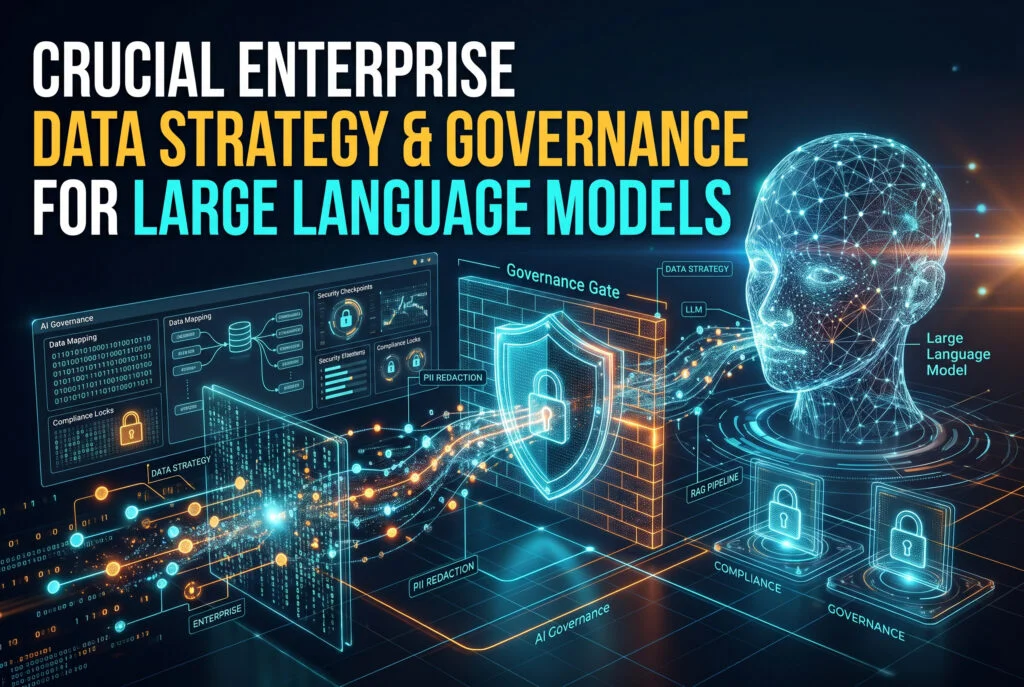
By defining these use cases with architectural precision, you provide a clear roadmap for employees. However, defining the rules is only the first step. The architecture supporting these rules must be anchored by a robust Data governance framework for LLMs to prevent unauthorized data spillage at the network edge.
Guidelines for Inputting Data into Public LLMs
Despite the push for enterprise-grade internal models, employees will inevitably interact with public LLMs. Whether it is an engineer looking for a quick syntax fix or a marketing director brainstorming campaign ideas, the Enterprise AI acceptable use policy must explicitly dictate the rules of engagement for public models. The fundamental rule of public LLMs is this: assume every keystroke is being recorded, logged, and potentially used to train the next iteration of the model.
To mitigate these risks, organizations must implement strict data sanitization and abstraction guidelines. If a development doesn’t present a clear strategic shift or measurable ROI, it isn’t worth the data exposure risk. Here are the core guidelines for interacting with public, non-enterprise AI systems:
1. Implement the Principle of Data Abstraction
Employees must be trained to abstract their queries before submitting them to a public LLM. This involves stripping out all specific context that could identify the company, the client, or the proprietary nature of the technology. For example:
- Prohibited Prompt: “Optimize this Python script for the payment gateway of Autonomous Enterprise’s new global caching feature: [insert proprietary code].”
- Permitted Prompt: “Write a Python function that optimizes a generic global caching mechanism to reduce compute overhead by 15%.”
By abstracting the request, the employee still receives the operational intelligence needed without exposing the enterprise’s architectural scalability secrets.
2. Mandatory PII and PHI Stripping
Under no circumstances can public LLMs be used to process raw customer data. If an employee needs to analyze customer feedback or format a dataset, they must utilize automated local sanitization scripts to replace names, emails, and account numbers with generic placeholders (e.g., [Customer A], [ID_001]) before the data ever touches an external API.
3. Utilizing Opt-Out Mechanisms (Where Available)
Your AI data policy must mandate that employees manually disable “chat history and training” settings on consumer-tier LLM accounts if they are using them for any work-related tasks. While this is not a substitute for an enterprise API agreement, it serves as a basic layer of defense against data harvesting by AI vendors.
4. The “Public Equivalency” Test
A simple, battle-tested heuristic for employees to follow is the Public Equivalency Test: “Would I be comfortable posting this exact prompt and its attached data on a public forum or social media platform?” If the answer is no, the data must not be entered into a public LLM. This simple triage system eliminates the noise and ensures that only low-risk, high-signal queries are processed externally.
5. Restriction on File Uploads
Modern public LLMs allow users to upload PDFs, CSVs, and Excel spreadsheets for advanced data analysis. The Enterprise AI acceptable use policy must strictly forbid the uploading of any internal company documents to public consumer interfaces. Document analysis must be routed exclusively through approved, locally hosted RAG (Retrieval-Augmented Generation) applications where data sovereignty is mathematically guaranteed.
Enforcement and Employee Training Tactics
A technical policy is only as effective as the engineering enforcement mechanisms backing it up. Relying on an employee handbook signature is a guaranteed path to failure. Directors and Enterprise Architects must implement advanced telemetry, automated incident response, and continuous training loops to ensure the AI data policy is strictly adhered to across the organization.
To enforce your AI data policy and maintain cost and risk efficiency, deploy the following technical and cultural tactics:
Technical Enforcement Mechanisms
- Deploy an AI Security Posture Management (AISPM) Tool: Integrate specialized AI security tools into your CI/CD pipelines and network edges. These tools act as “prompt firewalls,” inspecting outgoing API calls and web traffic to identify and block the transmission of proprietary code, API keys, or classified data to unauthorized AI endpoints.
- Cloud Access Security Broker (CASB) Configuration: Configure your enterprise CASB to monitor and control access to known consumer AI web applications. You can enforce granular controls, such as allowing employees to access a public LLM but technically blocking the text-input box from accepting copy-pasted blocks of text larger than 500 characters, significantly reducing the risk of bulk data exfiltration.
- Internal AI Proxies: Instead of allowing direct access to external APIs, route all enterprise AI requests through a centralized internal proxy. This allows your security team to maintain advanced telemetry on exactly who is calling which models, how many tokens are being consumed (to reduce compute overhead), and what data is being transmitted. If a prompt triggers a DLP rule, the proxy automatically halts the request and logs an automated incident response ticket.
Cultural and Training Tactics
Technical blocks will eventually be circumvented if the workforce does not understand the strategic mandate behind the policy. Training must cut through the noise and deliver high-signal value to employees.
- Scenario-Based Threat Modeling: Move away from boring compliance videos. Run tabletop exercises with your DevOps and Marketing teams showing them exactly how an attacker could use “Model Inversion” to extract the exact proprietary data they carelessly pasted into a public AI tool last week. Make the threat real and measurable.
- The “Path of Least Resistance” Provisioning: The best way to stop employees from using dangerous public AI tools is to provide them with superior, secure internal alternatives. If your internal, enterprise-secured LLM is faster, highly available, and integrated directly into their workflow (e.g., via IDE plugins or secure Slack bots), the incentive to use unauthorized “Shadow AI” drops to near zero.
- Continuous Policy Iteration: The AI landscape shifts monthly. Your Enterprise AI acceptable use policy cannot be a static document updated annually. Establish an AI Governance Committee—composed of technical leaders, legal counsel, and business unit heads—that meets quarterly to review infrastructure telemetry, assess new open-source models, and update the acceptable use tiers based on proven architectural scalability patterns.
Operationalizing AI at the enterprise scale requires a ruthless commitment to data security. By implementing a strictly filtered AI data policy, defining clear boundaries for employee interaction, establishing rigid rules for public LLMs, and backing it all up with automated technical enforcement, your organization can harness the immense power of generative AI without sacrificing its most valuable asset: its proprietary intelligence. The future belongs to those who build the blueprint today.


Leave a Reply