
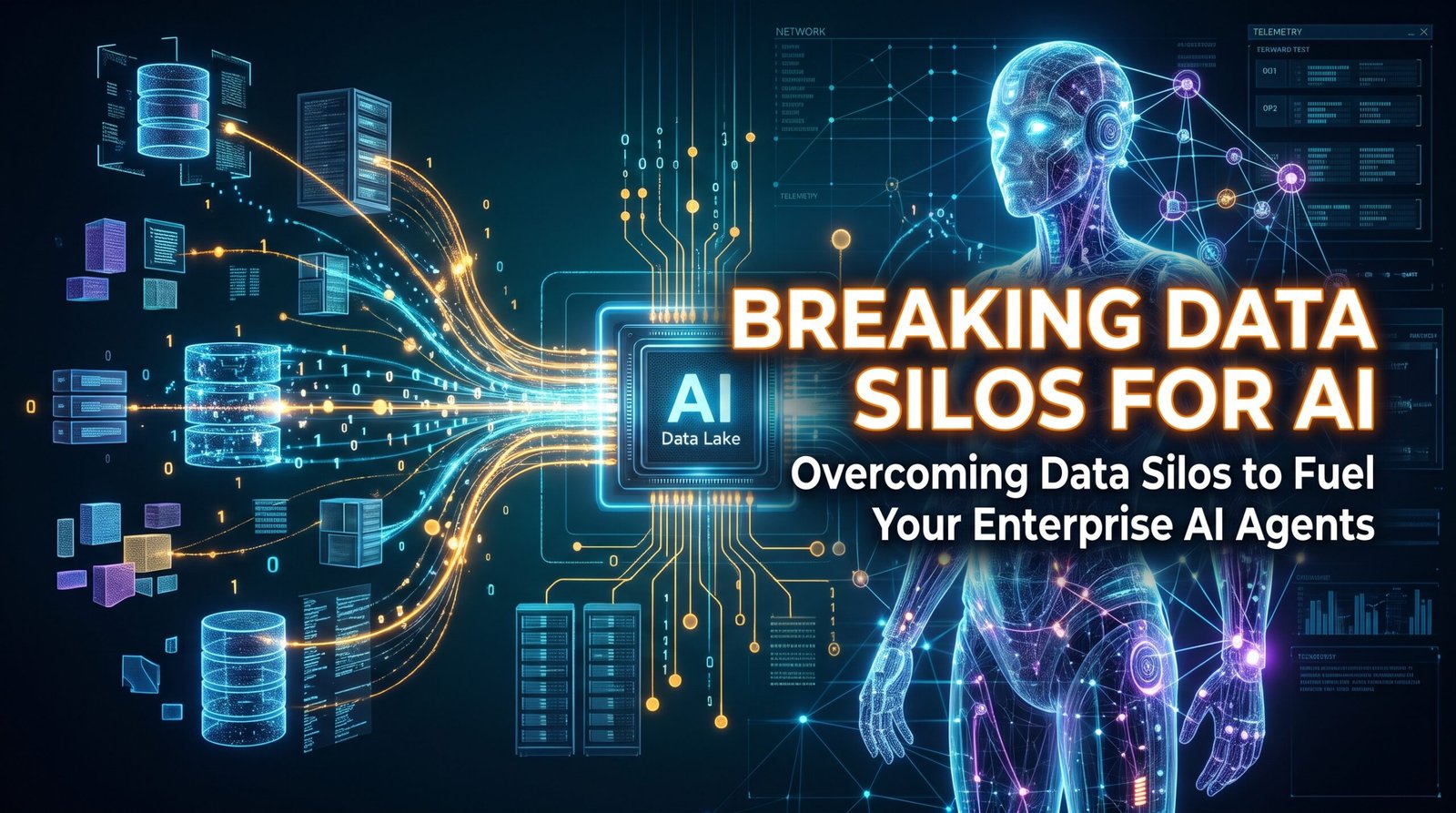
Breaking Data Silos for AI: Overcoming Data Silos to Fuel Your Enterprise AI Agents
The operationalization of AI at enterprise scale is no longer merely a model development challenge; it is fundamentally a critical architectural and engineering mandate. Today’s technical leaders are constantly inundated with marketing hype and theoretical frameworks that offer zero operational value. When it comes to deploying truly autonomous agentic systems, the reality is stark: your AI is only as intelligent, reliable, and secure as the data infrastructure supporting it. For organizations striving to build a unified data strategy, the most pressing bottleneck is not compute availability or parameter count—it is the persistent, rigid data silos that fragment institutional knowledge and blind AI agents to the broader enterprise context.
Enterprise AI agents require comprehensive, cross-departmental context to execute complex, multi-step reasoning tasks autonomously. When customer telemetry lives in one legacy on-premise relational database, financial transactions reside in a cloud data warehouse, and critical operational documentation is scattered across localized SharePoint instances, you create an environment of artificial ignorance. Overcoming these barriers requires a fundamental architectural advantage. It requires moving beyond decentralized, ad-hoc data pipelines and establishing a centralized, highly available foundation governed by strict AI Governance protocols. Without this, enterprise agents will hallucinate, stall, or confidently execute the wrong actions based on partial truths.
How Fragmented Data Breaks Agentic AI
To understand why breaking data silos for AI is an absolute necessity, we must examine the operational mechanics of agentic AI. Unlike traditional predictive models that perform single-variable analyses, modern LLM-powered agents operate by maintaining state, retrieving contextual grounding through RAG (Retrieval-Augmented Generation) pipelines, and chaining thoughts to formulate operational decisions. When an enterprise operates with fragmented data ecosystems, this deterministic reasoning process breaks down catastrophically.
Fragmented data architectures introduce severe latency and consistency issues into the inference pipeline. If an autonomous agent tasked with supply chain optimization needs to cross-reference real-time inventory levels against historical supplier performance and current market pricing, a siloed architecture forces the agent to query multiple disparate APIs with varying authentication protocols, data schemas, and latency profiles. This creates several critical failure points:
- Contextual Blind Spots: Agents forced to synthesize data from disjointed silos often miss critical metadata, leading to decisions based on incomplete context—a primary driver of enterprise AI hallucination.
- Inference Bottlenecks: Synchronous API calls to isolated, legacy databases dramatically increase time-to-first-token (TTFT) and overall inference latency, rendering real-time autonomous operations impossible.
- Security and Compliance Risks: Decentralized data access patterns make it nearly impossible to enforce Role-Based Access Control (RBAC) at the agent level, exposing the organization to significant data leakage risks.
- Operational Overhead: Engineering teams waste thousands of compute hours building brittle, point-to-point integrations rather than focusing on high-signal, battle-tested intelligence pipelines.
The solution is not to build more complex middle-tier routing logic, but to re-architect the data foundation entirely. An agent cannot act as a unified intelligence if its brain is partitioned into isolated sectors that cannot communicate efficiently.
Building a Centralized AI Data Lake
The architectural blueprint for the future of enterprise AI demands a shift away from domain-specific data warehouses toward a centralized AI-ready data lake, or lakehouse architecture. This consolidation is the bedrock of any successful Enterprise data strategy for AI adoption. A centralized data lake separates compute from storage, allowing organizations to scale their AI workloads dynamically while maintaining a single, immutable source of truth for all enterprise unstructured and structured data.
Building this infrastructure requires proven patterns for global caching, multi-tenancy, and high-availability infrastructure. The modern AI data lake must natively support massive-scale vector ingestion, transforming raw enterprise text, logs, and telemetry into dense vector embeddings that LLMs can natively comprehend. This requires a rigorous triage system at the ingestion layer, eliminating the noise and extracting only the top 1% of high-signal data. By centralizing this data into formats like Apache Parquet or Delta Lake, organizations achieve extreme cost and risk efficiency, drastically reducing the compute overhead traditionally associated with querying fragmented silos.
Furthermore, a centralized data lake enables the implementation of a robust, unified metadata layer. When AI agents search for context, they do not simply scan raw text; they rely on metadata tagging to understand data provenance, freshness, and classification. A centralized architecture allows data engineering teams to enforce enterprise-wide metadata standards, ensuring that when an agent retrieves a document, it intrinsically understands the document’s relevance, security classification, and relationship to other enterprise entities. This architectural scalability is what separates experimental AI toys from production-grade, enterprise-scale autonomous systems.
Normalizing Data Formats Across Departments
Consolidating data into a centralized infrastructure is only half the battle; if the data remains in proprietary, department-specific formats, it effectively remains siloed. Normalizing data formats across departments is a critical engineering mandate for a unified data strategy. Marketing teams might rely on JSON-based behavioral streams, finance on rigid tabular CSVs and XML, and operations on unstructured PDFs and plain text logs. Feeding this chaotic mixture directly into an enterprise agent’s context window will result in degraded model performance and exorbitant token costs.
To optimize cloud-native deployments and prevent infrastructure collapse under the weight of AI workloads, technical leaders must implement rigorous ETL (Extract, Transform, Load) and ELT pipelines designed specifically for machine intelligence. This involves:
- Standardization of Schemas: Enforcing strict data contracts between departmental data producers and the centralized AI data lake, ensuring that all incoming data adheres to a predictable, strongly-typed schema.
- Automated Unstructured Parsing: Deploying lightweight, specialized models to pre-process and normalize unstructured documents (e.g., extracting tables from PDFs, stripping HTML from emails) before they are vectorized.
- Semantic Layer Implementation: Creating a unified semantic layer that translates departmental jargon into a standardized enterprise ontology. For instance, normalizing “client_id” in sales and “cust_num” in support to a single, universally understood entity reference.
- Vectorization Pipelines: Transforming normalized data into high-dimensional vector representations stored in a highly available vector database, optimized for approximate nearest neighbor (ANN) search at millisecond latencies.
By normalizing data at the infrastructure level, organizations reduce the cognitive load on the LLM. Instead of forcing the model to act as a data parser and translator, the model can dedicate its parameter weights to its primary function: autonomous reasoning and task execution. This strategy directly mitigates deployment failures and enhances the measurable ROI potential of your AI investments.
Ensuring Real-Time Data Syncs for Agents
Agentic AI operates in the present tense. A unified data strategy that relies on batch processing and nightly data dumps is fundamentally incompatible with the demands of autonomous enterprise operations. If an agent is making decisions based on data that is 24 hours old, it is effectively operating in the past, leading to actions that are irrelevant, erroneous, or financially damaging. Overcoming data silos for AI requires the implementation of advanced streaming architectures to ensure real-time data synchronization.
To achieve this, enterprise architects must deploy event-driven data fabrics using technologies like Apache Kafka, Apache Flink, or cloud-native equivalents. These streaming platforms capture data mutations (Change Data Capture or CDC) at the source database level and propagate these changes instantly across the enterprise data ecosystem. When a customer updates their profile, a machine sensor detects a temperature anomaly, or a financial transaction is flagged for fraud, this event is published as a stream that the AI data lake and connected vector databases consume in real-time.
Ensuring real-time data syncs provides several critical advantages for agentic systems:
- Immediate Contextual Awareness: Agents are constantly grounded in the most current operational reality, drastically improving the accuracy and relevance of their outputs.
- Automated Incident Response: Real-time telemetry allows agents to detect anomalies and trigger automated remediation workflows instantly, transforming AI from a passive querying tool into a proactive operational asset.
- Continuous Embedding Updates: As new enterprise data is generated, streaming pipelines automatically re-calculate and index vector embeddings, ensuring the agent’s retrieval systems never serve stale information.
Implementing real-time synchronization requires advanced telemetry and rigorous monitoring to ensure data integrity and prevent pipeline bottlenecks. It demands a sophisticated approach to managing backpressure, ensuring idempotency, and handling schema evolution within the stream. However, the operational intelligence gained from this architecture is unparalleled.
The future of enterprise AI belongs exclusively to those with the most robust infrastructure. Breaking data silos is not a theoretical exercise; it is the foundational blueprint for achieving true architectural scalability and deploying autonomous agents that deliver uncompromising, measurable value to the enterprise. By building centralized AI data lakes, normalizing disparate data formats, and engineering real-time streaming capabilities, technical leaders can finally solve the intelligence bottleneck and unleash the full potential of their AI investments.


Leave a Reply