
Vector Databases Enterprise Explained for Enterprise Architects
The operationalization of artificial intelligence at an enterprise scale is no longer merely a model development challenge; it has rapidly evolved into a critical architectural and engineering mandate. As organizations move beyond experimental sandboxes and proofs-of-concept into production-grade Large Language Model (LLM) deployments, technical leaders are discovering a fundamental bottleneck: the database layer. Traditional relational databases and document stores were simply not designed to handle the complex, high-dimensional mathematics required for semantic search, context retrieval, and AI memory. To solve the intelligence bottleneck and achieve true architectural scalability, deploying a robust vector databases enterprise architecture is now an absolute necessity.
For Directors, Enterprise Architects, and Technical Leaders, navigating the shifting landscape of enterprise AI data storage requires cutting through the marketing noise. The future of enterprise AI belongs to organizations that treat AI infrastructure with the same rigorous engineering standards applied to global caching, multi-tenancy, and high-availability microservices. Integrating these advanced database systems into your tech stack requires a holistic approach to data lifecycle management, which is why a foundational Data Strategy is imperative before a single vector index is built.
This technical briefing provides a battle-tested blueprint for understanding, selecting, indexing, and securing vector databases in large-scale production environments. We will strictly examine the architectural scalability, operational intelligence, and cost-risk efficiency of these systems.
What is a Vector Embedding?
To architect a system that stores vector data, one must deeply understand the nature of the data itself. A vector embedding is a mathematical representation of unstructured data—such as text, images, audio, or system logs—mapped into a high-dimensional continuous space. Rather than relying on rigid keyword matching (lexical search), embeddings capture the underlying semantic meaning and context of the data. Machine learning models, such as OpenAI’s text-embedding-ada-002 or open-source alternatives like BGE-Large, analyze the input data and output an array of floating-point numbers.
In a production environment, this means a single paragraph of text might be translated into a dense vector array consisting of 768 to 1,536 dimensions. Each dimension represents a latent feature of the data learned by the neural network during its training phase. When an enterprise application needs to find related information—for instance, retrieving relevant proprietary documentation to feed into an LLM via Retrieval-Augmented Generation (RAG)—the system converts the user’s query into an embedding and calculates the geometric distance between the query vector and the stored document vectors.
The operational challenge for enterprise AI data storage lies in computing these distances at massive scale. The mathematical operations used to determine the proximity (or similarity) between vectors include:
- Cosine Similarity: Measures the cosine of the angle between two vectors. It is highly effective for text data because it focuses on the orientation (semantic direction) rather than the magnitude (length of the document).
- Euclidean Distance (L2): Measures the straight-line distance between two points in vector space. This is often preferred in computer vision and image retrieval applications where magnitude directly correlates to feature intensity.
- Dot Product: The sum of the products of the corresponding entries of the two sequences of numbers. When vectors are normalized, the dot product is mathematically equivalent to cosine similarity, but significantly faster to compute on modern CPU/GPU architectures.
Storing millions, or billions, of these high-dimensional arrays requires specialized storage engines. Relational databases using B-Tree indexing fail entirely here, as B-Trees are optimized for one-dimensional sorting. The vector database was engineered explicitly to solve this high-dimensional storage and retrieval problem, providing the operational intelligence necessary to serve semantic queries at sub-millisecond latencies.
Comparing Pinecone, Milvus, and Weaviate
When selecting a vector databases enterprise platform, architects must evaluate the infrastructure based on scalability patterns, high-availability, and deployment models. There is no one-size-fits-all solution; the choice depends on whether your organization prioritizes rapid deployment, cloud-native control, or sophisticated hybrid search capabilities. Below, we dissect the top 1% of high-signal, production-ready vector databases: Pinecone, Milvus, and Weaviate.
Pinecone: The Fully Managed, Serverless Paradigm
Pinecone is a proprietary, fully managed SaaS vector database designed for organizations that want to offload operational overhead and accelerate time-to-market. Pinecone recently transitioned to a serverless architecture, which separates compute and storage—a fundamental architectural advantage for handling highly variable AI workloads.
- Architectural Scalability: Pinecone Serverless utilizes blob storage (like AWS S3) for dense vector storage, pulling only necessary indexing structures into memory on demand. This virtually eliminates the need for manual sharding and replica management.
- Cost & Risk Efficiency: Because you pay strictly for the storage consumed and the operations executed, Pinecone reduces compute overhead for bursty workloads. However, the proprietary SaaS model introduces vendor lock-in and potential data egress costs, which must be modeled by enterprise architects.
- Best For: Teams requiring immediate deployment without the internal DevOps resources to manage distributed Kubernetes clusters.
Milvus: Cloud-Native Massive Scale
Milvus is an open-source vector database built explicitly for the Kubernetes ecosystem. It is the system of choice for enterprises dealing with billions of vectors that demand strict on-premises or private cloud deployment for compliance reasons.
- Architectural Scalability: Milvus features a highly decoupled, microservices-based architecture. It segregates the system into an access layer, coordinator services, worker nodes (Query, Data, and Index nodes), and standard cloud-native storage (MinIO, etcd, Pulsar). This allows architects to scale ingestion independently from query execution.
- Operational Intelligence: Managing Milvus requires deep Kubernetes expertise. You must handle your own telemetry, automated incident response, and node scaling. However, this grants unparalleled tuning over memory allocation, indexing algorithms, and hardware acceleration (GPU integration).
- Best For: Organizations with mature MLOps and Kubernetes engineering teams handling massive-scale, billion-vector datasets with strict data residency requirements.
Weaviate: Built-in Vectorization and Hybrid Search
Weaviate is an open-source, GraphQL-based vector database written in Go. Its defining architectural trait is its modular design, allowing models to be run directly within the database pipeline, and its exceptional hybrid search capabilities.
- Architectural Scalability: Weaviate excels in combining vector search with traditional keyword search (BM25). It uses a custom-built inverted index alongside its vector index, allowing for cross-filtering. If a query requires both semantic meaning (“financial risk models”) and strict metadata filtering (“created_date > 2023”), Weaviate processes this efficiently without retrieving large, unoptimized data payloads.
- Cost & Risk Efficiency: Weaviate allows for “bring your own model” (BYOM) modules, reducing API latency and network costs by embedding data at the database layer rather than requiring an external microservice hop.
- Best For: Enterprises building complex RAG applications that require highly accurate hybrid search, metadata filtering, and GraphQL integration.
Indexing Strategies for Rapid Semantic Search
A vector database is only as efficient as its index. Without indexing, querying a vector database requires calculating the distance between the query vector and every single vector in the database (a K-Nearest Neighbors, or k-NN, approach). This results in O(N) time complexity, which leads to immediate infrastructure collapse at enterprise scale. To mitigate this compute overhead, vector databases utilize Approximate Nearest Neighbor (ANN) algorithms. ANN trades a tiny fraction of accuracy (recall) for massive gains in speed and scalability. Understanding these indexing strategies is vital for optimizing enterprise AI data storage.
Hierarchical Navigable Small World (HNSW)
HNSW is currently the industry gold standard for vector indexing. It is a graph-based algorithm that constructs a multi-layered, hierarchical network of vectors. The bottom layer contains all vectors, and each subsequent higher layer contains fewer and fewer vectors, acting as “expressways” for search.
- How it works: When a search query is submitted, the algorithm enters the top layer, finding the nearest node, and then recursively drops down to the next layer, zeroing in on the target vector in O(log N) time.
- Architectural Impact: HNSW provides incredibly high recall and sub-millisecond latency. However, it is highly memory-intensive. Because the entire graph structure must reside in RAM for optimal performance, scaling HNSW across billions of high-dimensional vectors can result in massive cloud infrastructure costs.
Inverted File Index with Product Quantization (IVF-PQ)
For organizations prioritizing cost efficiency and memory optimization, IVF-PQ is the preferred architectural pattern. This index relies on clustering and compression.
- How it works (IVF): The vector space is partitioned into Voronoi cells based on centroids (clusters). During a search, the query vector is compared only to the centroids, and then only the vectors within the nearest clusters are searched, drastically reducing the search space.
- How it works (PQ): Product Quantization compresses the high-dimensional vectors by splitting them into sub-vectors and replacing them with a representative centroid ID from a codebook. This can reduce the memory footprint by up to 97%.
- Architectural Impact: IVF-PQ vastly reduces compute overhead and memory requirements, making it feasible to store billions of vectors on standard hardware. The trade-off is a measurable decrease in search accuracy (recall) compared to HNSW.
DiskANN and On-Disk Indexing
As enterprise vector datasets cross the terabyte threshold, keeping indexes entirely in RAM becomes financially unviable. Algorithms like DiskANN allow vector databases to store the bulk of the index on high-speed NVMe SSDs while keeping a highly compressed representation in RAM. This approach bridges the gap between the speed of HNSW and the cost-efficiency of standard block storage, establishing a critical deployment pattern for highly scalable systems.
Securing Enterprise Vector Stores
As vector databases become the central nervous system of generative AI applications, they also become a primary attack surface. Vector embeddings are not mathematically opaque hashes; they are reversible. Advanced model inversion attacks can potentially reconstruct sensitive raw text, PII, or intellectual property solely from the stored vector embeddings. Therefore, treating a vector database simply as a stateless cache is a critical security failure.
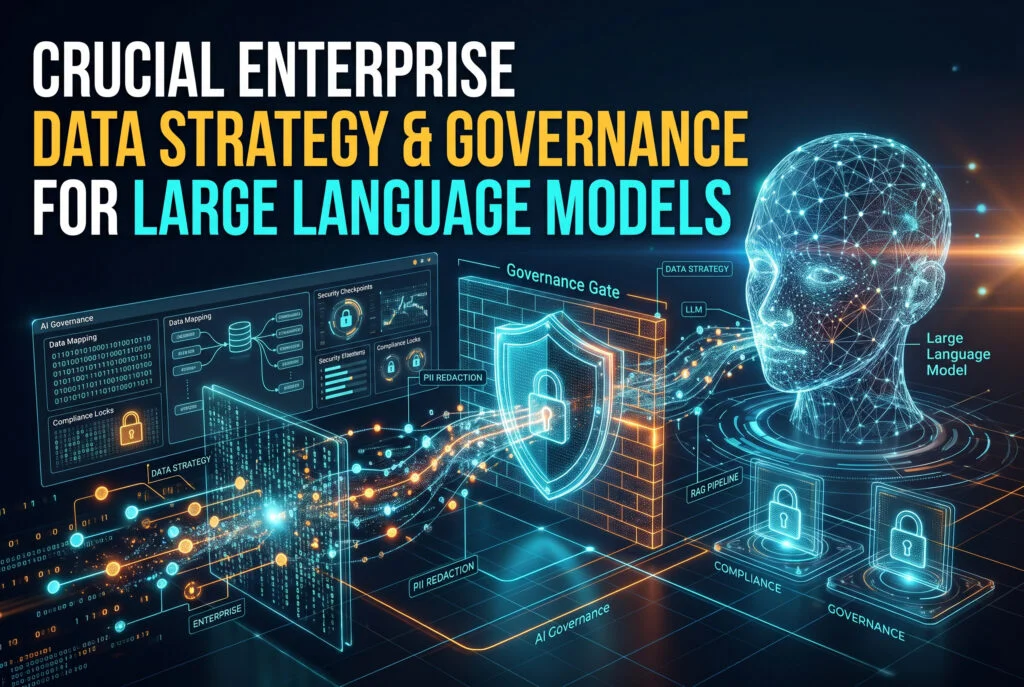
To deploy AI securely, organizations must enforce a comprehensive Data governance framework for LLMs, ensuring that the same strict access controls, compliance regulations, and auditing standards applied to primary operational databases are extended to the vector tier.
Role-Based Access Control (RBAC) and Multi-Tenancy
Enterprise vector stores must support granular multi-tenancy. Depending on the architecture, this can be achieved through physical isolation (dedicated clusters per tenant), logical isolation (separate collections or namespaces within a cluster), or metadata filtering (appending tenant IDs to vector metadata and enforcing filter policies at the query level). Metadata filtering requires robust application-level validation to prevent tenant-hopping attacks where a malicious user modifies their query payload to access another tenant’s vector space.
Data Encryption in Transit and at Rest
Enterprise AI data storage systems must integrate seamlessly with enterprise Key Management Services (KMS), such as AWS KMS or HashiCorp Vault. All data ingested into the vector database must be encrypted in transit using TLS 1.2 or higher, and encrypted at rest using AES-256. For highly regulated industries (finance, healthcare), organizations should utilize customer-managed keys (CMK) to ensure that the vector database vendor cannot cryptographically access the stored embeddings.
Network Isolation and VPC Peering
Vector databases should never be exposed directly to the public internet. If using a managed SaaS provider like Pinecone or Weaviate Cloud, architects must mandate PrivateLink or direct VPC peering connections. This ensures that the high-volume data pipeline from the embedding models to the vector database, and subsequently to the LLM interface, traverses entirely over a private, secured network backbone, mitigating the risk of packet interception and unauthorized API calls.
Auditing, Telemetry, and Prompt Injection Defense
Finally, robust operational intelligence requires comprehensive audit logging of all vector operations (CRUD actions) and query logs. Security Information and Event Management (SIEM) integration is mandatory to detect anomalous search patterns, which could indicate data exfiltration attempts. Furthermore, when integrating vector data into RAG pipelines, the retrieved context must be sanitized before being passed to the LLM to prevent indirect prompt injection attacks, where malicious data stored in the vector database compromises the output of the language model.
Conclusion
The transition to autonomous, AI-driven enterprise operations hinges entirely on the underlying data architecture. The deployment of a sophisticated vector databases enterprise solution is the fundamental bridge between disparate, unstructured data silos and intelligent, generative AI applications. Whether you select the serverless simplicity of Pinecone, the massive Kubernetes scale of Milvus, or the modular hybrid power of Weaviate, the decision must be rooted in rigorous engineering principles.
Technical leaders must look past the hype of LLMs and focus on what truly scales: optimized indexing algorithms like HNSW and IVF-PQ, highly available infrastructure, and impenetrable security paradigms. By architecting resilient enterprise AI data storage today, you ensure that your intelligence systems remain highly performant, cost-efficient, and secure against the operational demands of tomorrow.

Leave a Reply