
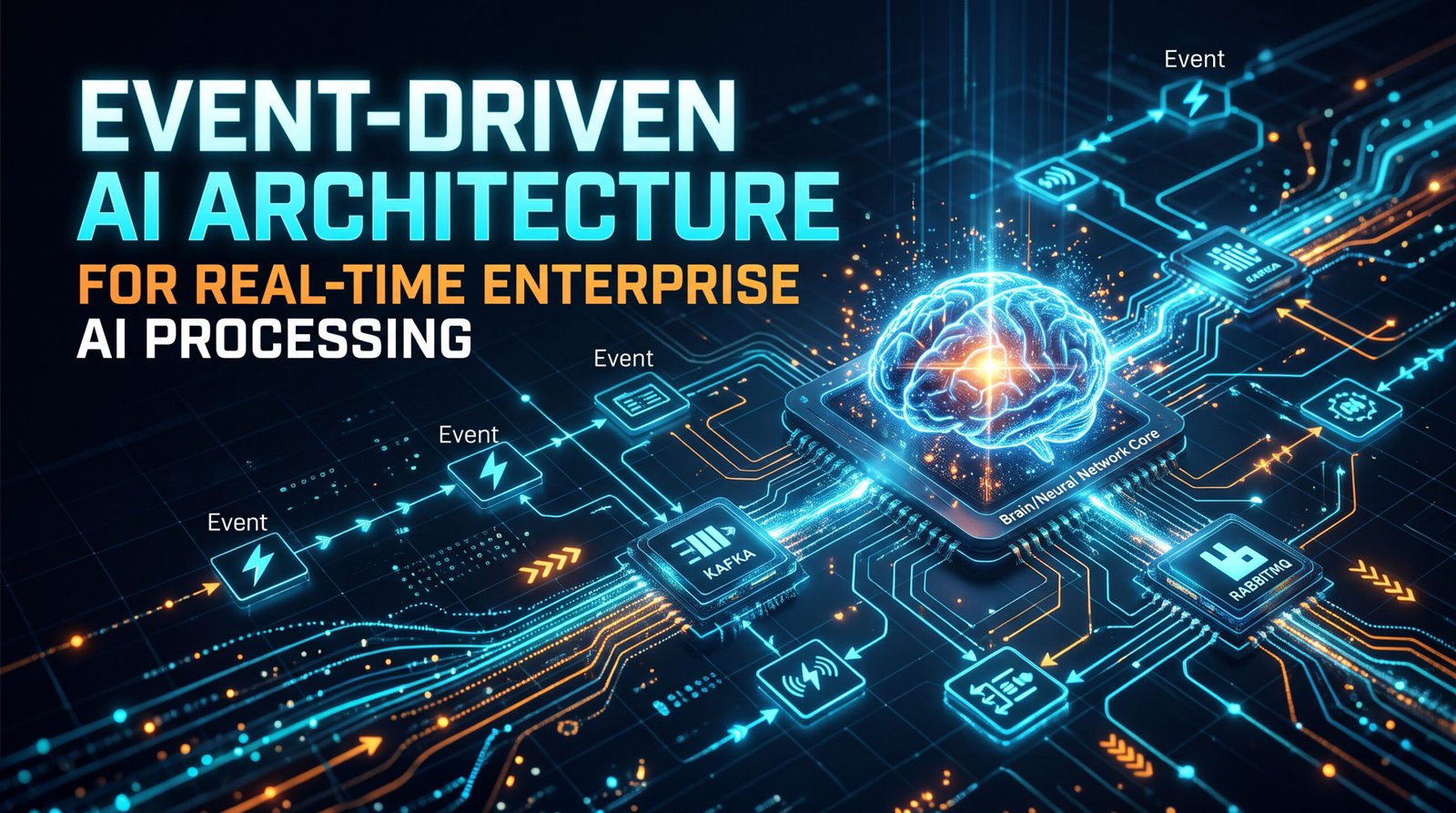
Event-Driven AI Architecture for Real-Time Enterprise AI Processing
The operationalization of AI at an enterprise scale is no longer merely a data science novelty or a model development challenge; it is fundamentally a critical architectural and engineering mandate. Today’s technical leaders—Directors, Enterprise Architects, and CTOs—are constantly inundated with marketing hype, theoretical frameworks, and surface-level news that offer zero operational value. To truly harness the power of artificial intelligence, organizations must move beyond fragile, synchronous API calls and adopt resilient, scalable infrastructure. This is where Event-driven AI becomes the linchpin of modern system design.
In traditional enterprise deployments, integrating machine learning models often relied on RESTful endpoints. While suitable for low-throughput, batch-oriented tasks, this synchronous approach crumbles under the weight of high-volume, continuous data streams. When a user or system requests a complex Large Language Model (LLM) inference, forcing the client to wait for a monolithic processing cycle leads to timeouts, degraded user experiences, and catastrophic resource locking. To solve the intelligence bottleneck, we must re-architect our foundational systems around Real-time enterprise AI processing.
At Autonomous Enterprise, we monitor, aggregate, and strictly filter the vast landscape of AI infrastructure, MLOps, and enterprise cloud architecture. We know that if a development doesn’t present a clear strategic shift, a fundamental architectural advantage, or a measurable ROI potential, it doesn’t make the cut. Transitioning to an event-driven paradigm is precisely the kind of strategic shift that separates industry leaders from laggards. By decoupling data ingestion from model inference, organizations can achieve true operational intelligence, advanced telemetry, automated incident response, and robust mitigation against deployment failures. For a deeper understanding of the foundational principles behind this shift, exploring modern AI Architecture is a prerequisite for building resilient, future-proof systems.
In this comprehensive guide, we will provide the blueprint for building an event-driven AI infrastructure. We will explore the precise mechanisms of message brokers, the intricacies of triggering LLM inferences on continuous data streams, and battle-tested patterns for avoiding bottlenecks in high-volume environments.
Defining Event-Driven AI Infrastructure
Before diving into implementation details, it is crucial to establish a rigorous definition of Event-Driven AI Infrastructure. At its core, an event-driven architecture (EDA) for AI shifts the paradigm from a request-response model to a publish-subscribe (Pub/Sub) or streaming model. In this ecosystem, state changes, system triggers, or user interactions are emitted as immutable “events.” These events are appended to a distributed ledger or message queue, where they can be consumed asynchronously by one or more AI inference services.
This decoupling is the secret to unparalleled architectural scalability. In a synchronous REST-based AI deployment, the caller must maintain an open connection while the GPU processes the request. If the GPU is heavily loaded, the request queues up, latency spikes, and the client application may time out, resulting in data loss or poor user experience. An event-driven approach fundamentally alters this dynamic:
- Asynchronous Processing: Producers (applications, IoT devices, user interfaces) emit events without waiting for the AI model to process them. They fire and forget, maintaining high responsiveness.
- Elastic Scalability: Because the ingestion layer (the message broker) is separated from the processing layer (the AI inference nodes), you can scale them independently. If inference volume spikes, you simply spin up more consumer pods without touching the data ingestion pipeline.
- Fault Tolerance and Replayability: If an AI node crashes during processing—a common occurrence in complex MLOps environments—the event is not lost. It remains in the broker until explicitly acknowledged, allowing the system to retry the inference automatically. Furthermore, streaming platforms retain data, enabling developers to replay historical events through new, updated models for backtesting.
- Microservices Integration: Event-driven systems naturally complement microservices, allowing disparate systems to react to AI outputs seamlessly. An LLM might process an event and output a classification, which is then published as a new event for a downstream billing or alerting service to consume.
To successfully implement this, Enterprise Architects must design a topology that accommodates the unique characteristics of AI workloads—specifically, the high compute cost and variable latency of generative models. Scaling LLMs in enterprise systems requires a profound understanding of how to manage state, context windows, and distributed caching mechanisms (like Redis or Memcached) alongside the event stream to enrich prompts in real-time before they hit the inference engine.
Setting up Message Brokers (Kafka, RabbitMQ)
The backbone of any event-driven AI architecture is the message broker. It acts as the central nervous system, routing massive volumes of data from producers to consumer AI models. Selecting, sizing, and configuring the right broker is a critical architectural decision that dictates the performance limits of your entire AI initiative. While there are many options in the enterprise cloud landscape, Apache Kafka and RabbitMQ dominate the high-performance tier.
Apache Kafka: The High-Throughput Streaming Platform
For large-scale, real-time enterprise AI processing, Apache Kafka (or managed services like Confluent Cloud and Amazon MSK) is often the gold standard. Kafka is a distributed event streaming platform designed for high throughput, durability, and horizontal scalability.
- Topic Partitioning for Parallel AI Processing: Kafka organizes data into topics, which are divided into partitions. This is a game-changer for AI workloads. By partitioning a topic based on a specific key (e.g., customer ID or document ID), you can attach a consumer group of AI inference services. Each consumer in the group reads from a specific partition, allowing you to parallelize GPU processing linearly while strictly maintaining the order of events for a given key—crucial for conversational AI where context sequence matters.
- Log Retention for Contextual RAG: Kafka retains messages for a configurable period (or indefinitely). This allows enterprise systems to build materialized views of data in real-time, feeding vector databases seamlessly for Retrieval-Augmented Generation (RAG) architectures.
- Exactly-Once Semantics (EOS): Kafka supports EOS, ensuring that even in the event of network partitions or node failures, an AI model will process a critical event (like a financial fraud detection trigger) exactly one time, preventing duplicated actions.
RabbitMQ: The Flexible Message Queue
While Kafka is a distributed log, RabbitMQ operates as a traditional message broker using the Advanced Message Queuing Protocol (AMQP). It excels in complex routing scenarios and environments where fine-grained message acknowledgment is required.
- Complex Routing Topologies: RabbitMQ uses exchanges (Direct, Topic, Fanout, Headers) to route messages to queues. If your AI architecture requires dynamically routing specific types of data to different specialized models (e.g., routing images to a Vision Transformer and text to an LLM), RabbitMQ’s routing capabilities make this configuration trivial.
- Priority Queuing: In enterprise environments, not all AI requests are equal. A real-time customer service chatbot query may need processing before a background document summarization task. RabbitMQ natively supports priority queues, ensuring that high-priority events bypass lower-priority ones to reach the AI inference nodes faster.
- Pre-fetch Limits for GPU Protection: RabbitMQ allows administrators to set a `prefetch_count`. This ensures that a consumer (the AI model) is only handed a specific number of unacknowledged messages at a time. This prevents the broker from overwhelming a GPU node with a massive spike in data, providing a built-in layer of backpressure.
Ultimately, the choice between Kafka and RabbitMQ depends on your specific operational intelligence needs. Kafka is optimized for massive data streams, log aggregation, and sequential processing, while RabbitMQ offers unparalleled flexibility for complex routing, priority tiering, and strict per-message acknowledgment.
Triggering LLM Inferences on Data Streams
Once the messaging backbone is established, the next architectural challenge is bridging the gap between the continuous data stream and the AI inference engine. Triggering Large Language Models (LLMs) on streaming data is significantly more complex than traditional microservice execution due to the compute-intensive nature of token generation and the requirement for rich context.
To achieve seamless real-time enterprise AI, architects must deploy robust consumer services that act as intermediaries between the message broker and the model serving infrastructure (such as NVIDIA Triton Inference Server, vLLM, or Ray Serve). The lifecycle of triggering an inference on a data stream follows a strict pattern:
- Event Consumption and Deserialization: The consumer service polls the broker (e.g., Kafka) for new messages. These messages are typically serialized (JSON, Avro, Protobuf) to minimize network overhead. The consumer deserializes the payload, extracting the core prompt or data payload requiring AI processing.
- Real-Time Context Injection (Dynamic RAG): An LLM is only as intelligent as the context it receives. Before the model is triggered, the consumer service must often enrich the raw event. This involves querying low-latency data stores (like Redis) or Vector Databases (like Milvus or Pinecone) to fetch real-time enterprise data, user history, or relevant documentation. This enriched payload is then compiled into a structured prompt.
- Asynchronous Inference Invocation: The consumer service forwards the enriched prompt to the inference server. Because LLM generation can take anywhere from hundreds of milliseconds to several seconds depending on token length, the consumer service must make this call asynchronously. Using modern frameworks like Python’s `asyncio` or reactive programming models prevents the consumer thread from blocking, allowing it to continue fetching and buffering incoming events.
- Handling Streaming Outputs: Many enterprise AI applications require streaming responses (delivering tokens to the user as they are generated) rather than waiting for the entire block of text. To handle this in an event-driven architecture, the inference server streams tokens back to the consumer, which can then publish these token chunks to a dedicated “output stream” topic on the broker. A downstream WebSocket service can then consume this output topic and push the tokens to the end-user’s browser in real-time.
- Commit and Acknowledge: Only after the inference is successfully completed (or explicitly failed after retries) does the consumer service send an acknowledgment (ACK) to the message broker. This ensures zero data loss. If the inference server crashes mid-generation, the broker will not receive the ACK, and the event will be automatically reassigned to a healthy node.
By treating inference as an asynchronous, state-managed pipeline rather than a simple function call, enterprises can reliably process millions of AI events per day without dropping requests or suffering catastrophic cascading failures.
Avoiding Bottlenecks in High-Volume Environments
The most profound challenge in Event-driven AI is mitigating the inherent speed mismatch between the data ingestion layer and the AI processing layer. A Kafka cluster can ingest hundreds of thousands of events per second with ease, while a cluster of high-end GPUs might only process a few hundred LLM inferences in that same second. Without rigorous architectural safeguards, this discrepancy will inevitably lead to bottlenecks, massive lag in consumer queues, and infrastructure collapse.
To ensure cost and risk efficiency while maintaining high availability, Enterprise Architects must implement advanced telemetry and proactive bottleneck mitigation strategies:
- Dynamic Autoscaling with KEDA: Kubernetes Event-driven Autoscaling (KEDA) is a critical component for AI infrastructure. Instead of scaling AI pods based on rudimentary CPU or memory metrics, KEDA scales your inference deployments based on the depth of the message queue. If the Kafka topic partition lag exceeds a defined threshold (e.g., 50 unprocessed messages), KEDA automatically provisions additional GPU nodes. Once the queue is drained, it scales them back down to zero, radically optimizing cloud compute costs.
- Implementing Backpressure Mechanisms: Backpressure is a system’s way of telling the data source to slow down. If the AI consumer pods are overwhelmed and cannot scale out further (due to budget limits or hard GPU quotas), the consumer must throttle its consumption rate. In RabbitMQ, this is handled via `prefetch` limits. In Kafka, consumer applications must dynamically adjust their polling frequency or utilize pause/resume API methods to stop fetching data until the current batch is processed.
- Dynamic Batching: AI inference is highly optimized for batch processing. Sending one request at a time to a GPU severely underutilizes its parallel processing capabilities. Consumer services should buffer incoming streaming events for a brief micro-window (e.g., 50 milliseconds) and send a batch of requests to the inference server simultaneously. Serving engines like vLLM handle continuous batching natively, optimizing memory bandwidth and significantly increasing total system throughput.
- Circuit Breakers and Dead Letter Queues (DLQ): Not all inferences succeed. Malformed data, context window overflows, or transient API errors can cause processing loops. Implementing the Circuit Breaker pattern ensures that if a model starts failing consistently, the system temporarily stops sending requests, allowing the infrastructure to recover. Events that repeatedly fail processing must be routed to a Dead Letter Queue. This allows the main stream to continue flowing unimpeded, while engineers can inspect and manually replay the failed events stored in the DLQ at a later time.
- Rate Limiting and Tiered Quality of Service (QoS): In multi-tenant enterprise environments, a single noisy neighbor can flood the event broker and consume all available GPU resources. Implementing strict API gateways and rate limiters before events enter the broker ensures fairness. Furthermore, architectures should employ tiered QoS—routing premium tier events to dedicated, high-availability GPU clusters, while routing lower-tier events to spot-instance clusters where latency SLAs are more relaxed.
By meticulously combining auto-scaling, dynamic batching, and resilient error handling, organizations can transform a volatile, unpredictable AI workload into a stable, high-throughput production engine. The future of enterprise AI undeniably belongs to those who build the most robust, event-driven infrastructures.

Leave a Reply