
Implementing AI Cost-Routing Frameworks for AI Model Selection
The operationalization of AI at enterprise scale is no longer just a model development challenge; it is a critical architectural and engineering mandate. As organizations transition from isolated proof-of-concept deployments to widespread, production-grade applications, technical leaders are confronting a harsh reality: the sheer cost of intelligence at scale. Relying on a single, monolithic frontier model for every enterprise query is an architectural anti-pattern that leads to bloated cloud bills, unnecessary latency, and unsustainable compute overhead.
To solve this intelligence bottleneck, engineering teams must shift away from static model configurations and adopt intelligent, multi-model architectures. At the core of this transition is AI cost-routing—a sophisticated infrastructural layer designed to dynamically evaluate incoming prompts and route them to the most cost-efficient, capable model for the specific task. By decoupling the application layer from the model inference layer, enterprises can achieve significant architectural scalability while maintaining strict governance over their compute spend.
In this technical deep-dive, we will explore the mechanics of dynamic orchestration, the engineering patterns required to implement robust routing gateways, and how these frameworks fundamentally transform the unit economics of enterprise machine learning pipelines.
What is Dynamic AI Model Routing?
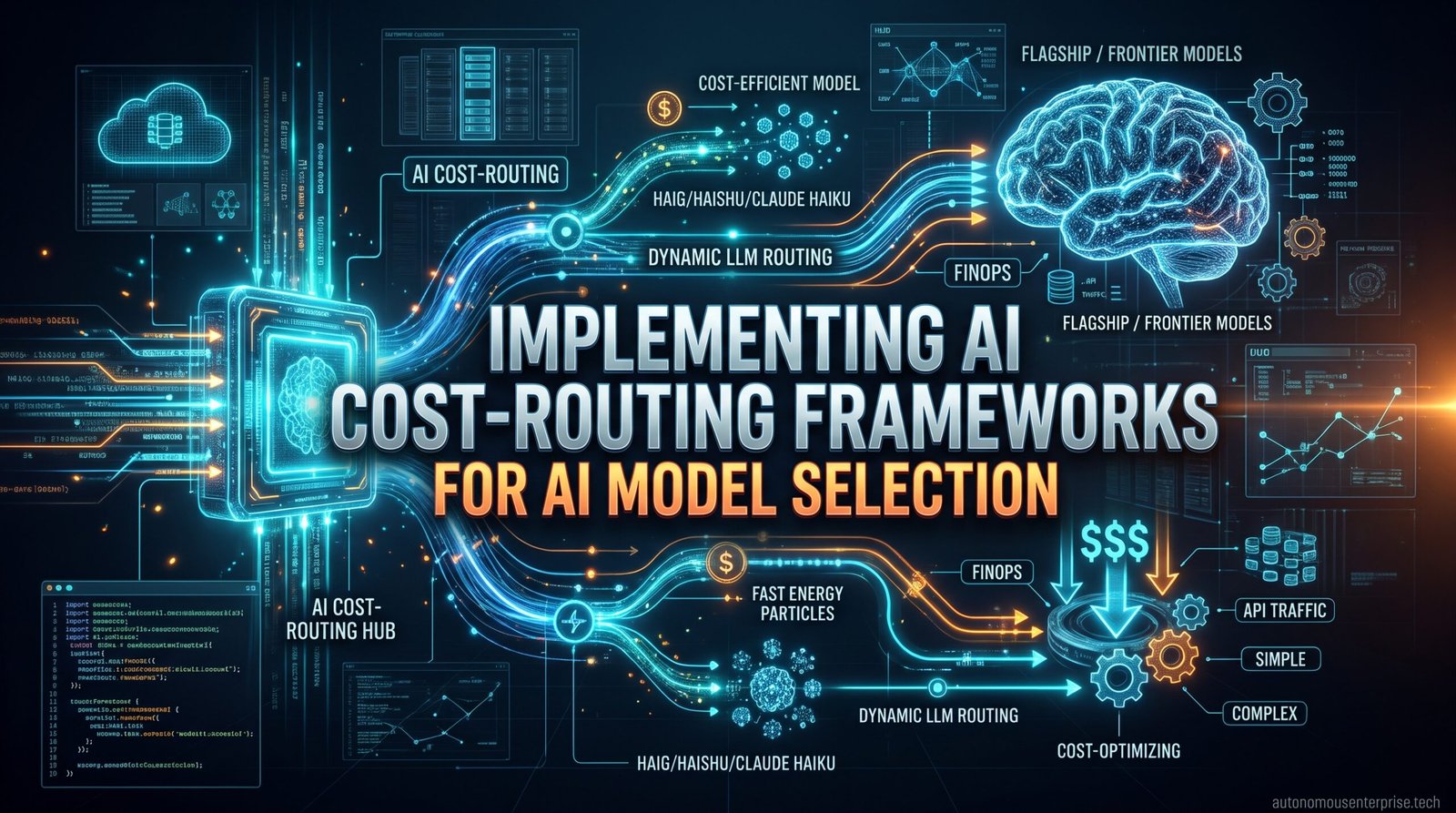
Dynamic AI model routing is an orchestration pattern that sits between the application interface (such as an internal tool, a customer-facing chatbot, or an API gateway) and the underlying Large Language Models (LLMs). Rather than hardcoding a single endpoint (e.g., sending all traffic to GPT-4 or Claude 3.5 Sonnet), the routing layer acts as a semantic load balancer. It evaluates the complexity, context length, and required cognitive depth of an incoming prompt in real-time, then dispatches the request to the optimal model based on pre-defined cost and performance thresholds.
Effectively optimizing Dynamic LLM routing costs requires more than simple round-robin load balancing. It demands an intelligent gateway capable of classifying intent and complexity within milliseconds. This architecture typically consists of several core components:
- The Orchestration Gateway: The central proxy that intercepts all incoming API calls, managing authentication, rate limiting, and telemetry logging before applying routing logic.
- The Intent and Complexity Classifier: A lightweight, high-speed classification mechanism (often utilizing semantic embeddings, fast heuristic rules, or a highly quantized small model) that scores the prompt’s difficulty.
- The Routing Engine: The rules-based or machine-learning-driven decision matrix that maps the complexity score to an available model tier, factoring in real-time latency, API quotas, and cost-per-token metrics.
- The Fallback Mechanism: An automated retry and escalation protocol. If a smaller model fails to produce a high-confidence output, or if it encounters a structural error, the router automatically re-routes the request to a more capable, heavy-duty model without disrupting the end-user experience.
- The Telemetry and Analytics Database: A time-series data store that logs routing decisions, inference latency, and exact token costs, allowing FinOps teams to continuously refine the routing thresholds.
By implementing this framework, organizations decouple their business logic from the rapidly evolving model ecosystem. When a newer, faster, or cheaper model is released, enterprise architects can simply plug its endpoint into the routing engine and adjust the traffic weights, achieving zero-downtime infrastructure upgrades and immediate cost optimization.
Routing Simple Queries to Cheaper Models (e.g., Claude Haiku)
Analyzing enterprise AI telemetry reveals a consistent pattern: the vast majority of daily API traffic does not require frontier-level reasoning. A significant percentage of queries involve basic data extraction, text summarization, tone modification, formatting transformations (e.g., JSON to CSV), or conversational pleasantries. Routing these low-complexity tasks to flagship models is a massive waste of computational resources.
This is where tiered AI cost-routing becomes highly effective. By configuring the routing engine to identify low-cognitive-load requests, enterprises can aggressively offload traffic to smaller, faster, and radically cheaper models like Claude 3 Haiku, Llama 3 8B, or Gemini 1.5 Flash. These models offer blistering inference speeds—often achieving time-to-first-token (TTFT) metrics under 200 milliseconds—while costing fractions of a cent per thousand tokens.
To successfully implement this, engineering teams must establish strict classification criteria to ensure quality is not degraded when stepping down to smaller models. The router should look for specific indicators that a prompt is “simple”:
- High Context, Low Reasoning: Retrieval-Augmented Generation (RAG) pipelines often inject massive documents into the context window, but only ask the model to extract a single specific fact. Smaller models excel at this needle-in-a-haystack retrieval, provided they have the necessary context window size.
- Deterministic Formatting: Tasks that require strict structural outputs, such as extracting named entities (NER) into a predefined JSON schema, can be easily handled by fine-tuned smaller models rather than relying on the generalist reasoning of a frontier model.
- Internal Log Summarization: Routine IT operations, such as summarizing server error logs or formatting daily compliance reports, do not require advanced strategic reasoning and can be safely offloaded.
- Stateless Conversational Turns: In multi-turn chatbot interactions, intermediate steps like acknowledging receipt of user data or asking for basic clarification can be routed to a fast, low-cost model.
By systematically diverting these workloads, infrastructure leaders can effectively begin Managing enterprise AI API costs at a granular level. The resulting drop in compute overhead can be reinvested into highly specialized fine-tuning processes or expanded infrastructure redundancy, fortifying the organization’s overall AI posture.
Reserving Flagship Models for Complex Logic
While aggressive cost savings on standard queries are critical, the true value of enterprise AI lies in its ability to execute complex, multi-step reasoning, sophisticated code generation, and nuanced data synthesis. By offloading the easy tasks to models like Claude Haiku, the orchestration layer frees up budget and rate-limit quotas to deploy flagship models—such as GPT-4o, Claude 3.5 Sonnet, or Gemini 1.5 Pro—precisely where they yield the most strategic impact.
The AI cost-routing framework must be highly sensitive to the signatures of complex logic. A prompt should trigger an escalation to a frontier model when the classifier detects:
- Deep Semantic Synthesis: Requests that ask the model to analyze conflicting information from multiple enterprise databases and form a synthesized, logically sound conclusion.
- Advanced Code Generation and Debugging: When developers require assistance in architecting distributed systems, finding security vulnerabilities in legacy codebases, or writing complex SQL joins for data warehousing.
- Agentic Workflows and Tool Calling: Scenarios where the model acts as an autonomous agent that must decide which external APIs to call, interpret the JSON responses, and chain multiple actions together to complete a business process.
- High-Stakes Legal or Financial Analysis: In environments where hallucination risks carry severe business penalties, deploying the models with the highest reasoning capabilities and lowest hallucination rates is a strict mandate.
Implementing a rigid boundary between simple and complex tasks requires robust observability. Enterprise architects should deploy automated evals (evaluations) within their CI/CD pipelines to continuously test the routing logic. If a smaller model begins failing on a specific subset of queries, the routing thresholds must be dynamically adjusted to ensure those edge cases are seamlessly passed to the flagship tier. This dual-layered approach ensures that application reliability remains pristine while compute efficiency is maximized.
The Financial ROI of an Orchestration Layer
The deployment of an AI cost-routing framework fundamentally alters the unit economics of scaling machine learning operations. Without dynamic orchestration, enterprise AI deployments are financially linear: as usage scales, costs scale directly in proportion, often leading to unpredictable budget overruns that alarm CFOs and FinOps teams.
With an intelligent gateway in place, the cost curve flattens. Because frontier models can be anywhere from 30 to 50 times more expensive per million tokens than their smaller counterparts, routing even 40% of standard enterprise traffic to a lower tier results in massive, immediate capital retention. This financial leverage represents a critical architectural advantage for organizations aiming to integrate AI across every department without crippling their cloud budgets.
To quantify the success of these deployments, technical leaders must look beyond raw token counting and establish sophisticated unit metrics. Measuring the true AI ROI demands tracking the cost-per-successful-business-transaction rather than just the cost-per-token. When an orchestration layer is correctly calibrated, the total cost of ownership (TCO) plummets, latency improves, and the business achieves a higher volume of successful AI interactions per dollar spent.
Furthermore, this multi-model strategy acts as a profound risk mitigation tactic against vendor lock-in and API degradation. If a specific provider experiences an outage, or if they dramatically increase their pricing structure, the AI cost-routing gateway can seamlessly redirect traffic to an equivalent model hosted on a different cloud provider or a locally hosted open-weight model. In the era of the Autonomous Enterprise, infrastructure resilience and financial efficiency are inseparable. Building an intelligent orchestration layer is not merely a cost-saving measure; it is the foundational blueprint for scalable, robust, and economically viable enterprise AI.


Leave a Reply