
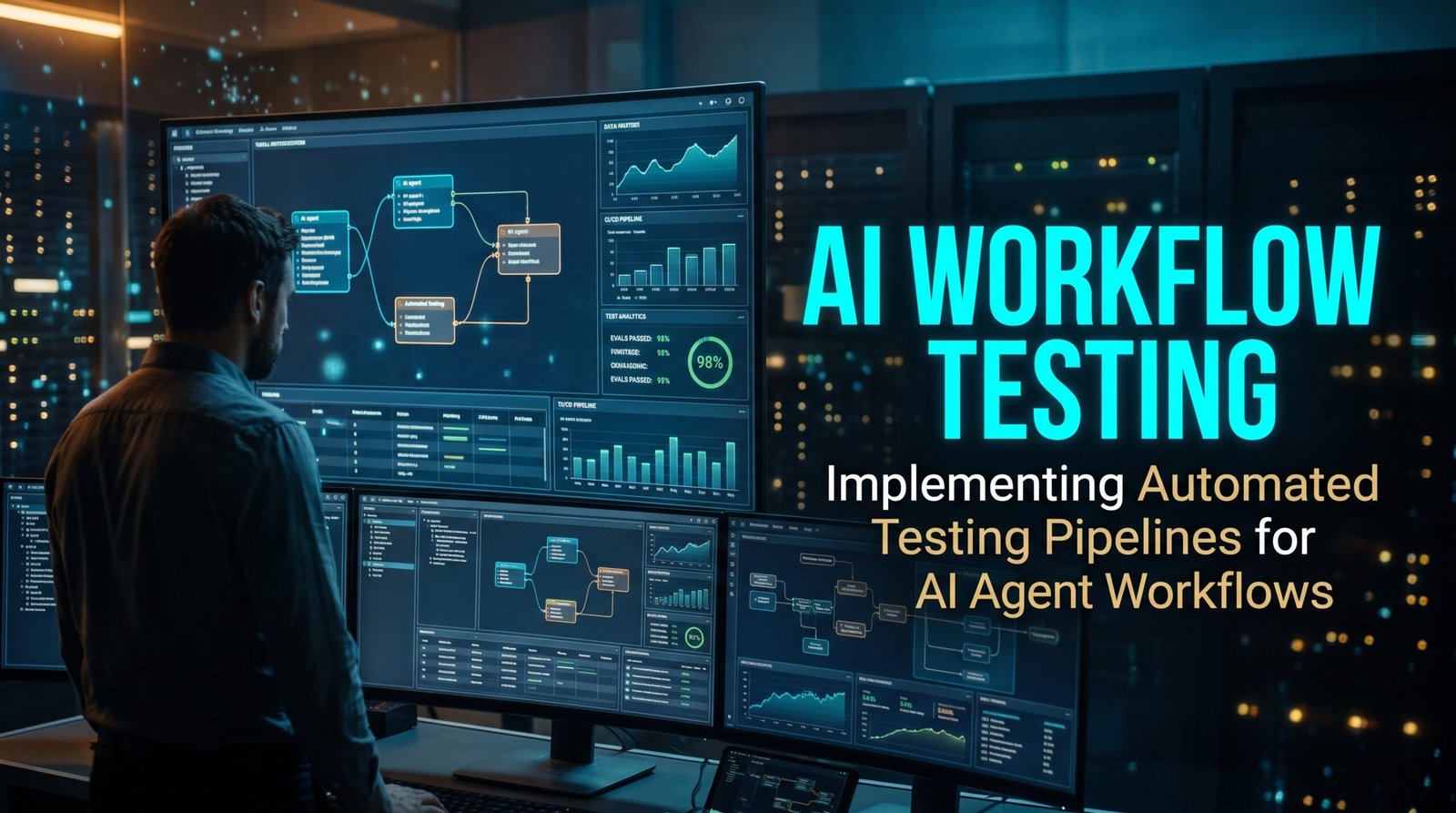
AI Workflow Testing: Implementing Automated Testing Pipelines for AI Agent Workflows
The operationalization of artificial intelligence at enterprise scale is no longer merely a model development challenge; it is a critical architectural and engineering mandate. As organizations transition from deploying passive, conversational copilots to unleashing autonomous AI agents that execute complex API calls, query secured databases, and make deterministic operational decisions, the risk profile changes exponentially. In this new paradigm, shipping broken or hallucinating AI agents is not just a UI inconvenience—it is a catastrophic operational failure that can lead to data corruption, compliance violations, and massive financial loss.
For Enterprise Architects, Directors of Engineering, and Technical Leaders, the mandate is clear: the future belongs to those with the most robust, scalable, and secure infrastructure. Yet, traditional software engineering practices are struggling to keep pace with the stochastic nature of modern machine learning models. Standard CI/CD (Continuous Integration and Continuous Deployment) pipelines were built for deterministic code where inputs always equal expected outputs. They break down entirely when faced with the probabilistic realities of Large Language Models (LLMs).
This is where the discipline of AI workflow testing becomes the ultimate competitive advantage. By implementing rigorous, automated testing for LLMs and AI agent workflows, enterprises can move beyond the marketing hype of “AI capabilities” and achieve true operational intelligence. This comprehensive guide details the architectural blueprints required to build resilient, automated testing pipelines that gate deployments based on empirical performance rather than anecdotal observation, ensuring that your enterprise AI applications scale reliably, securely, and cost-effectively.
The Challenge of Non-Deterministic Outputs
To engineer a robust testing pipeline, we must first understand why legacy testing methodologies fail when applied to generative AI. In traditional DevOps and software engineering, unit testing relies on strict assertions: `assert(output == expected_value)`. If a developer refactors a function, the pipeline runs the unit tests, and if the output matches the expected string or integer, the build passes. The system is entirely deterministic.
AI agent workflows, driven by Large Language Models, are inherently non-deterministic. Even with temperature settings dialed down to zero, the interplay of floating-point math across distributed GPU clusters, varying system prompts, dynamically retrieved context windows, and evolving model weights means that the exact sequence of generated tokens can—and will—vary. This stochastic nature introduces several critical engineering challenges for deployment:
- Prompt Drift and Brittleness: A minor adjustment to a system prompt designed to fix one specific edge case can inadvertently degrade performance across dozens of other workflows. Without automated testing, this “prompt drift” goes unnoticed until it hits production.
- Latent Space Variability: Upstream changes from foundational model providers (such as OpenAI, Anthropic, or open-source updates to Llama models) can alter the latent space representations. A model version upgrade might cause an agent that previously returned perfectly structured JSON to suddenly include conversational conversational filler that breaks downstream parsers.
- Contextual Hallucinations: AI agents are often tasked with synthesizing massive amounts of dynamically retrieved data. As the underlying data changes, the agent might confidently generate plausible but entirely fabricated responses.
- Security and Jailbreaking: Non-deterministic outputs make it incredibly difficult to guarantee that an agent will not succumb to prompt injection attacks, inadvertently leak PII (Personally Identifiable Information), or execute unauthorized actions via tool calling.
Because we cannot rely on exact string matching to validate AI workflows, we must shift our architectural mindset from deterministic assertions to probabilistic evaluations. We must build systems that test not just for exact matches, but for semantic similarity, structural adherence, factual grounding, and tone. This requires an entirely new layer of infrastructure within the CI/CD pipeline, fundamentally changing how we approach the software development lifecycle for AI.
Building Evals (Evaluations) for LLM Accuracy
The foundation of AI workflow testing is the “Eval” (Evaluation). Evals are the automated scoring mechanisms that replace traditional unit assertions. Building a scalable, reliable eval framework is arguably the most complex and critical component of modern LLMOps. Without robust evals, enterprise teams are flying blind, relying on “vibe checks” and manual QA that simply cannot scale to enterprise traffic volumes.
Developing a production-grade eval framework requires a multi-layered approach, blending heuristic metrics with advanced model-graded evaluations:
- The Golden Dataset: Every eval pipeline begins with a “Golden Dataset”—a meticulously curated collection of hundreds or thousands of input-output pairs that represent the ground truth for your specific enterprise use case. These are high-quality, human-validated examples of exactly how the AI agent should respond to various scenarios, edge cases, and adversarial inputs. This dataset must be version-controlled and continuously expanded as new failure modes are discovered in production.
- Heuristic and Deterministic Metrics: While the core generation is probabilistic, certain constraints must remain deterministic. We use heuristic evals to test for structural requirements. Did the model output valid JSON? Did it stay under the maximum token limit? Did it utilize the specific designated API tool? Did it refrain from using banned vocabulary? These checks are fast, cheap, and can be executed at the very beginning of the pipeline to fail bad builds quickly.
- Semantic Similarity and Embedding Distance: To test whether an output is “close enough” to the Golden Dataset without requiring an exact string match, we use embedding models. By converting both the generated output and the expected golden output into dense vector representations, we can calculate the cosine similarity between them. If the distance falls below a certain threshold, the eval fails. This is highly effective for testing whether the core meaning of the response has drifted.
- LLM-as-a-Judge: The most powerful, yet computationally expensive, eval strategy is using a superior LLM (e.g., using GPT-4 or Claude 3.5 Sonnet) to evaluate the outputs of your production model (which might be a faster, cheaper fine-tuned model like Llama 3 8B). You provide the “Judge LLM” with a strict grading rubric, the input prompt, the retrieved context, and the generated output, asking it to score the response on a scale of 1-5 for metrics like helpfulness, conciseness, and safety.
Implementing these evals requires a robust telemetry and tracking system. Teams must log every evaluation run, track the pass/fail rates over time, and alert engineers when a specific branch of code causes the average eval score to dip below the acceptable enterprise threshold. This continuous tracking ensures that your AI agents improve monotonically, preventing the dreaded “two steps forward, one step back” cycle of prompt engineering.
Regression Testing RAG Architectures
Retrieval-Augmented Generation (RAG) has become the de facto architecture for enterprise AI, allowing organizations to ground LLMs in their own proprietary, real-time data. However, testing a RAG workflow is exponentially more complex than testing a standard LLM call, because the architecture is fundamentally bipartite: it consists of a Retrieval engine (the vector database and embedding model) and a Generation engine (the LLM). A failure in either component results in a flawed user experience.
Regression testing for RAG architectures is a mandatory capability, particularly critical when Monitoring LLMs in production environments. If a team updates their data chunking strategy, switches their embedding model to a new provider, or tweaks the top-k retrieval parameters, they must be able to empirically prove that these infrastructural changes did not degrade the accuracy of the agent. To achieve this, enterprise architects must decouple the testing pipeline into distinct phases.
Phase 1: Evaluating the Retrieval Component
Before we even look at the LLM’s response, we must test the search capability. If the vector database retrieves irrelevant documents, the LLM is guaranteed to fail. We evaluate retrieval using classical information retrieval metrics adapted for vector search:
- Context Precision: Of the top ‘K’ documents retrieved from the vector database, how many were actually relevant to answering the user’s query? High precision means your agent isn’t being polluted with distracting noise.
- Context Recall: Did the retrieval system successfully fetch *all* the necessary pieces of information required to formulate a complete answer? If critical facts are left out of the context window, the agent will suffer from omission errors.
- Mean Reciprocal Rank (MRR): How high up in the retrieved results was the most crucial piece of context? In RAG, LLMs suffer from “lost in the middle” syndrome; the most important information needs to be at the very top of the context window.
Phase 2: Evaluating the Generation Component
Once we have verified that the retrieval engine is fetching the correct data, we must evaluate how well the LLM synthesizes that data. This is where specialized RAG evaluation frameworks (such as Ragas or TruLens) become invaluable. We test for two critical dimensions:
- Faithfulness (Factual Grounding): This eval checks for hallucinations. Does every claim made in the LLM’s output directly trace back to the retrieved context? If the agent invents facts outside of the provided documents, the Faithfulness score drops, and the build must be halted.
- Answer Relevance: Did the agent actually answer the user’s specific question, or did it just provide a generic summary of the retrieved documents? An output can be perfectly faithful to the text but completely irrelevant to the prompt.
By isolating the testing of the retrieval system from the generation system, technical leaders can pinpoint exact operational bottlenecks. If an agent fails a regression test, the pipeline will immediately reveal whether the failure was due to a bad vector search (requiring a tweak to the embedding strategy) or a hallucination (requiring a tweak to the LLM system prompt), drastically reducing MTTR (Mean Time To Recovery) for AI incidents.
Integrating Evals into the CI/CD Pipeline
Developing robust evaluations is only half the battle; the true architectural mandate is seamlessly integrating these automated testing for LLMs frameworks into the enterprise CI/CD pipeline. The goal is to establish automated deployment gates that prevent degraded AI agents from ever reaching production, without slowing down the velocity of the engineering team.
Because AI evaluations can be computationally expensive and time-consuming—especially when utilizing LLM-as-a-judge patterns against large Golden Datasets—a tiered, multi-stage CI/CD pipeline is required to balance speed with safety.
Stage 1: Pre-Commit and Pull Request (PR) Checks (The Fast Lane)
When a developer tweaks a system prompt, updates an agent tool schema, or modifies the RAG retrieval logic, the initial PR checks must provide rapid feedback (ideally within 2-5 minutes). This stage should execute deterministic unit tests, syntax validation for JSON schemas, and run a small, highly optimized subset of the Golden Dataset (e.g., 50 core examples) evaluated purely via fast embedding distance and heuristic metrics. If the code breaks core formatting or radically alters semantic meaning, the PR is blocked immediately.
Stage 2: Staging and Pre-Production (The Deep Evaluation)
Once the PR is approved and merged into the main branch, the pipeline triggers a comprehensive evaluation suite. This is the heavy-lifting phase of AI workflow testing. The pipeline provisions an ephemeral staging environment and runs the AI agent against the entire Golden Dataset (thousands of permutations, adversarial edge cases, and complex reasoning tasks). This stage utilizes LLM-as-a-judge to score Faithfulness, Tone, and Answer Relevance. Because this process can take hours and incur significant API costs, it is typically executed nightly or gated before a major release candidate is certified. Deployment to production is strictly blocked unless the overall eval score exceeds the baseline metrics of the current production model.
Stage 3: Shadow Testing (Traffic Mirroring)
For highly critical enterprise operations, passing the Staging evals is not enough. The next pipeline stage involves Shadow Testing. The new AI agent is deployed to the production environment, but it is entirely decoupled from the user interface. Live production traffic (user queries) is mirrored and sent to both the current live agent and the new shadow agent simultaneously. The shadow agent generates responses and executes simulated workflows, but its outputs are not shown to the user or committed to the active database. Instead, the telemetry system captures both outputs and runs asynchronous evals to compare their performance on real-world, unseen data. This provides the ultimate proof of architectural scalability and operational safety before the final switch is flipped.
Stage 4: Canary Deployments and Automated Rollbacks
When the new agent is finally promoted to live traffic, it should be done via a canary release—routing only 1% to 5% of user traffic to the new model. The operational intelligence layer continuously monitors the telemetry from this slice of traffic, checking for increased latency, spike in error rates, or drops in user feedback scores (e.g., thumbs up/down). If the automated monitoring detects a statistical degradation in quality or infrastructure performance, the pipeline triggers an automated rollback, instantly routing all traffic back to the previous stable version.
By architecting this multi-tiered CI/CD pipeline, enterprise technical leaders can tame the non-deterministic chaos of generative AI. Moving from subjective vibe checks to automated, empirical AI workflow testing is the definitive step toward building a truly resilient Autonomous Enterprise. It transforms AI from a fragile, experimental prototype into a hardened, battle-tested engine capable of driving global scale operations with unshakeable reliability.


Leave a Reply