
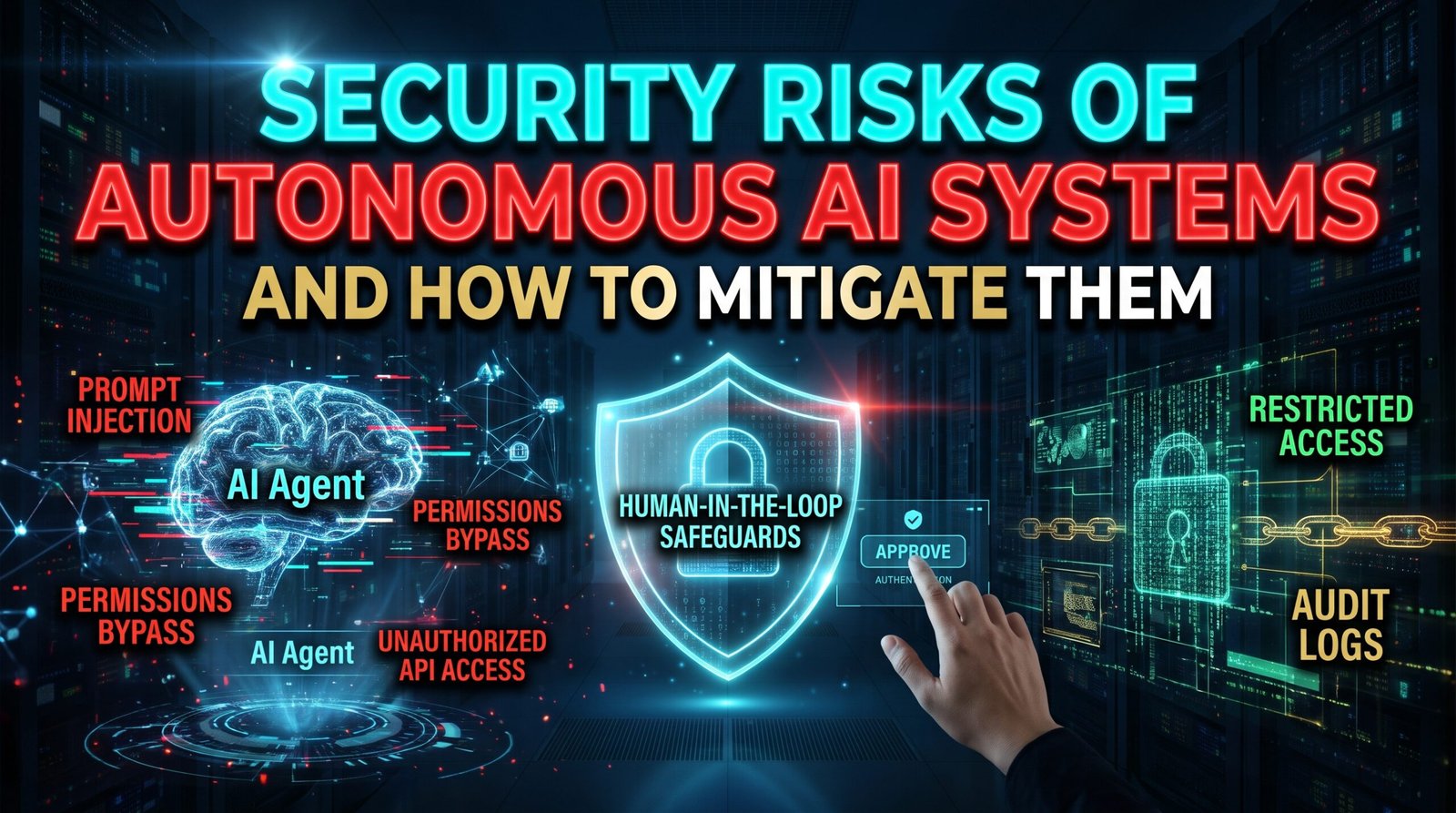
Agentic AI Security Risks of Autonomous AI Systems and How to Mitigate Them
The operationalization of AI at the enterprise scale has fundamentally shifted from a model development challenge to a critical architectural and engineering mandate. We have moved past the era of passive, read-only Large Language Models (LLMs) that merely summarize text or generate code snippets. Today, organizations are deploying active, goal-oriented agents capable of reasoning, planning, and executing actions across interconnected enterprise environments. This transition introduces a paradigm shift in threat modeling. Autonomous Systems are not just analyzing data; they are modifying state, altering databases, sending communications, and orchestrating complex workflows without direct human oversight.
For Directors, Enterprise Architects, and Technical Leaders, the stakes have never been higher. A compromised agent does not merely return a biased answer; it can execute arbitrary API calls, exfiltrate sensitive proprietary data, or inadvertently trigger a catastrophic infrastructure collapse. The marketing hype surrounding agentic capabilities often overshadows the stark reality: deploying these systems without rigorous, battle-tested security architectures is a liability. Securing autonomous systems requires a fundamental reimagining of access control, observability, and deterministic safeguards.
This comprehensive architectural briefing bypasses the theoretical frameworks to focus strictly on high-signal, operational intelligence. We will dissect the foundational security risks inherent to agentic architecture and provide proven, enterprise-grade mitigation strategies designed to ensure architectural scalability, cost efficiency, and uncompromising risk management. By understanding and neutralizing these threats, technical leaders can confidently deploy AI infrastructure that delivers measurable ROI rather than escalating operational vulnerabilities.
The Threat of Prompt Injection in Active Agents
Prompt injection is widely misunderstood as a simple conversational parlor trick used to make a chatbot break its character or ignore its safety guardrails. In the context of active, integrated enterprise architectures, prompt injection must be classified as a critical remote code execution (RCE) vulnerability. When an AI agent is connected to external tools, databases, and APIs, malicious instructions embedded within user inputs or retrieved data can hijack the agent’s execution flow, forcing it to perform unauthorized actions on behalf of the attacker.
The threat landscape is divided into two primary vectors: direct prompt injection and indirect prompt injection. Direct injection occurs when a user intentionally crafts an adversarial prompt designed to overwrite the system instructions. However, indirect prompt injection poses a far more insidious threat to enterprise environments. In an indirect attack, the malicious payload is hidden within external data sources that the agent legitimately accesses—such as a compromised website, an infected PDF document, or a poisoned internal database queried via Retrieval-Augmented Generation (RAG). When the agent ingests this compromised data, it blindly processes the hidden adversarial commands, potentially leading to unauthorized data extraction, privileged escalation, or lateral movement across the network.
To mitigate the threat of prompt injection in active agents, enterprise architects must implement deeply layered defense-in-depth strategies:
- Control Plane and Data Plane Separation: Treat the LLM reasoning engine as the control plane and external inputs as the data plane. Never concatenate untrusted user input directly into the core system instructions. Utilize modern API features, such as distinct system and user message arrays, to enforce structural boundaries between instructions and data.
- Input Sanitization and Semantic Filtering: Deploy intermediary, lightweight classification models acting as AI firewalls to analyze inbound requests and retrieved RAG contexts for adversarial intent before they ever reach the primary, high-value reasoning model. If an anomaly or injection pattern is detected, the request must be dropped immediately.
- Strict Output Parsing and Validation: Never trust the raw output of an agent. Implement strict, deterministic schema validation (e.g., using JSON schemas or libraries like Pydantic) to ensure the agent’s requested actions conform exactly to predefined, safe structures. If an agent attempts to call a tool with unauthorized parameters, the execution must fail safely.
- Instruction Hierarchy Enforcement: Continuously reinforce the primacy of the base system prompt. Utilize techniques such as prompt sandwiching, where the core operational constraints are repeated both before and after the untrusted data block, minimizing the cognitive drift caused by lengthy adversarial payloads.
Relying on prompt engineering alone to secure an agent is an architectural failure. True Agentic AI security requires structural constraints that treat all natural language input as fundamentally untrusted, volatile data streams.
Implementing the “Human-in-the-Loop” Failsafe
The pursuit of total automation often leads organizations to over-delegate critical decision-making to non-deterministic systems. However, as organizations deploy AI agents for enterprise environments, establishing a robust Human-in-the-Loop (HitL) pattern is not a regression in innovation; it is a vital operational intelligence mandate. An effective HitL failsafe prevents infrastructure collapse, mitigates deployment failures, and ensures that high-stakes operations remain under deterministic human governance.
In enterprise architecture, a HitL failsafe goes far beyond a simple “approve/deny” button on a dashboard. It requires the implementation of scalable, asynchronous state machines capable of pausing execution workflows, hydrating contextual state for human review, and resuming operations seamlessly upon authorized webhook callbacks. The challenge lies in determining precisely when a human is required without creating a new operational bottleneck that negates the efficiency gains of the AI system.
To implement an effective, scalable HitL failsafe, technical leaders should adopt the following architectural patterns:
- Risk-Based Execution Gating: Categorize all agentic tools and actions into risk tiers. Low-risk operations (e.g., querying public data, formatting internal reports) can proceed autonomously. High-risk operations (e.g., initiating financial transactions, modifying production database schemas, sending outbound communications to clients) must trigger a mandatory execution pause.
- Asynchronous Approval Queues: When an agent attempts a restricted action, it should serialize its current state and intent, push a payload to an asynchronous approval queue (such as AWS SQS or Kafka), and suspend its session. This prevents compute overhead from being wasted on idle, waiting agents.
- Context-Rich Alerting: The approval request routed to the human operator (via Slack, Microsoft Teams, or a dedicated internal portal) must contain high-signal telemetry. The human must see the exact intended API call, the parameters, the reasoning trace (the agent’s “chain of thought”), and a diff of the proposed changes. Blind approvals are worse than no approvals at all.
- Cryptographic Authorization: Human approvals must be securely signed and authenticated. The callback webhook that resumes the agent’s workflow should require a cryptographic token verifying the identity and role-based access of the approving human, preventing bad actors from spoofing the approval endpoint.
- Configurable Timeouts and Default-Deny Policies: If an approval request is not addressed within a specific time window, the system must default to a safe, denied state, alerting the initiating user that the operation has timed out.
By enforcing this architectural pattern, enterprises can harness the cognitive power of agentic systems while maintaining an impenetrable, deterministic safeguard over their most critical business operations.
Restricting Agentic Read/Write Permissions
The most devastating security failures in modern enterprise architecture occur not because a system was breached, but because a compromised system possessed far more access than it required to function. When dealing with autonomous AI, the Principle of Least Privilege (PoLP) must be applied with ruthless precision. An AI agent is essentially a highly capable, non-human service account. Granting an agent broad, unfettered access to cloud environments, databases, or API ecosystems guarantees that any logic failure, hallucination, or injection attack will result in maximum possible collateral damage.
The practice of securing autonomous systems demands the elimination of overly permissive, long-lived API keys and god-mode service accounts. Instead, technical leaders must engineer strict Identity and Access Management (IAM) frameworks tailored specifically to the unique behavior patterns of autonomous agents.
Consider the following architectural strategies for restricting agentic read/write permissions:
- Granular API Scoping: Agents must be provisioned with hyper-specific, granular permissions. If an agent is designed to summarize financial documents, it should possess read-only access strictly limited to the specific S3 bucket or SharePoint directory containing those documents. It must explicitly lack write, delete, or share permissions.
- Ephemeral Credentials and Just-in-Time Access: Never hardcode static API keys into an agent’s environment variables. Implement Just-in-Time (JIT) access mechanisms where the agent requests short-lived, ephemeral OAuth tokens or STS (Security Token Service) credentials that expire automatically after a brief window (e.g., 15 minutes). This drastically reduces the blast radius if an agent’s execution state is compromised.
- Egress Control and Network Perimeters: Deploy agents within tightly controlled Virtual Private Clouds (VPCs). Utilize strict egress firewalls to ensure the agent can only communicate with approved, allow-listed endpoints. If an injected payload attempts to force the agent to POST proprietary data to an external, unauthorized server, the network perimeter must block the connection at the packet level.
- Separation of Duties (Multi-Agent Architectures): Avoid monolithic “do-everything” agents. Instead, design multi-agent systems where distinct, isolated micro-agents handle specific tasks. A “Research Agent” might have internet read access but no internal database access, while a “Database Writer Agent” has internal access but no internet connectivity. These agents communicate through strictly defined, sanitized channels, preventing a single point of total compromise.
- Resource Quotas and Rate Limiting: Autonomous agents can easily fall into infinite loops or be manipulated into launching denial-of-service attacks against internal APIs. Enforce strict rate limits, compute quotas, and API budget caps at the infrastructure level to prevent an agent from exhausting organizational resources.
By treating agentic permissions as a zero-trust infrastructure challenge, enterprise architects can build highly resilient systems that are fundamentally immune to widespread lateral movement, regardless of the underlying LLM’s behavioral anomalies.
Logging and Auditing Autonomous Decisions
In traditional software engineering, application logs capture deterministic events: an API was called, a database query was executed, a user logged in. Autonomous AI systems, however, are inherently non-deterministic. An agent may solve the exact same problem using three different logical pathways on three different days. When a failure occurs, or a security audit is mandated, traditional logging infrastructure is entirely insufficient. To achieve true operational intelligence, enterprises must implement advanced telemetry and auditing frameworks specifically designed to capture the complex reasoning and decision-making processes of AI agents.
Agentic AI security relies heavily on robust observability. If you cannot reconstruct exactly why an agent took a specific action, you cannot trust the system. Comprehensive logging is not merely a compliance checklist item; it is the cornerstone of automated incident response, debugging, and continuous model optimization.
To establish enterprise-grade observability for autonomous systems, technical leaders must implement the following logging architectures:
- Structured ReAct (Reasoning and Acting) Traces: Logs must capture the full cognitive lifecycle of the agent. This includes the initial user prompt, the exact RAG context injected, the agent’s internal “chain of thought” or reasoning step, the specific tool called, the raw API response from that tool, and the final synthesis. All of this must be stored in structured JSON formats to allow for programmatic querying and analysis.
- Immutable Audit Ledgers: Because autonomous agents often deal with sensitive enterprise data, their operational logs must be tamper-proof. Stream agent telemetry directly into append-only, immutable storage systems or integrate deeply with enterprise Security Information and Event Management (SIEM) platforms like Splunk or Datadog. This ensures cryptographic proof of agent actions for compliance and forensics.
- Model and Environment Versioning: The behavior of an agent will change drastically depending on the underlying foundation model version (e.g., GPT-4 vs. Claude 3.5 Sonnet) and the current state of its prompt templates. Every log entry must strictly tag the model version, the prompt iteration, and the specific deployment environment, allowing engineers to pinpoint exactly when and why behavioral regressions occurred.
- Automated Anomaly Detection: The sheer volume of telemetry generated by autonomous systems makes manual review impossible. Deploy secondary, specialized machine learning models to monitor the agentic logs in real-time. These sentinel models should be trained to detect deviations in execution time, unusual tool combinations, out-of-bounds API parameters, or sudden spikes in token consumption, triggering automated alerts to the engineering team.
- Redaction of Sensitive Data: While comprehensive logging is vital, it is equally critical to ensure that Personally Identifiable Information (PII), proprietary secrets, and access tokens are not inadvertently written in plaintext to the log files. Implement robust data masking and redaction pipelines before telemetry is committed to storage.
By engineering a culture of radical observability, enterprises transform the “black box” of agentic AI into a transparent, measurable, and highly defensible operational asset.
The Blueprint for Resilient Enterprise Infrastructure
The integration of autonomous systems into enterprise architecture represents a monumental leap in operational capability, but it demands an equally significant evolution in security posture. The strategies outlined in this briefing—neutralizing prompt injection through architectural separation, enforcing deterministic Human-in-the-Loop failsafes, ruthlessly restricting read/write permissions, and establishing uncompromising observability—are not optional enhancements. They are the foundational requirements for deploying agentic AI at scale.
Technical leaders who rely on superficial guardrails or marketing promises will inevitably face catastrophic infrastructure failures. The future of enterprise AI belongs strictly to those who architect for resilience, prioritizing cost and risk efficiency alongside cognitive power. By treating Agentic AI security as a rigorous engineering discipline, organizations can confidently deploy autonomous systems that drive immense strategic value while remaining entirely under deterministic enterprise control.

Leave a Reply