
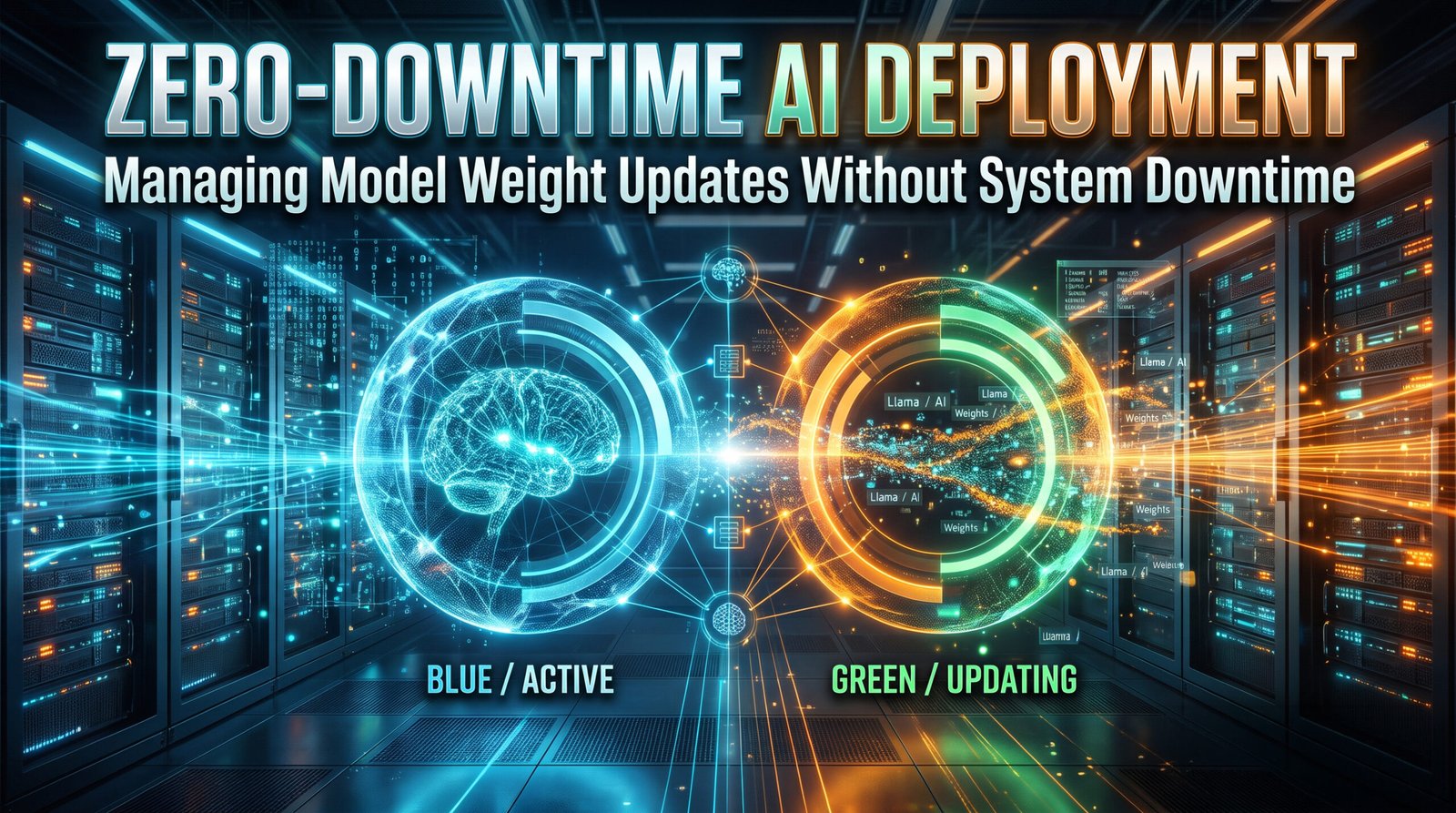
Zero-Downtime AI Deployment: Managing Model Weight Updates Without System Downtime
The operationalization of AI at enterprise scale is no longer just a model development challenge; it is a critical architectural and engineering mandate. For technical leaders, enterprise architects, and Directors of Engineering, transitioning from experimental AI to mission-critical infrastructure introduces rigorous demands on system uptime. One of the most complex challenges in this domain is executing a zero-downtime AI deployment. As organizations constantly refine their models to improve accuracy, reduce hallucinations, or adapt to new enterprise data, the act of updating LLM weights in a live production environment poses significant risks. A dropped connection, an out-of-memory (OOM) error during a model swap, or a momentary spike in latency can cascade into catastrophic system failure for downstream applications.
The Autonomous Enterprise recognizes that overcoming the intelligence bottleneck requires architectural superiority. Marketing hype, theoretical frameworks, and surface-level tutorials offer zero operational value when you are managing multi-gigabyte or terabyte-sized model weights across distributed, highly contested GPU clusters. Updating LLM weights without interrupting user sessions requires a synchronized orchestration of load balancers, container orchestration platforms (like Kubernetes), and specialized model serving frameworks such as KServe, Ray Serve, or vLLM. It demands strict architectural scalability, precise operational intelligence, and a zero-tolerance policy for infrastructure collapse.
For organizations deploying generative AI at scale, treating models as static assets is a failing strategy. Continuous improvement means continuous deployment, which forces engineering teams to confront the reality of stateful model transitions. This post provides the definitive blueprint for managing complex model transitions, synchronizing external knowledge bases, and executing flawless, zero-downtime AI deployments in high-availability enterprise environments.
The Mechanics of Blue-Green AI Deployments
Blue-green deployment is a staple of traditional software engineering, but applying it to enterprise AI introduces massive resource constraints and complex state management challenges. In a standard microservices architecture, spinning up a “green” environment requires minimal CPU and RAM overhead. In contrast, spinning up a green environment for a generative AI application involves provisioning clusters of expensive, highly contested GPUs (such as NVIDIA H100s or A100s) to hold the new multi-billion parameter model weights in memory simultaneously with the “blue” environment.
To execute a zero-downtime AI deployment using the blue-green methodology, infrastructure teams must architect a robust dual-cluster serving layer. The blue environment continues to serve active production traffic using the legacy model weights. Meanwhile, the green environment is provisioned, and the updated LLM weights are loaded into VRAM from persistent blob storage. Because loading massive models over the network into GPU memory can take several minutes, the green environment must be strictly isolated from the enterprise routing mesh until the weight initialization is completely verified.
For teams building the foundation of this architecture, establishing core LLMOps is the prerequisite step. Without robust CI/CD pipelines dedicated specifically to machine learning assets, attempting a live infrastructure swap will inevitably lead to downtime. Once the foundational deployment pipelines are in place, the mechanics shift entirely to traffic routing and state management.
Using an ingress controller or an advanced service mesh like Istio or Envoy, traffic is seamlessly shifted from blue to green only after the green environment passes stringent health checks. These cannot be standard HTTP 200 checks; they must be deep inference probes that verify the model can successfully generate tokens, handle concurrent batching, and that the Key-Value (KV) cache is functioning correctly under load.
- GPU Node Provisioning and Taint Management: Ensure that the Kubernetes scheduler allocates the green pods to nodes with sufficient available GPU memory, utilizing node affinity, taints, and tolerations to prevent scheduling conflicts with the active blue pods. This prevents resource starvation during the transition window.
- Pre-warming the Model and KV Cache: Before any live enterprise traffic is routed to the green environment, synthetic queries must be sent to pre-warm the compute graph and populate the initial KV cache. This ensures that the first live users routed to the new model do not experience a severe latency spike.
- Atomic Traffic Switch and Connection Draining: The service mesh must execute the traffic cutover atomically. Any active inference requests on the blue environment must be allowed to drain naturally (graceful termination), while all new connections are instantly routed to the green endpoints.
- Rapid Rollback Capabilities: If the green environment exhibits unexpected latency, GPU saturation, or semantic degradation upon receiving live traffic, the load balancer must instantly revert routing back to the blue environment. The blue environment remains fully scaled and operational until the green deployment is definitively validated under sustained load.
Canary Releases for New Open-Source Models
While blue-green deployments offer a clean infrastructure cutover, they assume binary success or failure. In the era of rapidly evolving foundation models, replacing an established enterprise model with a fine-tuned variant of a newer open-source release (e.g., migrating from a fine-tuned Llama-2 to Llama-3, or deploying a custom Mistral variant) carries significant semantic risk. A model might pass all synthetic offline benchmarks but fail to capture the nuanced intent of live enterprise users in production. This is where canary releases become critical for updating LLM weights safely and effectively.
A canary deployment strategy mitigates risk by exposing the new open-source model to a tiny fraction of production traffic—often just 1% to 5%—while the vast majority of traffic remains seamlessly routed to the stable model. This approach requires advanced operational intelligence and granular traffic shaping at the API gateway level. The system must be capable of routing specific user segments, tenants, or even specific types of prompts to the canary model based on HTTP headers, JWT claims, or payload inspection.
During a canary release for a new LLM, telemetry and observability are paramount. Technical leaders must monitor entirely different metrics than they would for traditional stateless REST APIs. It is not just about error rates and CPU utilization; it is about inference performance, memory bandwidth utilization, and output quality.
Without strict observability, a canary deployment is just a gamble. Integrating Monitoring LLMs in production environments ensures that degradation is caught before it impacts the broader user base. Engineering teams must continuously track Time to First Token (TTFT), Inter-Token Latency (ITL), and context window saturation rates. If the new open-source model exhibits a higher ITL or begins to hallucinate responses at a higher rate than the baseline, the canary can be automatically scaled down and traffic re-routed without widespread disruption.
To execute a flawless canary deployment for enterprise AI, technical leaders must implement the following architectural patterns:
- Traffic Shadowing (Dark Launching): Before even exposing the canary to live users, production traffic can be duplicated and sent to the new model asynchronously. The responses are logged and compared offline against the production model’s outputs. This allows architects to measure semantic drift and computational cost without any direct user impact.
- Statistical Validation via LLM-as-a-Judge: The canary model must process a statistically significant volume of requests before the deployment is aggressively scaled up. Automated evaluation frameworks can be deployed to score the canary outputs in real-time, verifying that the new weights maintain adherence to corporate guidelines and factual accuracy.
- Progressive and Automated Rollout: Once the canary is validated at 5%, traffic is incrementally increased (e.g., 10%, 25%, 50%, 100%) through automated deployment pipelines driven by real-time metrics. If at any point the error budget is exhausted or GPU memory limits are breached, the rollout is automatically halted and reverted to the stable state.
Synchronizing Vector Stores with New Embeddings
Zero-downtime AI deployment extends far beyond the LLM inference endpoints. Modern enterprise AI systems rely heavily on Retrieval-Augmented Generation (RAG) architectures, which tightly couple the generative model with massive vector databases like Pinecone, Milvus, Qdrant, or Weaviate. When updating LLM weights to a fundamentally new architecture, organizations frequently update their embedding models as well to improve retrieval accuracy and semantic density. This introduces a critical architectural challenge: new embeddings are fundamentally incompatible with the vector space of the legacy database.
You cannot simply hot-swap an embedding model. If a user query is vectorized using a new embedding model, but the enterprise knowledge base remains indexed with the old model’s dimensions, the cosine similarity searches will return complete nonsense, functionally breaking the AI application. Achieving a zero-downtime upgrade in this scenario requires a meticulous dual-writing and background indexing strategy that isolates the transition state from the live application.
The synchronization process begins by deploying the new embedding model alongside the old one as a separate microservice. The vector store must be configured to support versioned indexes or logical collections. A completely new, empty index is created in the background using the new dimensionality and distance metrics (e.g., transitioning from L2 distance to Inner Product). An automated data pipeline then begins the massive computational task of re-embedding millions of enterprise documents using the new model and writing them to the new index.
To maintain absolute system availability during this massive data migration, engineers must rely on strict operational patterns:
- The Dual-Write Pipeline: During the background re-indexing phase, any new documents added to the system by users or automated scrapers must be embedded by both the legacy model (and written to the active index) and the new model (and written to the background index). This critical step ensures that the new index does not become stale while the historical backfill process runs.
- Intelligent Query Routing: Once the background index is fully populated, HNSW graphs are built, and the index is verified, the inference gateway is reconfigured. Incoming queries are routed to the new embedding model, which queries the new vector index. The highly relevant retrieved context is then passed to the newly updated LLM weights.
- Deprecation of Legacy State: The legacy embedding model and the old vector index are kept online for a brief retention period to handle any in-flight asynchronous tasks, delayed batch jobs, or localized fallback routines. Once the system confirms zero operational reliance on the old vector space, the legacy resources are destroyed to optimize cloud compute costs.
Ensuring High Availability During Swaps
At the enterprise level, a zero-downtime AI deployment is ultimately measured by its resilience against infrastructure collapse. Updating LLM weights across a globally distributed, multi-tenant architecture involves orchestrating thousands of GPU nodes, managing Tensor Parallelism (TP) and Pipeline Parallelism (PP) across network boundaries, and mitigating cluster-wide network congestion. Ensuring high availability during these massive state transitions requires implementing robust operational intelligence, aggressive caching layers, and fallback mechanisms that protect the user experience at all costs.
To mitigate deployment failures, enterprise architects must strictly decouple the application layer from the model serving layer. When the underlying model weights are being swapped or scaled, the API gateway must absorb the architectural shock. This is heavily reliant on global caching strategies. Semantic caching frameworks, such as RedisVL or specialized proxy caches, sit directly in front of the inference endpoints. During a model swap window, the cache can aggressively serve historical, exact-match, or highly similar queries, significantly reducing the request load on the GPU clusters while they are in a vulnerable state of transition.
Furthermore, high availability demands the implementation of strict graceful degradation policies. If a weight update triggers a catastrophic OOM error on a subset of nodes, or if cluster interconnects fail during a tensor-parallel deployment, the system must not drop the user session. Instead, requests should be automatically routed to fallback models. These might be smaller, heavily quantized, but highly reliable models (such as an 8B parameter model deployed on less expensive hardware) that are permanently kept warm in the cluster precisely for this disaster recovery scenario.
To guarantee that the infrastructure does not collapse during these high-stress events, teams must enforce the following availability standards:
- Advanced Readiness Probes for AI: In Kubernetes, standard HTTP readiness probes are highly insufficient for LLMs. A pod should only be marked as ready when the multi-gigabyte model weights are fully loaded into GPU memory, the CUDA context is fully initialized, and a test inference pass has successfully completed. This prevents the load balancer from sending live traffic to a container that is still pulling a 40GB weight file from cloud storage.
- Multi-Region Failover Architecture: For global enterprises, updating LLM weights should never occur simultaneously across all geographic regions. Deployments must be staggered across availability zones. If the US-East deployment fails during a weight update, DNS-level routing and global load balancers immediately shift traffic to the US-West cluster, which is still securely running the stable model version.
- Rate Limiting and Load Shedding: During a deployment window, overall system capacity may be temporarily reduced as GPUs are shifted from active serving to weight-loading states. Implementing intelligent load shedding ensures that critical enterprise workloads (e.g., automated financial analysis generation) are prioritized over low-tier or internal requests, preventing cascading performance failures across the entire multi-tenant infrastructure.
Deploying state-of-the-art artificial intelligence at enterprise scale requires a paradigm shift: models must be treated as mission-critical infrastructure, not just research artifacts. Updating LLM weights is a high-risk operation that simultaneously stresses compute, memory bandwidth, networking interconnects, and persistent storage. Organizations can no longer afford to take their systems offline to implement a better algorithm.
By leveraging blue-green methodologies tailored specifically for GPU workloads, deploying canary releases safeguarded by deep, token-level telemetry, and executing seamless dual-write vector synchronizations, technical leaders can successfully eliminate the intelligence bottleneck without sacrificing system stability. The future of enterprise AI belongs to those with the most resilient infrastructure. Organizations that master the deep technical complexities of zero-downtime AI deployment secure a fundamental architectural advantage, allowing them to rapidly iterate on their foundation models and deploy the latest algorithmic breakthroughs directly to production with absolute confidence.



Leave a Reply