
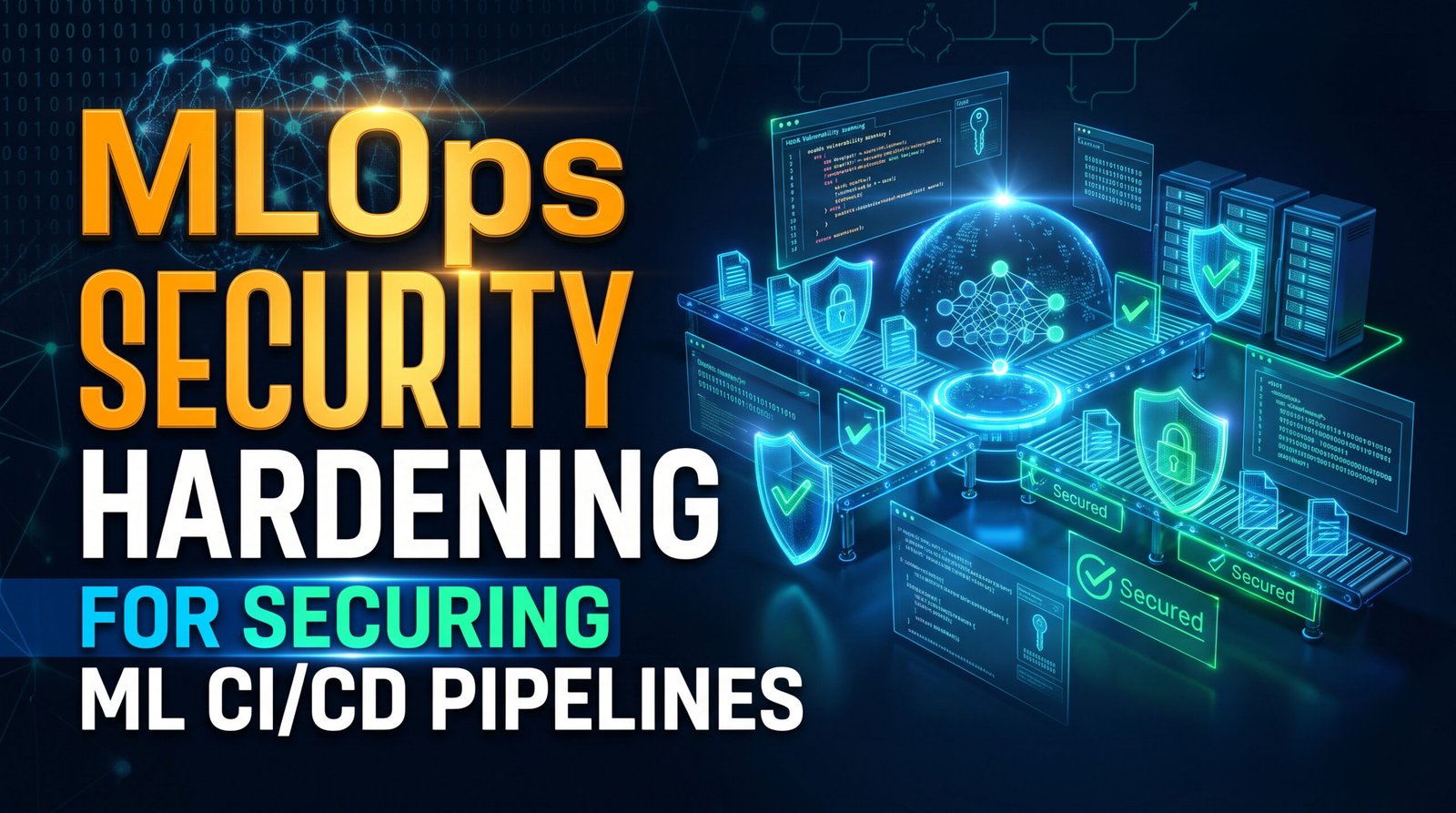
MLOps Security Hardening for Securing ML CI/CD Pipelines
The operationalization of AI at enterprise scale is no longer just a model development challenge; it is a critical architectural and engineering mandate. For Directors, Enterprise Architects, and Technical Leaders tasked with deploying high-availability infrastructure, the traditional software development lifecycle (SDLC) falls fundamentally short when applied to machine learning. Standard continuous integration and continuous deployment (CI/CD) pipelines were designed to compile deterministic code, not to manage massive datasets, probabilistic model weights, and highly distributed training environments. Consequently, achieving true architectural scalability requires integrating rigorous MLOps security directly into the pipeline fabric.
Modern ML systems expose an entirely new attack surface. Threat actors are no longer just looking for exposed endpoints or SQL injection vulnerabilities; they are targeting the ML supply chain itself. From data poisoning and dependency confusion in Python ecosystems to the malicious injection of code via deserialization attacks on model weights, the risks are immense. If an enterprise AI initiative lacks a robust security architecture, a compromised pipeline can lead to infrastructure collapse, massive data exfiltration, or the deployment of a backdoored model that quietly corrupts business intelligence.
To scale AI reliably, technical leaders must eliminate the noise of marketing hype and focus strictly on operational intelligence and risk efficiency. This requires building deployment pipelines that treat models as untrusted artifacts until verified. By embedding security gates throughout the lifecycle, organizations can achieve the speed of automated deployment without sacrificing the integrity of their enterprise infrastructure. The foundation of this approach relies on a mature understanding of MLOps, ensuring that every layer of the technology stack—from the model registry to the orchestration engine—is hardened against advanced threats.
Identifying Vulnerabilities in the MLOps Supply Chain
The MLOps supply chain is exponentially more complex than traditional software because it encompasses three distinct but overlapping lifecycles: code, data, and models. Each of these pipelines introduces unique vulnerabilities that must be systematically identified and mitigated to prevent catastrophic deployment failures.
When assessing vulnerabilities in the MLOps supply chain, enterprise architects must look beyond standard static application security testing (SAST). The threat landscape for machine learning requires a holistic approach that scrutinizes data provenance, third-party libraries, and the integrity of the model training environment.
- Data Pipeline Poisoning: Machine learning models are inherently a reflection of the data they ingest. If an attacker gains access to the data lake, feature store, or data ingestion pipelines, they can introduce subtle anomalies. This “data poisoning” degrades the model’s accuracy or, worse, creates intentional blind spots (backdoors) that the attacker can exploit in production. Securing the CI/CD pipeline requires cryptographic hashing of datasets and strict access controls on the feature store to ensure data immutability.
- Dependency Confusion and Typosquatting: The Python ecosystem, heavily relied upon in ML engineering, is notoriously vulnerable to supply chain attacks. Data scientists frequently pull libraries from public repositories like PyPI. Attackers upload malicious packages with names identical or similar to internal, proprietary enterprise libraries. When a CI/CD runner executes a
pip installwithout a tightly controlled, private artifact registry (such as JFrog Artifactory or AWS CodeArtifact), it may inadvertently pull the malicious package, granting attackers remote code execution within the training environment. - Compromised Model Registries: The model registry (e.g., MLflow, Weights & Biases, Amazon SageMaker Model Registry) is the single source of truth for deployable artifacts. If an attacker compromises the registry, they can swap a validated, highly accurate model with a malicious replica. Pipeline hardening mandates that registries are treated as highly sensitive critical infrastructure, utilizing immutable tags, cryptographic signing, and strict version control.
- Environment Inconsistencies: The gap between a data scientist’s Jupyter notebook and the production Kubernetes cluster is a massive vulnerability zone. Untracked dependencies, ad-hoc scripts, and manual configurations lead to environment drift, making reproducible builds impossible. Containerizing training and deployment environments with minimal, hardened base images is non-negotiable for mitigating these discrepancies.
Addressing these vulnerabilities requires integrating specialized scanning tools directly into the CI/CD runners. Before a model is ever permitted to move from the training phase to the staging environment, the pipeline must automatically verify data provenance, scan all Python dependencies against a continuously updated CVE database, and validate that the environment configuration perfectly matches the enterprise’s architectural scalability blueprints.
Scanning Model Weights for Malicious Injection
One of the most critical and often overlooked aspects of MLOps security is the structure and serialization of the model weights themselves. In traditional software, CI/CD pipelines compile source code into a binary executable, which is then scanned for malware. In machine learning, the “executable” is a massive file containing the learned weights and biases of a neural network. The method used to save and load these weights presents a profound security risk.
The default serialization format for many popular frameworks, notably PyTorch, has historically been Python’s pickle module. The architectural flaw here is that pickle is not simply a data format; it is a program that reconstructs Python objects. When an ML framework unpickles a model file, it executes the instructions contained within it. If an attacker intercepts the model artifact and injects malicious bytecode, unpickling the model in the production environment will result in immediate, arbitrary code execution. This can lead to total cluster takeover, secrets exfiltration, and lateral movement across the enterprise network.
To achieve operational intelligence and mitigate this deployment risk, enterprise architects must enforce strict model weight scanning and formatting standards within the CI/CD pipeline:
- Transition to Safe Serialization Formats: The most immediate architectural shift is to ban the use of
picklefor model serialization. The industry is rapidly adoptingsafetensors, a format developed by Hugging Face that stores tensors safely without executing any code. CI/CD pipelines should feature a hard gate that immediately fails the build if a.pklor.binfile is detected, forcing data science teams to save and export models exclusively insafetensorsor ONNX (Open Neural Network Exchange) formats. - Automated Malware Scanning: Just as container images are scanned for vulnerabilities, model artifacts must be scanned for known malware signatures and malicious payloads before being committed to the registry. Integrating tools like ClamAV, Protect AI’s ModelScan, or custom Yara rules into the CI/CD pipeline ensures that any anomaly is flagged. The pipeline should automatically quarantine suspicious models and trigger automated incident response protocols.
- Cryptographic Signing and Verification: To ensure that a model has not been tampered with between the training phase and production deployment, the pipeline must cryptographically sign the model weights. Using frameworks like Sigstore (Cosign), the CI runner signs the artifact and pushes the signature to an immutable ledger. When the Kubernetes deployment controller attempts to pull the model, an admission controller (like Kyverno or OPA Gatekeeper) verifies the signature. If the signature is invalid or missing, the deployment is blocked, ensuring cost and risk efficiency by preventing compromised code from reaching production.
- Provenance and Attestation (SLSA): Implementing Supply Chain Levels for Software Artifacts (SLSA) frameworks for machine learning involves generating attestations that definitively state who trained the model, on what infrastructure, using what data, and precisely when. This metadata travels with the model weights, providing auditors and security teams with complete visibility into the artifact’s origins.
Securing API Keys in the Orchestration Layer
Machine learning workflows are intensely API-driven. From pulling data out of Snowflake or AWS S3, to interfacing with third-party foundational models, tracking experiments in MLflow, and provisioning GPU nodes via Kubernetes, the orchestration layer requires a vast array of credentials, tokens, and API keys. Securing these secrets is a foundational pillar of MLOps security hardening.
The orchestration layer—typically managed by tools like Kubeflow, Apache Airflow, or Argo Workflows—acts as the nervous system of the ML CI/CD pipeline. If an attacker gains access to this layer, they gain access to the entire enterprise cloud architecture. A common, highly dangerous anti-pattern is the hardcoding of API keys directly into training scripts, Dockerfiles, or Jupyter notebooks, which are subsequently committed to Git repositories.
To eliminate this risk and ensure architectural scalability, technical leaders must implement dynamic, ephemeral secrets management seamlessly integrated into the CI/CD orchestration layer:
- Centralized Secrets Vaults: No credentials should ever exist in plaintext within the codebase or the CI/CD configuration files. Enterprises must deploy a centralized secrets management solution, such as HashiCorp Vault, AWS Secrets Manager, or Azure Key Vault. The CI/CD runners and the orchestration engine must authenticate with the vault using trusted identities to retrieve secrets at runtime.
- Ephemeral and Time-Bound Credentials: Long-lived static API keys are a massive liability. If a developer’s laptop is compromised or a log file inadvertently prints a key, an attacker has perpetual access until the key is manually revoked. Hardening the pipeline requires the use of dynamic, ephemeral credentials. When a training job spins up, the orchestration engine requests a temporary token that is strictly valid only for the duration of the job (e.g., 2 hours). Once the job completes or fails, the credential evaporates, drastically reducing the attack surface.
- OIDC Integration and Workload Identity: In modern cloud-native deployments, passing secrets around can be minimized by using OpenID Connect (OIDC) and workload identity federation. Instead of storing AWS IAM keys in a GitHub Actions secret, the pipeline assumes a highly restricted IAM role directly via OIDC. In a Kubernetes environment (like EKS or GKE), pods running training jobs are assigned specific service accounts tied to cloud IAM roles, ensuring that access to S3 buckets or database instances is managed seamlessly without exchanging static keys.
- Secrets Scanning in the CI Pipeline: As a preventative measure against human error, the CI/CD pipeline must include a pre-commit and post-commit secrets scanning step. Tools like TruffleHog or GitLeaks should scan every pull request. If a suspected API key, token, or password is detected in the diff, the commit is rejected, the build fails, and an alert is sent to the security operations center (SOC).
- Restricting Notebook Environments: Data scientists often prioritize rapid experimentation over security, leading to the creation of `.env` files laden with production keys. Enterprise architects must provide secure, managed notebook environments (e.g., SageMaker Studio, Vertex AI Workbench) that inherently leverage workload identities, removing the need for data scientists to handle API keys manually altogether.
Role-Based Access Control for Model Deployment
The culmination of the ML CI/CD pipeline is the deployment of the model into a live production environment. Whether deploying a traditional XGBoost model for fraud detection or managing complex generative AI fleets, the transition from staging to production must be governed by strict, cryptographically enforced Role-Based Access Control (RBAC). The principle of least privilege must be applied not just to human users, but to every service account, pipeline runner, and deployment controller.
In many immature organizations, the data scientist who trains the model also holds the permissions to push that model into the production cluster. This lack of separation of duties is a critical risk failure. If the data scientist’s account is compromised, the attacker has a direct path to production. Furthermore, Monitoring LLMs in production environments requires distinct operational telemetry that should be managed by infrastructure teams, not necessarily model developers.
To build a hardened deployment pipeline, technical leaders must architect granular RBAC policies that reflect the specific personas and stages of the MLOps lifecycle:
- Separation of Duties (SoD): The deployment architecture must strictly separate the roles of Model Creator (Data Scientist), Pipeline Executor (ML Engineer/DevOps), and Production Approver (SecOps/Lead Architect). A data scientist can experiment, train, and push a model to a development registry. However, the CI/CD service account is the only entity permitted to move the model to the production registry after passing all automated security scans. Finally, moving the model into the live serving infrastructure requires a manual approval gate governed by a different set of credentials.
- Namespace Isolation in Kubernetes: For containerized ML deployments, the orchestration cluster must be heavily partitioned using Kubernetes namespaces. Development, staging, and production environments should exist in separate namespaces with stringent Network Policies. A training job in the `ml-dev` namespace must be physically and logically prevented from communicating with the `ml-prod` model serving namespace. RBAC policies must dictate that developers only have read/write access to `ml-dev`, while `ml-prod` is immutable and only accessible by the automated CD deployment controller (e.g., ArgoCD).
- Zero-Trust Deployment Pipelines: The CI/CD pipeline itself must operate under a zero-trust model. Just because a request originates from the internal CI runner does not mean it should be blindly trusted. The deployment engine must verify the SLSA attestations, the cryptographic signatures of the model weights, and the vulnerability scan reports before initiating the deployment rollout (such as a canary or blue/green deployment).
- Auditing and Compliance Telemetry: Every action taken within the model registry and the deployment environment must be logged and monitored. If an API key is rotated, if a user’s RBAC permissions are elevated, or if a model is deployed, the event must be pushed to a centralized SIEM (Security Information and Event Management) system. This immutable audit trail is essential for forensic analysis in the event of an incident and is a strict requirement for enterprise compliance frameworks (SOC2, HIPAA, GDPR).
In conclusion, the future of enterprise AI belongs to organizations that treat machine learning infrastructure not as a science experiment, but as highly secure, mission-critical engineering. Securing ML CI/CD pipelines demands a departure from legacy security postures. By rigorously identifying supply chain vulnerabilities, scanning model weights to prevent malicious execution, enforcing dynamic secrets management in the orchestration layer, and strictly partitioning deployments via RBAC, technical leaders can prevent infrastructure collapse. Implementing these architectural advantages ensures that enterprise AI initiatives scale with absolute cost and risk efficiency, transforming theoretical models into robust, reliable, and secure autonomous systems.


Leave a Reply