
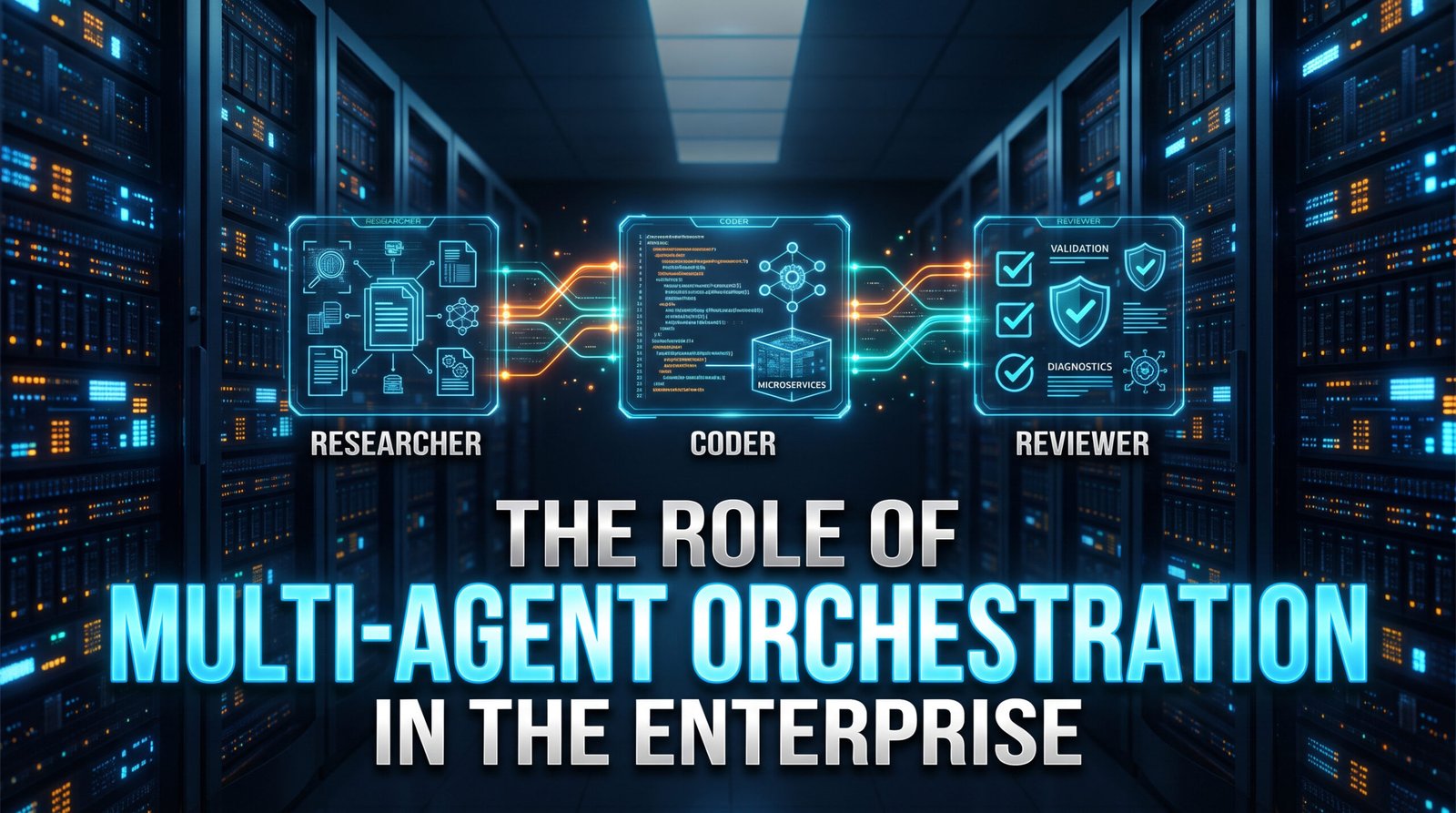
The Role of Multi-Agent Orchestration in the Enterprise
The operationalization of AI at enterprise scale is no longer just a model development challenge; it is a critical architectural and engineering mandate. For the past two years, technical leaders have been inundated with marketing hype, theoretical frameworks, and monolithic language models that offer surface-level utility but zero operational reliability when subjected to the rigors of production environments. The reality facing Directors, Enterprise Architects, and Technical Leaders is stark: relying on a single, isolated Large Language Model (LLM) to execute complex, multi-step enterprise workflows is an architectural anti-pattern. This is where multi-agent orchestration becomes the definitive blueprint for the modern, high-functioning organization.
We are witnessing a fundamental paradigm shift away from fragile prompt engineering toward robust, distributed cognitive architectures. The future of enterprise AI belongs to those with the most robust infrastructure, and that infrastructure must now support autonomous entities that collaborate, critique, and execute asynchronously. In this comprehensive technical analysis, we will deconstruct the underlying engineering principles of enterprise multi-agent systems, moving past the noise to extract only the battle-tested intelligence required to deploy and scale AI reliably.
Moving from Single to Multi-Agent Systems
The limitations of single-agent systems become catastrophically apparent when deployed in enterprise environments that demand high availability and zero-tolerance for logical degradation. A standalone model operating within a basic wrapper is constrained by its context window, subject to hallucination loops, and fundamentally incapable of true parallel execution. When tasked with a multifaceted directive—such as migrating a legacy database while simultaneously writing unit tests and generating compliance documentation—a single agent must process these requirements sequentially. This sequential processing not only creates immense compute overhead but also drastically increases the probability of task failure as context degrades over thousands of tokens.
Transitioning to enterprise multi-agent systems resolves this intelligence bottleneck through the architectural principle of separation of concerns. Instead of forcing one model to be a generalist, we deploy specialized, tightly scoped agents designed for specific functional domains. This modularity allows Enterprise Architects to swap out underlying models based on task requirements—routing complex reasoning tasks to a massive parameterized model while delegating simple formatting tasks to a smaller, cost-efficient, low-latency model. This strategy directly mitigates deployment failures and reduces cloud compute costs.
Furthermore, moving to a multi-agent topology introduces native fault tolerance. If a single agent fails or encounters an API rate limit, the orchestration layer can gracefully degrade, retry, or reroute the task without collapsing the entire workflow. This resilience is a non-negotiable requirement for true Agentic AI architectures. By isolating variables and parallelizing workloads, organizations achieve a measurable ROI potential that justifies the necessary infrastructure investments. We transition from a state of fragile linear execution to a robust, directed acyclic graph (DAG) of cognitive processing.
Defining Roles: Researcher, Coder, and Reviewer Agents
To successfully operationalize multi-agent orchestration, technical leaders must treat AI agents not as monolithic tools, but as specialized microservices. Just as engineering teams are divided into distinct disciplines, a robust autonomous system requires strict role definitions to maintain operational intelligence and mitigate deployment failures. The most fundamental triad in enterprise development workflows consists of the Researcher, the Coder, and the Reviewer.
The Researcher Agent
The Researcher Agent is the vanguard of the operation, tasked with data aggregation, context retrieval, and scope definition. Operating primarily through advanced Retrieval-Augmented Generation (RAG) pipelines, this agent interfaces with global caching layers, vector databases, and enterprise knowledge graphs. Its primary function is to gather highly accurate, context-specific telemetry and documentation. The Researcher must be engineered to aggressively filter noise, verifying the veracity of its sources before passing state down the pipeline. From an infrastructure perspective, this agent requires high-bandwidth access to internal data lakes and secure APIs, utilizing strict multi-tenancy rules to ensure data leakage across enterprise siloes does not occur.
The Coder Agent
Once the Researcher has established the factual and contextual boundaries, the payload is handed off to the Coder Agent. This entity is responsible for execution, script generation, and direct interaction with enterprise cloud architecture. The Coder operates within tightly controlled ephemeral environments (such as sandboxed Kubernetes pods) to prevent infrastructure collapse in the event of malicious or erroneous code execution. When designing AI agents for enterprise, the Coder must be decoupled from broad internet access, operating strictly on the sanitized parameters provided by the Researcher. This specialization allows the Coder to leverage models fine-tuned specifically for syntax, structural logic, and API integration, maximizing cost efficiency.
The Reviewer Agent
The Reviewer Agent acts as the final gatekeeper, providing a critical layer of automated incident response and risk mitigation. Unlike traditional CI/CD pipelines that rely on static analysis, the Reviewer Agent applies dynamic cognitive critique to the Coder’s output. It evaluates the execution against the original directive, checks for edge-case vulnerabilities, assesses compute overhead, and ensures compliance with enterprise architectural standards. If the Reviewer detects a flaw, it does not simply fail the build; it generates detailed, highly-specific feedback and routes the task back to the Coder for remediation. This continuous, autonomous feedback loop is the hallmark of high-signal, battle-tested AI infrastructure.
How Agents Communicate and Resolve Conflicts
The efficacy of multi-agent orchestration hinges entirely on the underlying communication protocols and conflict resolution mechanisms. If agents cannot efficiently share state or reconcile differing outputs, the system will rapidly devolve into deadlock, rendering it useless for enterprise applications. Advanced telemetry and operational intelligence must be embedded deeply into the communication layer.
State Management and Communication Topologies
In enterprise architecture, relying on simple conversational memory is insufficient. Enterprise multi-agent systems require robust, scalable infrastructure for state management. This is typically achieved through event-driven architectures utilizing message brokers like Apache Kafka or RabbitMQ, combined with high-speed shared memory stores like Redis.
- Hierarchical Topologies: A Supervisor Agent acts as the central router, dispatching tasks to worker agents and aggregating their responses. This is highly controllable and secure, but can create a single point of failure and latency bottlenecks if the orchestrator is not scaled properly.
- Peer-to-Peer (Graph) Topologies: Agents communicate directly with one another based on predefined event triggers. While this allows for massive parallelization and speed, it requires stringent global caching and advanced telemetry to monitor the asynchronous web of interactions and prevent cyclical logic loops.
Resolving Autonomous Conflicts
Conflict is inevitable when multiple autonomous entities are introduced into a workflow. For instance, a Coder Agent might prioritize optimization, while a Reviewer Agent strictly enforces legacy security policies, resulting in a stalemate. To mitigate this risk, architects must implement programmatic consensus algorithms.
One proven pattern is the integration of an Arbiter Model—a lightweight, purely logical LLM whose sole function is to evaluate deadlocks based on a strict enterprise scoring rubric. Another approach is programmatic decaying constraints: if agents fail to reach consensus after a defined number of iterations, the strictness of the prompt is dynamically relaxed, or the system escalates the issue to a human-in-the-loop (HITL) via automated incident response integrations with platforms like PagerDuty or Jira. By treating agentic conflict as a standard infrastructure timeout rather than a model failure, teams can maintain high availability.
Infrastructure Requirements for Orchestration
Theoretical frameworks for multi-agent systems often gloss over the brutal realities of hardware, networking, and cloud economics. Deploying multi-agent orchestration at scale requires uncompromising infrastructure. If a deployment does not present a measurable ROI potential and a fundamental architectural advantage, it is merely an expensive science experiment. To achieve the Autonomous Enterprise, technical leaders must focus on three core infrastructure pillars: compute elasticity, security isolation, and advanced telemetry.
Compute Elasticity and Cost Efficiency
Multi-agent workflows are notoriously spiky in their compute demands. A single user request might spawn twenty asynchronous agent interactions in a matter of seconds. Relying on static infrastructure or standard provisioned throughput will result in either massive cost overruns or catastrophic rate limits. Organizations must adopt cloud-native deployments utilizing Kubernetes operators specifically designed for LLM orchestration. These operators dynamically spin up ephemeral agent pods just-in-time, execute the workload, and instantly scale down to zero. Furthermore, architects must implement semantic global caching. By caching the vectors of previous multi-agent conclusions, organizations can drastically reduce compute overhead, bypassing the orchestration layer entirely for mathematically similar requests.
Security Isolation and Multi-Tenancy
When autonomous systems are granted read/write access to enterprise environments, the blast radius of a compromised or hallucinating agent is severe. Strict multi-tenancy and zero-trust architectures are mandatory. Each agent must operate with the principle of least privilege, authenticated via short-lived, dynamically generated IAM tokens. Network policies must physically isolate the compute environments of the Researcher (which may touch external data) from the Coder (which touches internal databases). VPC peering and private link connections should be utilized to ensure that agent-to-agent communication never traverses the public internet, thereby preventing data exfiltration and ensuring SOC2/HIPAA compliance.
Advanced Telemetry and Observability
You cannot manage what you cannot observe. Standard APM (Application Performance Monitoring) tools are insufficient for enterprise multi-agent systems, as they track system metrics but not cognitive flow. Technical leaders must deploy specialized AI telemetry that logs the exact prompts, responses, latency, and token consumption of every individual agent in the graph. This operational intelligence allows engineering teams to visualize the entire DAG execution path in real-time.
When a deployment failure occurs, architects need to know immediately whether it was a vector database latency spike, a model rate limit, or a logical hallucination by the Reviewer Agent. By aggregating this telemetry into platforms like Datadog or Prometheus, teams can build automated incident response workflows that automatically failover to backup models (e.g., swapping from a high-parameter primary model to an open-source fallback) without dropping the user session. This level of rigor ensures that the multi-agent system remains a highly available, battle-tested asset rather than a brittle prototype.
The transition to multi-agent architectures is not merely an upgrade in AI capability; it is a fundamental restructuring of enterprise engineering. By strictly adhering to these architectural patterns—enforcing role separation, building resilient communication layers, and investing in scalable, observable infrastructure—organizations can eliminate the intelligence bottleneck. The future belongs to those who build the foundation today.



Leave a Reply