
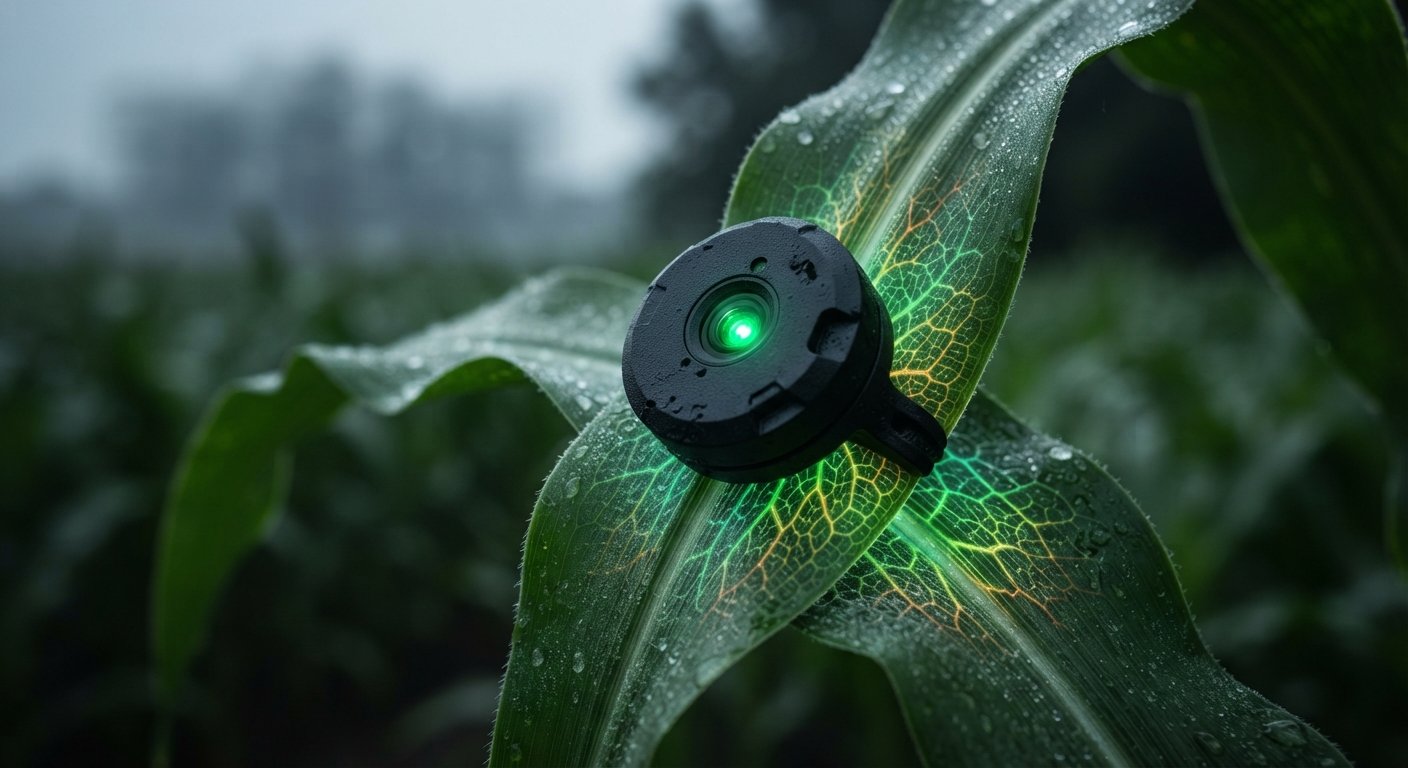
Edge AI Decouples Crop Health Diagnosis from Cloud: Quantized VLMs Deliver Sub-Second Insights Offline
Key Enterprise Leader Takeaways
- Edge Autonomy: PlantVLM-Edge enables sophisticated VLM-driven crop health diagnosis directly on resource-constrained edge devices, eliminating cloud dependency for critical field operations.
- Performance Breakthrough: Achieves 98.6% full-precision answer quality with 4-bit quantization, reducing VLM weight memory by 49% and delivering a 64-token response in under 0.8 seconds.
- Strategic Democratization: This framework democratizes expert agricultural knowledge, making advanced diagnostic and management guidance accessible to growers in remote areas, fostering sustainable production.
- Architectural Flexibility: The backbone-agnostic design supports various VLM types and scales, offering enterprises a flexible foundation for next-generation, on-device AI applications beyond agriculture.
The AI Strategic Shift
This development marks a significant strategic shift towards truly autonomous edge AI, moving sophisticated vision-language models from data centers to the point of need. By enabling high-fidelity, real-time diagnostics directly on resource-constrained devices without cloud connectivity, PlantVLM-Edge fundamentally redefines operational paradigms in sectors like agriculture. This decentralization of expert intelligence promises substantial ROI through increased operational efficiency, reduced latency, and enhanced resilience in remote environments, making advanced AI accessible where it previously wasn’t feasible.
Strategic Analysis
The advent of PlantVLM-Edge represents a critical inflection point for enterprise AI architecture, particularly for organizations operating in distributed or remote environments. Historically, deploying powerful vision-language models (VLMs) on edge devices has been a computational and memory bottleneck, necessitating constant cloud connectivity for inference. PlantVLM-Edge shatters this dependency by demonstrating that highly accurate, conversational VLM capabilities can run entirely on resource-constrained edge hardware, even offline.
The core innovation lies in its robust quantization framework, which achieves a remarkable 98.6% of full-precision answer quality with 4-bit activation-aware weight quantization (AWQ), while drastically reducing VLM weight memory by 49% for a 2B backbone. This is not merely an incremental improvement; it’s a paradigm shift for optimizing inference strategy and slashing operational costs associated with cloud egress and continuous connectivity. For C-Suite executives, this translates directly into enhanced operational resilience, reduced latency for critical decision-making, and a significant reduction in total cost of ownership for AI deployments in the field.
Beyond agriculture, the implications for industrial IoT, remote diagnostics, and field service operations are profound. Imagine maintenance technicians receiving expert-level diagnostic guidance for complex machinery in remote locations, or autonomous inspection systems providing real-time, conversational insights without a network connection. The backbone-agnostic nature of PlantVLM-Edge, validated across different VLM types and scales, offers enterprises a flexible blueprint for deploying customized, high-performance AI at the very edge of their operations. This capability also complements efforts to reduce VLM post-training costs, making the entire lifecycle of edge VLM deployment more economically viable. While PlantVLM-Edge focuses on standalone edge deployment, its success paves the way for future federated learning and agentic AI systems that can collaboratively learn and operate across distributed edge networks, further enhancing collective intelligence and adaptability.
The Bottom Line and ROI Potential
This development signals a clear mandate for enterprise leaders to re-evaluate their AI deployment strategies, particularly for use cases demanding real-time insights, operational autonomy, and resilience in connectivity-challenged environments. The era of cloud-dependent AI for every task is rapidly evolving towards a more intelligent, distributed architecture.
Here are concrete steps for your enterprise:
- Pilot Edge AI for Critical Operations: Identify mission-critical field operations or remote assets where real-time, offline AI diagnostics or guidance could significantly improve efficiency, safety, or uptime. Initiate pilot programs leveraging quantized VLM frameworks.
- Invest in Edge-Native MLOps Capabilities: Prioritize building internal expertise or partnering with specialists in model quantization, on-device serving, and efficient inference optimization to maximize the performance and cost-effectiveness of edge AI deployments.
- Assess Cloud Dependency & Resilience: Conduct a thorough audit of current AI-driven processes that rely heavily on cloud connectivity. Evaluate the potential for migrating critical components to an edge-native architecture to enhance resilience, reduce latency, and mitigate data transfer costs.
- Explore Cross-Sector Applications: Look beyond immediate industry parallels. The principles demonstrated by PlantVLM-Edge are transferable to diverse sectors, from manufacturing quality control and infrastructure monitoring to healthcare diagnostics in remote clinics.
By taking these actions, enterprises can unlock substantial ROI through reduced operational expenditures (e.g., lower cloud costs, less downtime), accelerated decision-making, enhanced service delivery in underserved areas, and the creation of entirely new, highly resilient product and service offerings that differentiate them in a competitive landscape.



Leave a Reply