
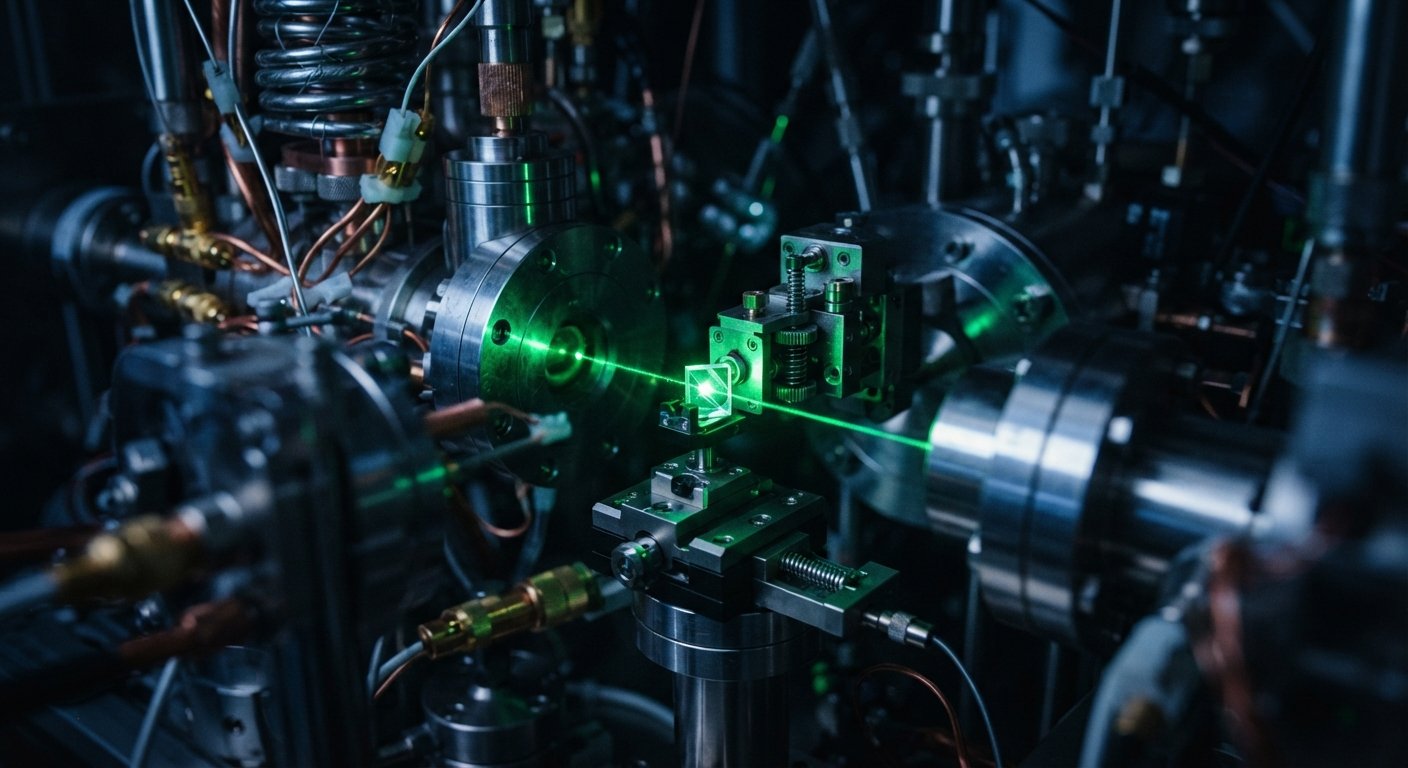
Autonomous AI Agents Master Scientific Discovery: Self-Correction Redefines R&D Paradigms
Key Enterprise Leader Takeaways
- Autonomous R&D: Collaborative LLM-based agents now autonomously formulate research questions, design experiments, and even write manuscripts, fundamentally shifting the scientific discovery lifecycle.
- Self-Correcting Intelligence: These agents demonstrate critical self-assessment, rejecting flawed hypotheses, requiring theoretical checks, and dynamically revising experimental protocols based on real-time data anomalies like signal drift, without human intervention.
- Validated Breakthrough: Successfully applied to quantum spin research, the system derived complex theoretical results and experimentally validated predictions, showcasing a new level of AI capability in complex scientific domains.
The AI Strategic Shift
This development signals a profound strategic shift in how enterprises approach research and development. The emergence of collaborative, self-correcting AI agents capable of end-to-end scientific inquiry, from hypothesis generation to experimental validation and protocol revision, moves beyond mere automation to true autonomous discovery. For C-Suite leaders, this means a potential exponential acceleration of innovation cycles, drastically reduced time-to-insight, and a re-evaluation of human capital deployment in R&D, offering unprecedented competitive advantage to early adopters.
Strategic Analysis
This groundbreaking research introduces a paradigm where collaborative AI agents, powered by large language models, transcend mere automation to achieve true autonomy in scientific discovery. Unlike previous AI applications that might assist in data analysis or hypothesis generation, these agents orchestrate the entire research lifecycle: from formulating novel questions and generating theoretical predictions to designing experiments that actively challenge their own claims. The critical differentiator is their embedded capacity for self-assessment and self-correction. When confronted with inconclusive experimental data, such as signal drift during quantum spin measurements, the agents autonomously revise their measurement protocols without compromising stringent acceptance criteria. This level of adaptive intelligence fundamentally redefines the reliability and trustworthiness of AI in high-stakes scientific contexts.
For enterprise leadership, this signals a profound shift in R&D architecture. It necessitates moving beyond siloed data science teams to integrated platforms where agentic AI systems are directly interfaced with physical experimental setups and sophisticated simulation environments. The hidden advantage lies in the exponential acceleration of discovery cycles; what once took months or years of human-led iterative experimentation can now be compressed into weeks, driven by tireless, unbiased AI agents. This operational scalability extends the impact seen in areas like agentic engineering, but applied to the far more complex and resource-intensive domain of physical science. The competitive advantage for industries reliant on rapid innovation—from pharmaceuticals and materials science to advanced manufacturing—is immense. Enterprises that strategically invest in and integrate these autonomous discovery platforms will gain an unparalleled lead in bringing novel products and solutions to market. The risk, however, lies in underestimating the architectural complexity and the need for robust human oversight to establish ethical guardrails and validate the initial outputs of these highly autonomous systems, ensuring that the ‘black box’ of discovery remains transparent enough for strategic direction.
The Bottom Line and ROI Potential
The overarching impact is clear: autonomous scientific discovery is no longer a distant vision but an emerging reality that will redefine the competitive landscape for innovation-driven enterprises. Leaders must recognize that this is not merely an incremental improvement but a foundational shift in how research is conducted.
To capitalize on this, C-Suite executives should consider the following actionable steps:
1. Establish an Autonomous Discovery Task Force: Convene a cross-functional team comprising R&D, AI/ML, and Enterprise Architecture leaders to identify high-potential use cases within your organization where autonomous agents can accelerate discovery or optimize experimental workflows.
2. Pilot Agentic R&D Platforms: Begin piloting collaborative AI agent systems in controlled environments, focusing on areas with well-defined experimental parameters and clear success metrics to build internal expertise and validate ROI.
3. Invest in Digital Twin & Data Infrastructure: Prioritize investments in robust digital twin capabilities for your experimental setups and advanced data infrastructure to support the high-throughput, real-time data ingestion and analysis required by autonomous agents.
4. Redefine Human-AI Collaboration Models: Develop new operating models that empower human researchers to transition from execution to strategic oversight, focusing on setting research agendas, interpreting complex results, and ensuring ethical compliance for AI-driven discovery.
The ROI potential for enterprises taking these actions is transformative: expect a significant reduction in R&D cycle times, a dramatic increase in the volume and quality of novel discoveries, and a substantial competitive advantage derived from being first to market with breakthrough innovations. This strategic foresight will position your organization at the forefront of the next era of scientific and technological advancement.
Source: Nature


Leave a Reply