
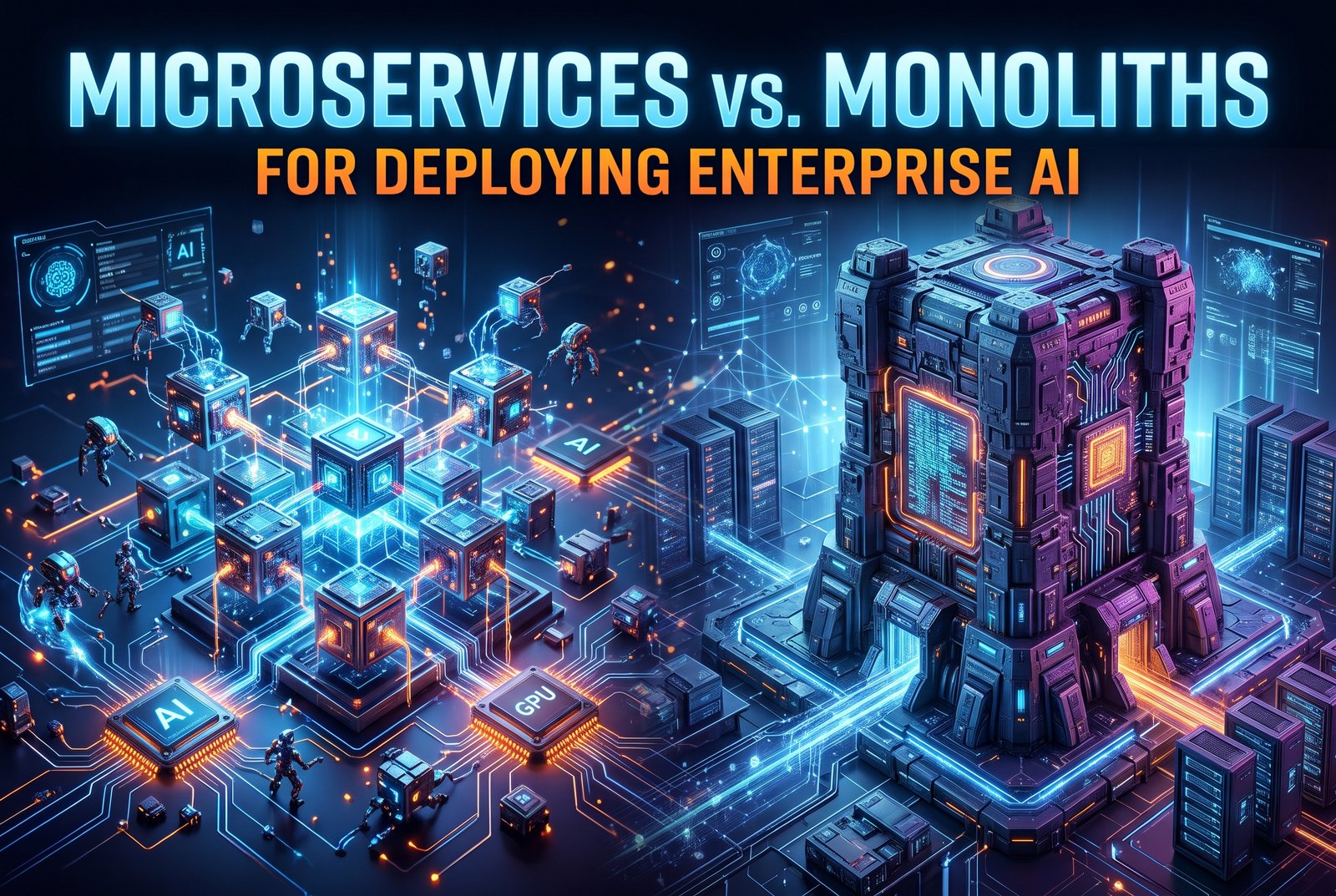
Microservices for AI vs. Monoliths for Deploying Enterprise AI
The operationalization of artificial intelligence at enterprise scale is no longer merely a model development challenge; it is a critical, complex architectural and engineering mandate. As organizations move beyond theoretical frameworks and sandbox environments into high-stakes production, technical leaders—Directors, Enterprise Architects, and VP-level engineers—are confronted with fundamental design decisions that will dictate the future scalability, reliability, and cost-efficiency of their AI initiatives. Among the most consequential of these decisions is selecting the appropriate structural foundation: should you rely on traditional monolithic architectures or transition to distributed microservices?
For years, software engineering has leaned heavily toward microservices for modern web applications, but the integration of Large Language Models (LLMs), dense neural networks, and generative AI pipelines introduces entirely new dimensions of complexity. AI workloads require heterogeneous compute resources, massive memory bandwidth, and strict latency budgets that traditional web applications do not. The sheer size of enterprise AI models—often consuming tens or hundreds of gigabytes of GPU VRAM—means that infrastructure design cannot be an afterthought. It is the very bottleneck that determines whether an AI deployment drives measurable ROI or results in catastrophic infrastructure collapse.
At Autonomous Enterprise, we strictly filter the noise of the MLOps landscape to focus on battle-tested intelligence. A fundamental architectural advantage is required to survive in the AI era. When evaluating the core components of your Enterprise Architecture, the decision between microservices and monoliths for AI deployment dictates your ability to scale compute dynamically, isolate faults gracefully, and mitigate the spiraling costs of cloud infrastructure. In this comprehensive technical briefing, we dissect the competing paradigms of monolithic and microservices architectures specifically through the lens of enterprise AI deployment.
Analyzing the Monolithic AI Approach
Historically, when data science teams first transition a model from a Jupyter Notebook to a production endpoint, the natural tendency is to package the entire workflow into a single, monolithic application. In a monolithic AI deployment architecture, the web server, the business logic, the data preprocessing pipelines, the feature engineering modules, and the machine learning model serving layer are tightly coupled and compiled into a single unified codebase and execution environment.
On the surface, this approach offers seductive simplicity. A monolith requires only a single deployment pipeline. There is only one codebase to version control, one overarching environment to manage, and debugging can be performed within a unified stack. Furthermore, because all components reside within the same memory space, the network latency between the application logic and the AI inference engine is effectively zero. Function calls between the data processing layer and the neural network happen in-memory, avoiding the serialization and deserialization overhead associated with network requests.
However, when applied to enterprise-grade AI, the monolithic architecture rapidly devolves into an operational nightmare. The primary fatal flaw lies in the inability to scale heterogeneous resources independently. Consider an application where a web interface handles thousands of concurrent user requests, but only a fraction of those requests trigger a complex LLM inference. In a monolith, to scale the web interface to handle high traffic, you must replicate the entire application container. Because the application includes the massive AI model, every new instance demands expensive, high-tier GPU instances, even if the GPU is sitting idle 90% of the time. This results in devastating compute waste and massive cloud overhead.
Beyond resource scaling, monolithic AI deployments suffer from what is known as “dependency hell.” Modern AI frameworks like PyTorch, TensorFlow, and Hugging Face Transformers require highly specific, rigid underlying dependencies, including exact versions of CUDA toolkits, cuDNN libraries, and hardware-specific drivers. When you bind your standard enterprise business logic (which may require frequent updates for UI or database changes) to your AI inference logic (which requires stable, fragile ML environments), you create a brittle system. A minor update to a standard web library could inadvertently conflict with the model’s dependencies, bringing down the entire application.
Furthermore, monoliths lack fault isolation. If a memory leak occurs during a complex tensor operation, or if a malformed payload causes an Out-Of-Memory (OOM) error on the GPU, the entire monolith crashes. The web interface, the database connectors, and the user sessions are all destroyed because a single inference request failed. For organizations demanding high-availability infrastructure, this total system vulnerability is an unacceptable risk.
Why Microservices Excel in LLM Deployments
To solve the intelligence bottleneck and achieve true architectural scalability, technical leaders must pivot toward a microservices-based AI deployment architecture. In this paradigm, an application is decomposed into loosely coupled, highly cohesive services that communicate over robust network protocols. For AI, this means explicitly separating model serving (inference) from business logic, data routing, and user interfaces.
The operational value of Microservices for AI cannot be overstated, particularly when deploying Large Language Models. The challenge of Scaling LLMs in enterprise systems necessitates a decoupled approach where specific components can leverage purpose-built hardware. By extracting the LLM into its own dedicated microservice—often managed by specialized inference servers like NVIDIA Triton Inference Server, vLLM, or Ray Serve—enterprise architects unlock independent scaling.
Independent scalability is the linchpin of cost-efficient AI infrastructure. With a microservices architecture, you can deploy your lightweight API gateway and business logic on inexpensive, highly available CPU clusters. Meanwhile, your heavy LLM inference microservice resides exclusively on expensive, specialized GPU nodes. If user traffic spikes, you can scale out the CPU-based services instantly and cheaply. If the volume of complex token-generation requests increases, you can scale the GPU nodes independently, relying on advanced metrics like concurrent request queues or KV-cache utilization to trigger autoscaling.
This decoupling also enables unparalleled agility in model lifecycle management. In an enterprise environment, data science teams frequently iterate on models. They may want to shadow-test a quantized Llama 3 model against an existing Mixtral model, or deploy a specialized fine-tuned adapter for a specific business unit. Microservices enable seamless A/B testing and canary deployments. A central API gateway can dynamically route a percentage of inference requests to the new model microservice without requiring any downtime or redeployment of the core application.
Moreover, fault isolation is dramatically improved. If an LLM microservice exhausts its GPU VRAM and crashes under the weight of a massive context window, the failure is contained. The overarching application remains operational; the API gateway can gracefully catch the timeout, alert the automated incident response system, and either serve a cached response, fallback to a smaller auxiliary model, or return a clean error message to the user, all while the primary ML orchestration platform automatically spins up a replacement GPU pod.
Containerization Strategies (Docker and Kubernetes)
The foundation of distributed AI microservices relies heavily on advanced containerization and orchestration strategies. While containerizing standard web applications is a solved problem, containerizing enterprise AI workloads introduces severe complexities regarding image bloat, hardware pass-through, and orchestration logic.
Docker serves as the fundamental building block. However, naively building Docker images for AI microservices often results in container images exceeding 10GB due to the inclusion of massive machine learning frameworks and model weights. Elite engineering teams employ multi-stage Docker builds to strip out unnecessary build dependencies, ensuring the final runtime image is as lean as possible. Furthermore, enterprise architects must decouple model weights from the container image entirely. Baking a 40GB LLM into a Docker image creates insurmountable bottlenecks in CI/CD pipelines and deployment times. Instead, the Docker container should only house the inference engine and API logic, while the model weights are mounted dynamically at runtime via network-attached storage (like Amazon EFS or GCP Filestore) or specialized distributed caching layers.
For orchestration, Kubernetes (K8s) is the undisputed standard, but orchestrating microservices for AI requires extending Kubernetes far beyond its default capabilities. Technical leaders must leverage the Kubernetes Device Plugin framework, specifically the NVIDIA GPU Operator, to expose underlying GPU hardware to the containerized microservices. This allows architects to define precise resource requests and limits in their pod specifications, ensuring that an LLM microservice is exclusively scheduled on nodes equipped with the necessary A100 or H100 GPUs.
Kubernetes also provides the critical infrastructure for advanced node management. Using Node Selectors, Taints, and Tolerations, enterprise architects can create isolated “GPU Node Pools” within their broader cluster. This ensures that standard CPU-bound microservices are never accidentally scheduled on expensive GPU instances, preserving compute for the AI workloads that actually need it.
To manage the lifecycle of these complex AI microservices, frameworks like KServe or Seldon Core are layered on top of Kubernetes. These tools introduce Custom Resource Definitions (CRDs) tailored specifically for ML deployments, abstracting away the complex networking and scaling logic required to manage inference endpoints. They provide built-in support for request batching, scale-to-zero capabilities (to shut down expensive GPUs when no inference requests are active), and traffic splitting for multi-model deployments.
Managing Latency Across Distributed AI Services
If there is a fundamental compromise in transitioning from a monolith to a microservices-based AI deployment architecture, it is the introduction of network latency. In a distributed system, data must be serialized, transmitted across a network, and deserialized before the model can even begin inference. When dealing with high-dimensional data—such as image tensors, dense vector embeddings, or massive text payloads—this network overhead can severely degrade the user experience and violate strict Service Level Agreements (SLAs).
Mitigating this latency requires aggressive, engineered solutions at multiple layers of the enterprise stack. First, standard REST APIs relying on JSON payloads are grossly inefficient for transmitting tensor data. JSON serialization is CPU-intensive and results in massive payload bloat. High-performance AI microservices must transition to gRPC and Protocol Buffers (Protobuf). gRPC uses HTTP/2 for multiplexed, persistent connections and transmits data in a highly compressed binary format, drastically reducing both transmission time and CPU overhead during serialization/deserialization.
Second, architects must implement robust Service Meshes, such as Istio or Linkerd. While service meshes introduce a marginal amount of latency via sidecar proxies, they are mandatory for operational intelligence in enterprise AI. They provide critical telemetry, tracing every inference request as it hops between microservices, allowing engineers to pinpoint exactly where latency is accumulating. Furthermore, service meshes handle complex routing logic, retries, and circuit breaking, preventing cascading failures if an AI microservice becomes overwhelmed.
To fundamentally bypass latency, global caching layers are essential. Not every request needs to hit the GPU. By implementing semantic caching architectures—using vector databases or specialized Redis modules—the system can evaluate incoming prompts. If a user asks a question that is semantically identical (though perhaps phrased differently) to a question asked five minutes ago, the caching layer intercepts the request and instantly returns the pre-computed response. This completely bypasses the network hop to the inference microservice, saves expensive GPU compute cycles, and reduces response times from seconds to milliseconds.
Finally, continuous model optimization plays a critical role in latency management within a microservices ecosystem. Techniques such as continuous batching (which vLLM pioneered), KV caching, and model quantization (reducing precision from FP16 to INT8 or INT4) ensure that once the payload reaches the microservice, the actual inference time is minimized.
Ultimately, the transition from monoliths to microservices for deploying enterprise AI is not merely a software trend; it is a structural necessity for survival. While it introduces complex orchestration and networking challenges, it provides the only viable path to massive scale, unyielding fault tolerance, and strict cost efficiency. The future of enterprise AI operations belongs to those who build the most robust, decoupled, and intelligent infrastructure.



Leave a Reply