
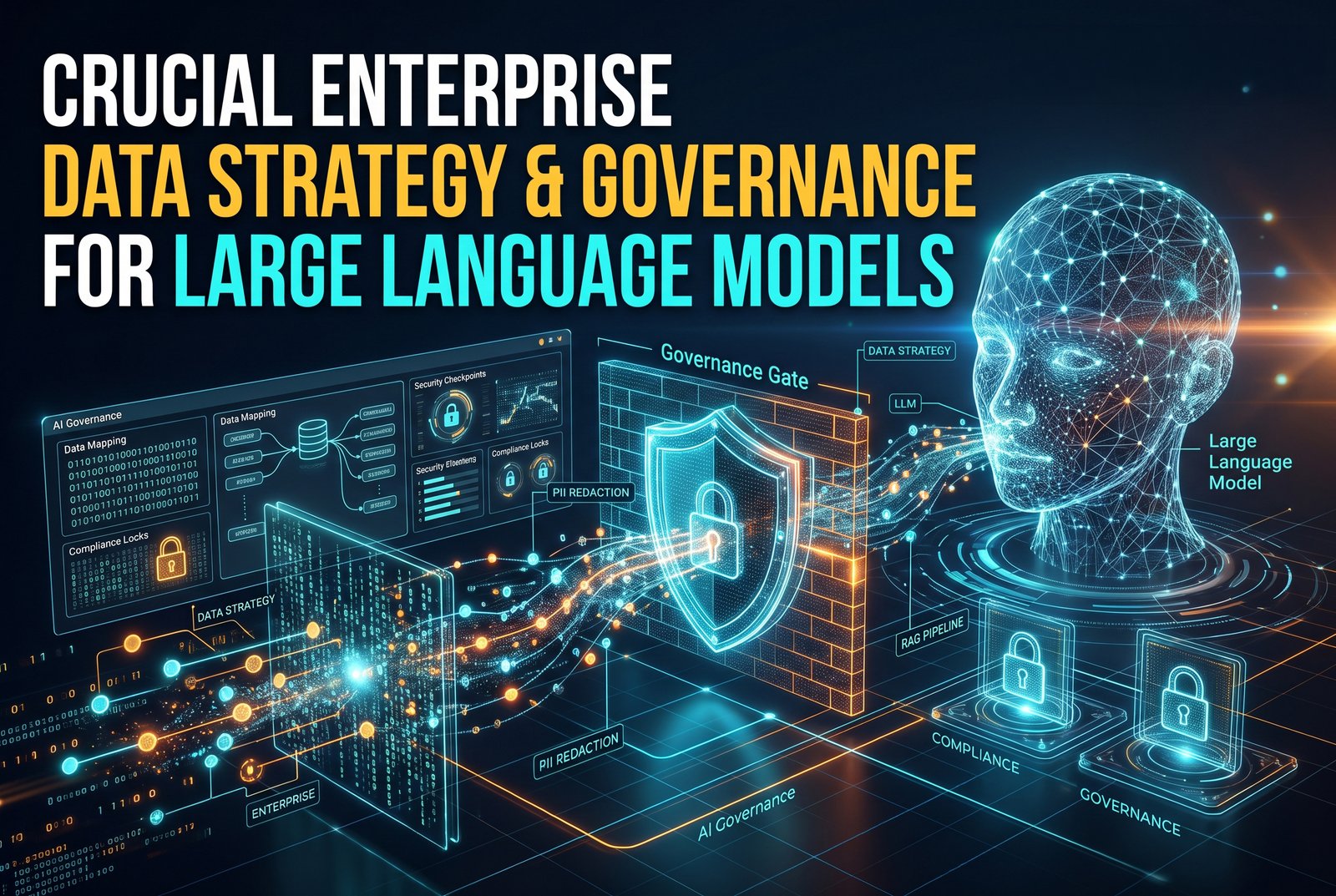
Crucial Enterprise Data Strategy & Governance for Large Language Models
The operationalization of AI at enterprise scale is no longer merely a model development challenge; it is a critical architectural and engineering mandate. For Directors, Enterprise Architects, and Technical Leaders, the inundation of marketing hype and theoretical frameworks offers zero operational value. The reality is that the intelligence bottleneck in modern enterprises is rarely the foundational model itself. Instead, the bottleneck is the underlying data architecture supporting it. Deploying generative AI and Large Language Models (LLMs) requires an uncompromising, battle-tested approach to Data Strategy and AI Governance. Without a rigorous, high-signal data foundation, even the most advanced models will hallucinate, expose sensitive information, or collapse under the weight of enterprise-scale query latency.
An effective enterprise data strategy for AI adoption fundamentally shifts how organizations ingest, process, secure, and serve information. It requires moving away from legacy batch-processing mentalities and embracing continuous, vector-ready, multi-modal data pipelines. This comprehensive blueprint dissects the architectural scalability, operational intelligence, and cost-efficiency required to build an uncompromising data infrastructure. We will explore the proven patterns for high-availability RAG deployments, the strict triage systems needed for data governance, and the telemetry required to mitigate deployment failures at a global scale.
Why AI Mandates a Fundamentally New Data Strategy
For the past two decades, enterprise data architectures were designed for human consumption and deterministic machine processing. Data warehouses and data lakes were optimized for Business Intelligence (BI) dashboards, structured SQL queries, and highly aggregated reporting. These legacy pipelines relied heavily on Extract, Transform, Load (ETL) paradigms that forced data into rigid schemas. However, the advent of LLMs and generative AI has completely inverted these requirements, demanding a fundamentally new Data Strategy that prioritizes unstructured data, semantic relationships, and real-time contextual retrieval.
Large Language Models do not query relational databases in the traditional sense; they process probabilistic linguistic patterns. Consequently, an enterprise data strategy for AI adoption must pivot from schema-on-write to embedding-on-read architectures. This transition introduces profound challenges in architectural scalability. When enterprise data is converted into high-dimensional vectors, the infrastructure must support massive parallel processing, specialized hardware (GPUs/TPUs) for embedding generation, and high-performance vector similarity search. The storage footprint expands exponentially, and the compute overhead required to keep these embeddings synchronized with the underlying source data can quickly derail cloud cost optimization efforts.
This foundational shift fundamentally relies on breaking data silos for AI. Fragmented data landscapes—where HR records live in isolated Workday instances while engineering documentation sits in disconnected Confluence servers—prevent the holistic context LLMs need to generate accurate, cross-functional insights. Transitioning toward a unified data strategy ensures that these previously walled-off information domains are standardized, indexed, and made accessible to the AI orchestration layer without compromising structural security.
Furthermore, AI mandates a shift from static data governance to dynamic operational intelligence. In a legacy BI system, a data quality error results in an inaccurate chart—a manageable internal issue. In an LLM-driven application (such as an automated customer support agent or a financial reasoning engine), a data anomaly can result in a highly convincing, catastrophic hallucination that is immediately exposed to clients or regulatory bodies. Therefore, technical leaders must implement automated incident response mechanisms and advanced telemetry directly into the data ingestion layer to filter out low-signal noise before it ever reaches the context window of a model.
To establish this new paradigm, enterprise architects must focus on three foundational pillars:
- Semantic Transformation: Moving beyond basic text extraction to implement layout-aware parsing, multimodal ingestion (text, image, audio), and context-preserving data transformation that retains the structural hierarchy of enterprise documents.
- High-Availability Infrastructure: Designing global caching layers and multi-tenant vector databases that can handle thousands of concurrent similarity searches without degrading latency or triggering infrastructure collapse.
- Strict Information Filtering: Utilizing a rigorous triage system to eliminate redundant, contradictory, or obsolete data, ensuring that the model is only grounded in the top 1% of high-signal, battle-tested intelligence.
Ultimately, a modernized data strategy is the primary defense against the soaring compute costs associated with prompt engineering and LLM inference. By pre-filtering and perfectly structuring the data that feeds the model, enterprises can utilize smaller, cheaper, and faster models while achieving superior reasoning capabilities.
Structuring Unstructured Data for RAG Architectures
Retrieval-Augmented Generation (RAG) has emerged as the definitive architectural pattern for injecting enterprise knowledge into LLMs without the prohibitive costs and operational risks of continuous model fine-tuning. However, RAG is only as effective as the unstructured data pipeline that feeds it. Structuring unstructured data—such as PDFs, intranet wikis, Slack conversations, and legacy codebases—requires a meticulous engineering approach to ensure high recall, low latency, and contextual accuracy.
The first critical challenge in a RAG architecture is document parsing and extraction. Enterprise data is inherently messy. A standard PDF contains headers, footers, tables, multi-column layouts, and embedded images. Naive text extraction strips away this spatial and hierarchical context, resulting in disjointed paragraphs that destroy the semantic meaning required for accurate embedding. Advanced data pipelines must utilize layout-aware parsers powered by computer vision models to accurately identify boundaries, preserve table structures as markdown or JSON, and maintain the lineage of the extracted text. This structural preservation is a non-negotiable architectural advantage.
Once the data is extracted, it must be divided into processable segments through a process known as chunking. The chunking strategy directly dictates the success or failure of the RAG deployment:
- Fixed-Size Chunking: While computationally inexpensive and easy to implement, strictly cutting text every 500 tokens frequently severs critical semantic concepts in half. This leads to retrieval failures where the vector database returns incomplete thoughts, forcing the LLM to hallucinate the missing context.
- Recursive Character Text Splitting: A more robust approach that attempts to split text at natural boundaries (paragraphs, sentences, and words) based on a prioritized list of separators. This ensures that the structural integrity of the prose remains largely intact.
- Semantic Chunking: The most advanced and highly recommended approach for enterprise scale. Semantic chunking utilizes smaller, faster embedding models to calculate the cosine similarity between sequential sentences. A chunk boundary is only created when the similarity score drops below a specific threshold, indicating a shift in topic. This guarantees that each retrieved chunk represents a complete, self-contained concept.
Following chunking, the text must be embedded and indexed in a vector database. To achieve architectural scalability, technical leaders must select vector stores capable of handling multi-tenancy and global distribution. The deployment must support Hierarchical Navigable Small World (HNSW) algorithms or Inverted File Index (IVF) structures to ensure sub-millisecond retrieval times across billions of vectors. Furthermore, metadata tagging is an absolute necessity. Storing the raw embedding is insufficient; each vector must be enriched with robust metadata, including document creation dates, author credentials, access control lists (ACLs), and source system IDs.
Choosing the right architecture for enterprise AI data storage is paramount in this phase. Traditional relational databases cannot scale to meet the high-dimensional mathematical calculations required by embeddings. Consequently, evaluating and deploying purpose-built vector databases enterprise teams can rely on—such as Milvus, Pinecone, or highly tuned pgvector implementations—becomes a core competency for modern infrastructure squads, ensuring persistent performance under extreme query loads.
This metadata enables hybrid search capabilities—combining dense vector similarity search with sparse keyword search (like BM25) and strict metadata filtering. Hybrid search drastically reduces the search space, optimizing cloud-native deployments by lowering compute overhead and significantly improving the precision of the context injected into the LLM. When an enterprise user asks a question about “Q3 financial results for the EMEA region,” the system can instantly filter the vector database by `region: EMEA` and `document_type: financial_report` before executing the semantic search, eliminating noise and ensuring measurable ROI.
Establishing AI Data Governance and Access Frameworks
Deploying AI at scale introduces unprecedented vulnerabilities in information security and access control. In a traditional software ecosystem, a user navigating a dashboard is strictly limited by hardcoded application logic and database-level Row-Level Security (RLS). In an LLM-driven interface, the user is interacting with a highly permissive, natural language engine that can creatively bypass traditional guardrails to access underlying information. Therefore, establishing a rigorous data governance framework for LLMs is a critical engineering mandate, not merely a compliance checkbox.
Before a single vector is indexed, organizations must establish a comprehensive AI data policy. This overarching documentation serves as the legal and operational bedrock, defining exactly what internal datasets are permissible for model consumption. Furthermore, defining strict parameters around enterprise AI acceptable use ensures that employees understand the boundaries of generative AI interaction, preventing inadvertent intellectual property leakage at the human layer before system guardrails even need to trigger.
Effective AI Governance begins at the data ingestion layer and extends through the vector database and into the runtime prompt construction. The most critical component of this framework is the implementation of granular Role-Based Access Control (RBAC) and Attribute-Based Access Control (ABAC) at the vector level. When a document is ingested, chunked, and embedded, the resulting vectors must inherit the exact security permissions of the source system. If a document in SharePoint is restricted to the “C-Suite” Active Directory group, every corresponding vector chunk in the database must be tagged with that specific permission attribute.
At inference time, the RAG architecture must execute a secure retrieval protocol. When a user submits a prompt, the system must first authenticate the user, retrieve their associated authorization tokens and group memberships, and append these attributes as hard filters to the vector database query. The vector store must only return chunks that the user is explicitly authorized to view. This pre-retrieval filtering guarantees that the LLM is never exposed to sensitive data that the user does not possess the rights to access, fundamentally preventing unauthorized data leakage through the conversational interface.
Beyond access control, a robust data governance framework for LLMs requires strict data lineage, provenance, and auditability. Enterprise architects must deploy advanced telemetry to track the lifecycle of every data point. This includes:
- Source-to-Context Lineage: The ability to trace every sentence generated by the LLM back to the specific chunk, embedding, and original source document. This is critical for debugging hallucinations and defending the AI’s outputs during regulatory audits.
- Data Poisoning Prevention: Automated pipelines that monitor source repositories for malicious prompt injections or intentionally manipulated data designed to compromise the LLM’s behavior. This requires continuous hashing and cryptographic verification of source documents.
- Version Control and Rollbacks: The infrastructure must support vector database snapshots and automated incident response protocols to instantly roll back the knowledge base if corrupted or unauthorized data is accidentally ingested into the production environment.
Finally, true governance requires proactive mitigation of systemic skew. Performing a rigorous AI data bias audit on source material prevents historical prejudices in corporate data from being amplified by the LLM. By systematically identifying and neutralizing skewed datasets prior to embedding, architects are actively ensuring fair enterprise AI deployments that protect brand reputation and maintain equitable, objective outputs across all use cases.
By enforcing these strict governance frameworks, organizations mitigate the risk of deployment failures and prevent infrastructure collapse caused by catastrophic security breaches. An autonomous enterprise relies on trust; building that trust requires an uncompromising approach to securing the data that feeds the intelligence engine.
Navigating Privacy and Compliance in AI Models
The intersection of Large Language Models and global data privacy regulations (such as GDPR, CCPA, and HIPAA) creates one of the most complex architectural challenges in modern enterprise IT. Traditional models of data compliance were built around relational databases where deleting a user’s record was as simple as executing a SQL `DELETE` statement. In the era of AI, data is transformed into abstract mathematical representations (embeddings) or baked directly into the parametric memory of fine-tuned models, making compliance a formidable engineering hurdle.
To navigate privacy and compliance safely, technical leaders must architect robust Data Loss Prevention (DLP) and Personally Identifiable Information (PII) redaction pipelines that operate *before* the embedding process. Once a piece of sensitive data—such as a Social Security Number, credit card detail, or private medical record—is converted into a vector and stored, identifying and removing it becomes exponentially more difficult. High-signal architectures utilize specialized, lightweight NLP models (such as Microsoft Presidio or custom Named Entity Recognition pipelines) at the ingestion gateway.
The technical procedures involved in sanitizing data for LLMs require automated, deterministic scrubbing prior to the data ever reaching the embedding model. This irreversible sanitization is the only mathematically proven method to guarantee secure AI training data, ensuring that even if a vector database is compromised, threat actors cannot reverse-engineer the embeddings back into raw, sensitive corporate or customer profiles.
These pipelines must enforce a rigorous triage system: incoming unstructured data is scanned, PII is identified with high confidence, and the sensitive information is either completely redacted, irreversibly hashed, or replaced with synthetic surrogate values (e.g., replacing “John Doe” with “[PERSON_1]”). Only the sanitized text is allowed to proceed to the embedding model. This strategy drastically reduces enterprise risk and ensures that the downstream vector database remains completely unpolluted by regulated data.
Furthermore, enterprises must engineer solutions for the “Right to Be Forgotten,” a core tenet of GDPR. If an organization relies on continuous model fine-tuning (which Autonomous Enterprise generally advises against for rapidly changing knowledge due to high cost and low flexibility), removing a specific user’s data from the model’s neural network requires “machine unlearning”—a computationally expensive and mathematically unproven science. This is another reason why RAG architectures provide a clear strategic shift and architectural advantage.
In a properly governed RAG deployment, achieving compliance is a matter of vector lifecycle management. If a data deletion request is received, the enterprise data pipeline can identify the source document via metadata lineage, locate the corresponding vector IDs in the database, and physically delete the vectors. The knowledge is instantly removed from the LLM’s available context without requiring a multi-million-dollar model retraining cycle.
Finally, for highly regulated industries (defense, finance, healthcare), public cloud APIs for embedding and inference are often non-starters due to data sovereignty requirements. Navigating this requires deploying air-gapped infrastructure. Enterprise architects must leverage localized, open-weights models (such as Llama 3 or Mistral) and host them on sovereign cloud partitions or on-premises GPU clusters. This ensures that sensitive enterprise data never traverses the public internet, satisfying the most uncompromising regulatory mandates while maintaining operational intelligence and high availability.
Building the Continuous Data-to-AI Pipeline
The final mandate for operationalizing AI at enterprise scale is the transition from static data integration to a Continuous Data-to-AI Pipeline. The value of an LLM degrades rapidly if its underlying knowledge base is stale. If a company updates its API documentation, changes its pricing structures, or releases new compliance guidelines, the AI must reflect these changes instantly. Achieving this requires the fusion of DataOps and MLOps into a unified, automated, and highly resilient architecture designed to prevent infrastructure collapse under continuous load.
A Continuous Data-to-AI Pipeline is an event-driven architecture. Rather than relying on nightly batch processing—which introduces unacceptable latency in AI responses—the infrastructure must monitor source systems (CRMs, ERPs, Document Management Systems) for real-time change data capture (CDC). When a document is created, updated, or deleted, a webhook or event stream (such as Apache Kafka) triggers an isolated serverless function or containerized worker.
This worker executes the strict pipeline discussed previously:
- Extraction & Parsing: Pulling the new content and preserving layout structures.
- Sanitization & PII Redaction: Passing the text through the compliance gateway.
- Semantic Chunking: Intelligently dividing the text based on meaning.
- Embedding Generation: Calling the embedding model to generate high-dimensional vectors.
- Vector Upsertion: Atomically updating the vector database, overwriting old chunks and inserting new ones, complete with updated metadata.
To maintain cost and risk efficiency, this pipeline must be heavily optimized. Embedding models charge per token, and vector databases charge per gigabyte of memory and per query compute. A naive pipeline that re-embeds an entire 500-page document because a single typo was fixed in the first paragraph will result in massive, unnecessary cloud compute overhead. Enterprise architectures must utilize robust caching mechanisms, hashing algorithms (like Merkle trees), and delta-processing to ensure that only the specific paragraphs or chunks that were fundamentally altered are re-embedded and synchronized.
Equally critical is the implementation of advanced telemetry and drift monitoring. Technical leaders cannot operate these pipelines blindly. The system must continuously monitor the “embedding drift” of incoming data. If the vector distribution of new documents suddenly shifts significantly from the historical baseline, it could indicate a data formatting error, a pipeline failure, or a malicious data injection attempt. Automated incident response protocols must instantly halt the pipeline, quarantine the anomalous data, and alert the MLOps engineering team before the corrupted vectors corrupt the AI’s responses.
Furthermore, the pipeline must monitor retrieval metrics. By logging every user query, the corresponding retrieved chunks, and the implicit/explicit user feedback (e.g., thumbs up/down, or follow-up corrections), enterprises can identify knowledge gaps. If users frequently ask about a specific topic but the vector database returns low-similarity scores, the automated telemetry flags this as a missing data domain, allowing data stewards to strategically acquire and ingest the required documentation.
Ultimately, the future of enterprise AI belongs to those with the most robust infrastructure. The organizations that will dominate the next decade are not those building the largest proprietary foundational models, but those engineering the most sophisticated, compliant, and continuously synchronized Data-to-AI pipelines. By strictly filtering noise, enforcing rigorous governance, and designing for architectural scalability, technical leaders provide the exact blueprint required to operationalize intelligence at a global scale.



Leave a Reply